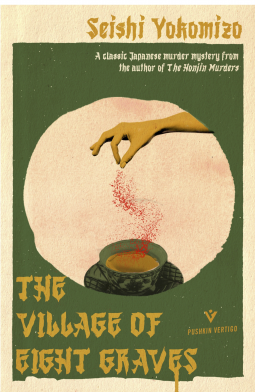
The Village of Eight Graves by Seishi Yokomizo – trans. Bryan Karetnyk

Over the last few years I have discovered several Japanese crime authors – including Soji Shimada and Yukito Ayatsuji – thanks to Pushkin Press making them available in English translations, but the one who has impressed me the most is Seishi Yokomizo. I really enjoyed The Honjin Murders, one of his many books to feature the detective Kosuke Kindaichi; I didn’t like The Village of Eight Graves, another from the same series, quite as much, but it’s still an entertaining read.

First published in 1950, the novel is set in the small Japanese village of Eight Graves where, centuries earlier, eight samurai were brutally murdered, bringing down a curse upon the village and giving it its sinister-sounding name. In the 1920s the curse struck again when a village leader went on a violent killing spree. Now, twenty-five years later, our narrator Tatsuya Terada, a young man who has been raised in Kobe by his mother and stepfather, is informed by a lawyer that his real father was the man responsible for those terrible murders. It seems that Tatsuya is now the heir to the family estate and must return to Eight Graves to claim his inheritance – but before he has even left Kobe he receives an anonymous letter warning him to stay away.

On his arrival in Eight Graves, Tatsuya finds that most of the other villagers are hostile and unwelcoming, believing that his presence will bring bad luck and tragedy to the village yet again. And so, when more murders begin to take place, suspicion immediately falls on Tatsuya – but as he is our narrator, we know that he is innocent. Or is he? Kosuke Kindaichi is called in to investigate, but at the same time Tatsuya is carrying out investigations of his own to find the real culprit and clear his own name.

Unlike in The Honjin Murders, where the untidy and unassuming Kindaichi plays a big role in the story, in this book we hardly see him at all. Almost as soon as he arrives in Eight Graves he disappears into the background again. We know that he is working on solving the mystery, but we don’t actually watch him doing it because we stick exclusively with Tatsuya’s narration and he and Kindaichi have very little interaction until nearer the end of the book. This makes this one less of a detective novel and more of a thriller or adventure novel, as Tatsuya explores the village alone looking for clues and stumbling into danger.

Yokomizo creates a wonderful atmosphere in this book with Tatsuya’s investigations leading him into networks of tunnels, caves with stalactites, and underground lakes and caverns. The legend of the eight murdered samurai is also incorporated into the story, along with a search for hidden treasure said to be buried somewhere within the village and a rivalry between two branches of Tatsuya’s family: the ‘House of the East’ and the ‘House of the West’. It’s an entertaining novel and there’s always something happening – but I did think the parts where Tatsuya is wandering around in the caves and tunnels became a little bit tedious. The absence of Kosuke Kindaichi for most of the book was also disappointing and I think I would have preferred a more conventional detective novel with the focus on solving the mystery rather than on treasure hunting.

Still, this book was fun to read and I loved the setting. Now I need to read the other Yokomizo novel currently available in English: The Inugami Curse.

Thanks to Pushkin Vertigo for providing a copy of this book for review via NetGalley.

They Do It with Mirrors by Agatha Christie

This month’s theme for the Read Christie 2021 challenge is ‘a story set after WWII’. There were plenty of options for this one – any book published after 1945 would count – and I eventually decided on They Do It with Mirrors, a 1952 Miss Marple novel.

The story begins with Miss Marple meeting an old friend, Ruth, who tells her that she’s worried about her sister, Carrie Louise, although she doesn’t give any specific reasons for her concern. Carrie Louise, like Ruth, has had several husbands and her latest, Lewis Serrocold, has established a rehabilitation centre for juvenile criminals at their home, Stonygates. Miss Marple agrees to go and visit Stonygates to see if she can find out what’s going on and, on her arrival, she finds a large number of people assembled at the house, including Carrie Louise’s daughter, granddaughter and stepson, as well as several other family members and servants.

As Miss Marple gets to know the various members of the household, she also begins to feel that something is not quite right – and she is proved to be correct when Christian Gulbrandsen, the son of Carrie Louise’s first husband, is found shot dead in his room. At the same time, Lewis Serrocold is shot at in his study by one of the ‘juvenile delinquents’, a young man who claims to be Winston Churchill’s son. Lewis is unharmed, but as one of the other characters remarks, “you don’t expect murder and attempted murder in the same house on the same night!” The police, led by Inspector Curry, soon arrive on the scene and begin their investigations, but it’s Miss Marple, of course, who eventually solves the mystery.

I don’t think this is one of Christie’s best, but I did still enjoy it – and unlike my last Christie novel, Death on the Nile, where I guessed the solution almost immediately, I didn’t manage to solve this one before the culprit was revealed. The title of the book refers to the fact that things and people are not always what they seem and sometimes, like a magician, ‘they do it with mirrors’ to cause confusion and misdirection. Well, I certainly allowed myself to be misdirected, but I do think it would have been possible to work it out if I’d been paying more attention.

This book has an interesting setting which gives Christie a chance to explore Lewis Serrocold’s work with the young offenders and the way in which these young men were viewed by 1950s society. This doesn’t really play a big part in the story and it could have worked just as well as a conventional country house mystery without this element, but it does provide some extra interest.

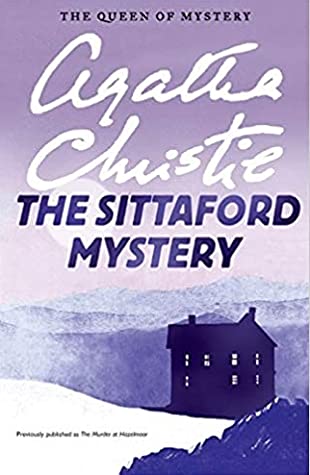
December’s theme for Read Christie 2021 is ‘a story set during bad weather’. The suggested title is The Sittaford Mystery, which is one I haven’t read yet.

Death on the Nile by Agatha Christie

This month’s theme for Read Christie 2021 is ‘a story set on a mode of transport’. There are plenty of those to choose from and I’ve already read a few of them – Murder on the Orient Express, Death in the Clouds and The Mystery of the Blue Train – but I decided to read a book I’ve never read before, one of Christie’s most famous novels, the 1937 Poirot mystery Death on the Nile.

When Linnet Ridgeway, a beautiful heiress, is found shot dead in her cabin during a cruise along the Nile, there are two suspects with obvious motives. One is her husband, Simon Doyle, who will inherit her money on her death; the other is Simon’s former fiancée Jacqueline de Bellefort, who was left heartbroken by Simon and Linnet’s marriage and has followed them on to the steamer Karnak, threatening revenge. However, both Simon and Jacqueline have alibis, so Hercule Poirot, also touring the Nile on the same cruise, is forced to turn his attention to the other passengers – many of whom, it seems, are hiding secrets of their own and could also have reasons to want Linnet dead.

As it happens, another of Christie’s detectives, Colonel Race (whom I recently met in Sparkling Cyanide), soon arrives onboard the Karnak, on the trail of a man suspected of terrorism. Although it seems unlikely that this will be the same person who killed Linnet, Race joins Poirot in the search for the murderer. It was interesting to see them working together – this is Poirot’s book, of course, and he is the one who solves the mystery, but Race makes some useful contributions and his presence in the story means that Poirot can share some of his theories and thought processes with him (and therefore with the reader).

Knowing that this is one of Christie’s most popular books, I expected to love it but, although I did enjoy it, I don’t think it’s a favourite. That’s partly because I thought the characters, with only one or two exceptions, were a particularly unpleasant, privileged and entitled group, so I didn’t have much sympathy for either the victim or any of the people who found themselves under suspicion! Also, I guessed who had committed the crime almost immediately – before it happened, in fact – which took away some of the fun. I don’t think it was necessarily a particularly easy mystery to solve; I feel as though I’ve read another book recently (maybe not a Christie one) based on a similar idea and once I had that idea in my head, it seemed quite obvious who had done it. What I couldn’t work out was exactly how it was done, so I was still kept in suspense waiting for Poirot to explain it.

Next month’s Read Christie theme is ‘a story set after WWII’. This will mean any Christie novel published after 1945; I’ve already read a lot of them, but any suggestions are welcome!

Book 8 for R.I.P. XVI

Death of a Tin God by George Bellairs

This is the fourth book I’ve read from George Bellairs’ Inspector Littlejohn series and although I haven’t been reading them in order, it doesn’t seem to matter at all. Each novel works as a standalone mystery and there’s very little focus on Littlejohn’s personal life so you can easily jump around from an early book to a later one and back again without feeling that you’ve missed anything important.

Death of a Tin God was first published in 1961 and begins with Thomas Littlejohn (now a Superintendent rather than an Inspector) flying from Dublin to the Isle of Man to visit his friend, Caesar Kinrade, the Archdeacon of Man. Littlejohn is looking forward to a quiet break, but his arrival coincides with the death of Hal Vale, a Hollywood star who has been filming on the island. Hal is found electrocuted in the bath in his hotel room and the circumstances suggest that it was not an accident. Littlejohn finds himself assisting the local police with their investigations and as the mystery deepens, he travels to the South of France to look for the answers.

I enjoyed this book but found the solution a bit predictable as the murderer turned out to be the person I had suspected from the beginning. There were some clever twists and red herrings along the way that did put some doubt into my mind, but I still wasn’t at all surprised when the truth was revealed. However, I very rarely manage to solve a mystery before the detective does, so I don’t mind too much when it occasionally happens! And I do like spending time with Littlejohn and watching him carry out his investigations; he’s not the most memorable of fictional detectives, but that means the focus stays firmly on the plot without his own personality getting in the way. His usual sidekick Sergeant Cromwell is absent for most of the book, but instead he teams up with Inspector Knell of the Manx police and Inspector Dorange in Nice who I believe are also recurring characters in the series and have good working relationships with Littlejohn.

One of the things I’ve loved about the other Bellairs novels I’ve read is the way he creates such a strong cast of supporting characters and suspects. In Dead March for Penelope Blow and A Knife for Harry Dodd in particular, there are some very colourful, larger than life characters who could almost have jumped straight out of the pages of a Dickens novel. In this book, I found the characterisation more bland and less interesting, but maybe that was a reflection of the shallow, vapid celebrity world Bellairs has chosen as the setting for this particular novel. Littlejohn is described several times as feeling slightly out of his depth amongst this assortment of glamorous film stars, ruthless publicity agents and millionaire bankers with yachts, so perhaps the reader is intended to feel the same.

I liked the idea of the book being set on the Isle of Man, as it’s not a common setting for mystery novels (or fiction in general), but it turned out that half of the story actually took place in Aix-en-Provence in France – and neither setting was described as vividly as I would have liked. I know Bellairs set some of the other Littlejohn books on the Isle of Man too, so maybe some of those have more local colour than this one. Although this is not one of my favourite books in the series so far, I’m still looking forward to reading more of them.

Thanks to Agora Books for providing a copy of this book for review via NetGalley.

Book 5 for R.I.P. XVI

Crooked House by Agatha Christie

September’s topic for the Read Christie 2021 challenge is ‘a story featuring a school’. I’ve already read the obvious choice, Cat Among the Pigeons, so I was grateful to the challenge hosts for providing a list of alternative suggestions. Crooked House doesn’t involve an actual school, but it does fit the general theme as it features two children who are being home-schooled.

First published in 1949, this was apparently one of Christie’s own favourites; in the foreword, she says that ‘practically everybody has liked Crooked House, so I am justified in my own belief that it is one of my best’. Now that I’ve read it, I can say that although it’s not one of my absolute favourites, it would definitely be in my top ten so far. It’s one of her standalones – with no Poirot, Marple or other famous detective – and, like several of her other novels, has a title inspired by a children’s nursery rhyme:

There was a crooked man, and he went a crooked mile,
He found a crooked sixpence against a crooked stile;
He bought a crooked cat, which caught a crooked mouse,
And they all lived together in a little crooked house.

The ‘crooked house’ of the title is a mansion in the quiet London suburb of Swinley Dean and the people who ‘all live together’ there are ten members of the Leonides family. When the family patriarch, old Aristide Leonides, a Greek businessman, is found poisoned by his own eye medicine, suspicion immediately falls on his second wife, the much younger Brenda. It would certainly be more convenient for the rest of the family if Brenda could be proved to be the murderer – none of them like her and believe her to have married Aristide for his money – but so far there is no real evidence against her. Aristide’s eldest granddaughter, Sophia, is desperate to know the truth as she feels it won’t be fair to marry her fiancé, Charles Hayward, while a scandal is hanging over her family. As it happens, Charles is the son of the Assistant Commissioner of Scotland Yard so, joining forces with Chief Inspector Taverner, the detective assigned to the crime, he sets out to solve the mystery so that he and Sophia will be free to marry.

One of the things I loved about this book was that the murderer really could have been anybody. Brenda is initially the main suspect as there are hints that she has been having an affair with Laurence Brown, tutor to Sophia’s younger siblings Eustace and Josephine, and would therefore need Aristide out of the way. However, Aristide’s eldest son Roger also appears to have a clear motive involving money and the company business, while his younger son Philip could have committed the murder out of jealousy. Then there are the brothers’ two wives, Clemency and Magda, and a spinster aunt, Edith de Haviland. Any of these people could have had reasons for wanting the old man dead, as well as the knowledge and opportunity to carry out the crime. At no point does Christie become too concerned with the technical details of the murder or get bogged down with discussions of alibis and timings, concentrating instead on motives, personalities and relationships – my favourite kind of mystery novel!

I didn’t guess who did it, of course. The correct solution did cross my mind once or twice, but I dismissed it as unlikely because I was so convinced that it was somebody else. I’m annoyed with myself for not working it out as I can see now that the clues were all there in plain sight!

Next month’s Read Christie theme, if anyone wants to join in, is ‘a story set on a mode of transport’. I’m probably going to read Death on the Nile, but there are plenty of others you could choose, including Murder on the Orient Express, Death in the Clouds or The Mystery of the Blue Train.

Book 3 read for R.I.P. XVI

The Mummy Case by Elizabeth Peters

It’s been years since I last read an Amelia Peabody mystery and when I picked up The Mummy Case, the third in the series, I was concerned that I had left too big a gap between books. Luckily, this seems to be a series you can easily return to after a long absence as each book, at least so far, has worked as a standalone mystery.

The Mummy Case is set in 1894 and opens with married Egyptologists Amelia Peabody and Radcliffe Emerson at home in England planning their next trip to Egypt. Amelia dreams of exploring the pyramids of Dahshoor on this visit, but her hopes are shattered with the discovery that her husband has left it too late to submit their application and permission has already been granted to another archaeologist. Amelia and Emerson are offered Mazghunah instead – a barren and uninspiring site believed to be of little historical significance – and they reluctantly accept.

Despite their lack of enthusiasm, the expedition proves to be much more exciting than either of them had expected. Before they even reach their destination, they become caught up in the murder of an antiquities dealer in Cairo who is found dead in his own shop – and when they eventually arrive at Mazghunah, Amelia becomes convinced that somebody connected with the murder has followed them there. When a scrap of papyrus is stolen from their camp and an entire mummy case belonging to a visiting tourist also disappears, even Emerson has to agree that they have stumbled onto the trail of a clever and ruthless Master Criminal!

Unlike their first two mysteries (described in Crocodile on the Sandbank and The Curse of the Pharaohs), Amelia and Emerson have help in solving this one. For the first time, their young son Ramses has accompanied them on a dig and while he often proves to be more of a hindrance, getting into trouble at every opportunity, he also manages to appear at several crucial moments to save the day. Described as ‘catastrophically precocious’ by Amelia, he sounds more like a seventy-year-old professor with a speech impediment than a seven-year-old child and although I’ve been told that he improves as a character later in the series, in this book I found him extremely irritating. However, he’s clearly not meant to be taken too seriously – and to be fair, Amelia finds him irritating too:

The old woman’s cacodemonic laughter broke out again…”The wisdom of the Prophet is yours, great lady. Accept an old woman’s blessing. May you have many sons – many, many sons…”

The idea was so appalling I think I turned pale.

I enjoyed this book, despite Ramses, but I don’t think it was as strong as the previous two in the series. The plot seemed to meander all over the place and it was easy to lose sight of what the central mystery was that the characters were trying to solve. I do still love Amelia and Emerson, though – their good-natured bickering is always entertaining! It was also interesting to learn a little bit about Mazghunah and its disappointingly incomplete ‘pyramids’ and to meet the real-life archaeologist Jacques de Morgan – although seeing him only through Amelia’s eyes gives us a slightly biased impression as he is their rival and the man who is excavating the much more attractive site of Dahshoor!

I am looking forward to continuing with the fourth book in the series, Lion in the Valley.

Book 43/50 read for the 2021 Historical Fiction Reading Challenge.

Book 2 read for R.I.P. XVI

Evil Under the Sun by Agatha Christie

August’s theme for the Read Christie 2021 challenge is ‘a story set by the seaside’, which seemed the perfect opportunity to pick up an unread Poirot novel, Evil Under the Sun. It’s set on an island off the coast of Devon, where Hercule Poirot is on holiday at the exclusive Jolly Roger Hotel.

Christie begins by introducing us to all of the people staying at the hotel, including Arlena Stuart, a beautiful former actress. Arlena is described by one of the other characters as ‘the personification of evil’ – and she certainly seems to be causing plenty of trouble. Fellow guest Patrick Redfern can’t take his eyes off her and Arlena appears to be encouraging his attentions, regardless of how hurtful this is to Patrick’s young wife, Christine. Arlena’s own husband, Captain Marshall, claims he hasn’t noticed her behaviour, but is he telling the truth? Meanwhile, Marshall’s teenage daughter from a previous marriage hates her stepmother and resents the way she has come into the family home, bringing scandal and unhappiness with her.

When Arlena’s dead body is found at Pixy Cove, a secluded part of the island, almost everyone becomes a suspect. It’s fortunate that Poirot is already on the scene and can begin investigating immediately! In fact, as he later tells his friend, Captain Hastings, he had begun even before the murder took place…

Hastings said, staring: “But the murder hadn’t happened, then.”

Hercule Poirot sighed. He said: “But already, mon cher, it was very clearly indicated.”

“Then why didn’t you stop it?”

And Hercule Poirot, with a sigh, said as he had said once before in Egypt, that if a person is determined to commit murder it is not easy to prevent them. He does not blame himself for what happened. It was, according to him, inevitable.

Having just read three Miss Marple novels in a row for Read Christie, it made a nice change to get back to Poirot for this month’s read. I usually prefer the Poirots to the Marples and Evil Under the Sun – first published in 1941 – is another good one. Setting the story on a private island, for the use of the hotel guests only, is not just an atmospheric setting but also a clever one as it immediately limits the suspects to those already on the island at the beginning of the book. With his understanding of the kind of person Arlena was, Poirot is quickly able to pick out one suspect as the most likely culprit, but due to timings and alibis it seems impossible that this person could have committed the crime. As the novel progresses, more clues emerge, along with the usual red herrings and misdirections Christie likes to throw in our way!

I didn’t manage to solve the mystery, but once the solution was revealed I could see how perfectly all of the clues fitted together – like a jigsaw puzzle, as Poirot describes it. It did seem that the way in which the crime was carried out depended on a lot of good luck and on people behaving in a certain manner, but I still think Christie was fair with the reader and I have no complaints. I’m now looking forward to September’s book, which will be Crooked House.