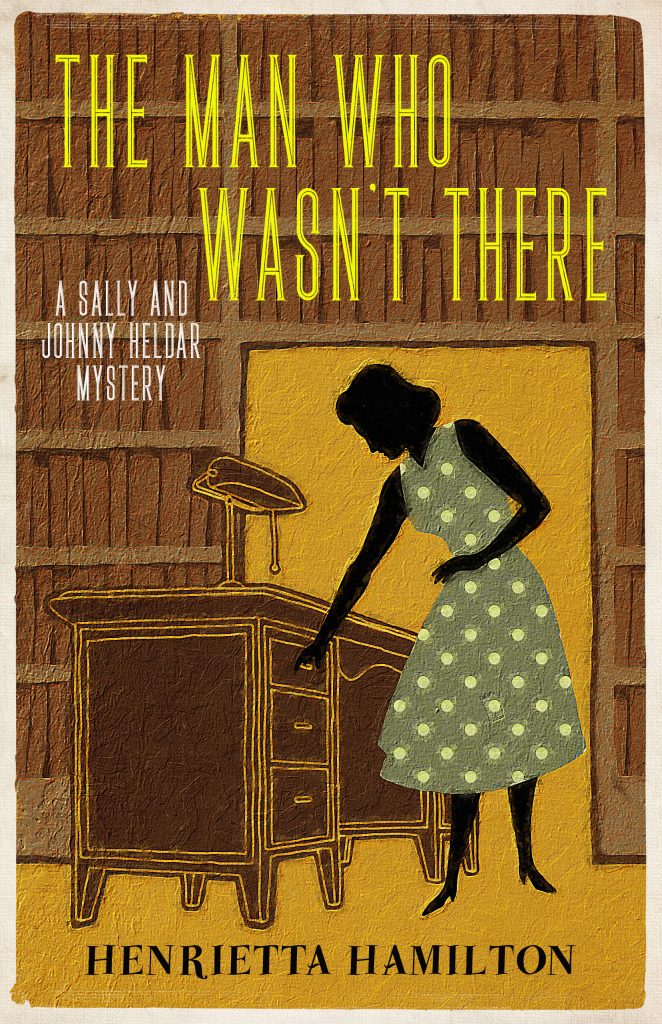
The Man Who Wasn’t There by Henrietta Hamilton

Henrietta Hamilton is an author I discovered recently through Agora Books’ Uncrowned Queens of Crime series. Hamilton (a pseudonym of Hester Denne Shepherd) had four novels published between 1956 and 1959, all featuring the crime-solving husband and wife team of Johnny and Sally Heldar. I have read two of them – Answer in the Negative, which I didn’t particularly enjoy, and The Two Hundred Ghost, which I did. When I was given the opportunity to read The Man Who Wasn’t There, I assumed it was another of the four books, but I quickly discovered that the circumstances behind the publication of this novel are more intriguing.

After Hamilton’s death in 1995, her nephews found some typed manuscripts of thirteen books that had never been published in her lifetime – including several more Sally and Johnny mysteries. This is one of them, made available at last by Agora Books. As one of the author’s nephews suggests in the introduction, it may have been changing tastes in literature that led to his aunt’s books no longer being published; by the late 1950s the Golden Age of detective fiction was largely over and The Man Who Wasn’t There does feel like a book written a decade or two earlier.

Johnny and Sally Heldar are a young married couple who run an antiquarian bookshop and are gaining a reputation for themselves as amateur detectives. Therefore, when Johnny’s cousin Tim discovers that his fiancée, Prue, is involved in a murder case, he turns to Johnny and Sally for help. Prue had been working as secretary to the murdered man, Mr Frodsham, who has been found shot dead in his study and Prue herself has become one of the suspects. Tim is hoping the Heldars can prove her innocent – and it certainly seems that there are plenty of other people with motives, including Frodsham’s mistress and her husband, another woman he was blackmailing, and some old enemies from his days in the French Resistance.

I like Sally and Johnny and it was nice to spend some more time in their company (although I do wish Johnny would let his wife take a more active part in the investigations), but I found the plot of this particular novel a bit too complicated and detailed for such a short book. I struggled to keep track of all the characters, what time they arrived at or left the victim’s house, what they were all doing during the war, even the number of different guns involved. Most of this information is delivered in the form of long conversations as Johnny and Sally ‘think out loud’ to each other or interview suspects, so you also need to remember who said what and to whom. Still, I think Hamilton was fair to the reader and gave us all the clues we needed to be able to solve the mystery.

I probably won’t read any more books in this series as I’ve tried three now and only really enjoyed one of them, but I can see from looking at other reviews that lots of people love her books so I hope the rest of the unpublished manuscripts find their way into print very soon.

Thanks to Agora Books for providing a copy of this book for review via NetGalley.

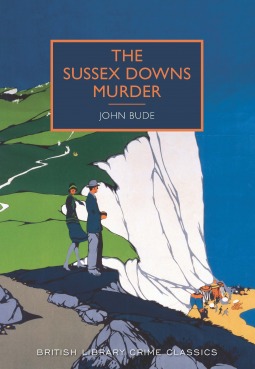
The Sussex Downs Murder by John Bude

I am now halfway through my 20 Books of Summer list and obviously not going to finish all of the remaining books by the end of the month, but I’m pleased that I’ve managed to read this one, The Sussex Downs Murder, as I’ve had it on my shelf for a few years now and could never seem to find the right time to read it. It turns out that summer was the perfect time, as the story takes place in July…

The novel opens on a Saturday evening with John Rother saying goodbye to his brother and sister-in-law and leaving their Sussex farm, Chalklands, to drive to Harlech in Wales for a holiday. He doesn’t get very far, however, and his car is found abandoned the next morning just a few miles away from the farm. John has disappeared, but there are bloodstains inside the car and signs of a violent struggle. Has he been killed? Kidnapped? Superintendent William Meredith is called in and when human bones are found in a delivery of lime from the Chalklands lime-kilns a few days later, it seems that he is dealing with a murder case.

In his careful, methodical way Meredith begins to investigate, examining every clue and interviewing every possible witness. He forms a theory almost immediately, but when a second crime occurs and proves him wrong, he is forced to think again, and slowly – too slowly for his Chief Constable who threatens to bring in Scotland Yard – starts to piece together what has happened.

John Bude, whose real name was Ernest Elmore, is a popular author within the British Library Crime Classics series, but this is the first of his books that I’ve read. Originally published in 1936, it’s the second Superintendent Meredith novel and I enjoyed it enough to want to read more of them. I liked Meredith, although we don’t get to know very much about his background or personal life – apart from some great scenes with his son, Tony – and I appreciated the way his thoughts are shared with the reader, so that we can follow each step of his investigations and see in which direction the clues are leading him. I also liked the Sussex setting; it’s not an area that I know, but there’s a map at the beginning and all of the towns and villages, chalk hills and rings of trees – are real places and geographical features.

My only problem with this book was that the solution to the mystery was far too easy to guess; I had my suspicions from very early in the story and was proved right. I don’t usually manage to solve the crime before the detective does, so I wonder if other readers found this one particularly obvious too.

This is book 10/20 of my 20 Books of Summer 2021

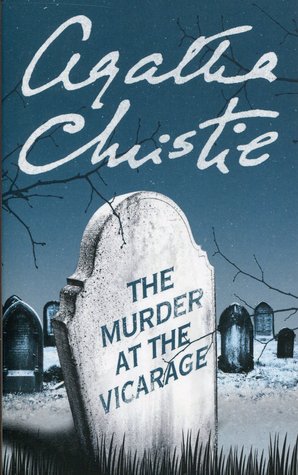
The Murder at the Vicarage by Agatha Christie

This month’s theme for Read Christie 2021 is ‘a story starring a vicar’ and the chosen title is an obvious one – The Murder at the Vicarage, which was first published in 1930 and is the first book in the Miss Marple series. I have read most of the later Marple novels, but never this one and I thought it would be interesting to go back to the beginning and read the book that introduced Miss Marple to the world of crime fiction.

The novel is set, like many of the other Marple novels, in the village of St Mary Mead, a place where everyone knows everyone else and nobody’s behaviour goes unnoticed! When Colonel Protheroe is found dead in the study at the vicarage, shot while waiting for the vicar to return home, Miss Marple and the other villagers immediately begin to gossip and to speculate on who the murderer could be. At first suspicion falls upon Anne Protheroe, the Colonel’s unhappy wife, and Lawrence Redding, the man with whom she has been having an affair. However, Colonel Protheroe was not a popular man and there is no shortage of other suspects – Miss Marple herself insists that she can think of at least seven.

The story is narrated by the vicar, Leonard Clement, who is drawn into the mystery not only due to the murder victim being found in his study, but also because the people of St Mary Mead see him as a trusted friend in whom they can confide and share pieces of information they prefer not to give to the police. The vicar’s narrative is both intelligent and amusing, as he reflects on his household, his domestic arrangements and his relationship with his younger wife, Griselda, as well as carrying out his own investigations into the murder case.

Someone else who is investigating the murder for herself is Miss Marple – and of course she finds her way to the solution before the police do, using her knowledge of human nature and her powers of observation. Miss Marple as she appears in this first novel is slightly different from the woman we meet in the later books in the series and is not particularly well liked by her neighbours, who see her as someone who goes around poking her nose into everyone else’s business. Unlike in some of the other books, where she seems to have been added to the story almost as an afterthought and the plot would have worked just as well without her, in this one she is there from beginning to end – often just in the background, but everything she says and does and every suggestion she makes turns out to be vital to the solving of the mystery!

Although I did enjoy this book, particularly as I found it such a difficult one to solve – I think I suspected almost everyone and allowed myself to get distracted by all the red herrings Christie throws into the plot – it took me a while to get into it. There were so many characters to keep track of and apart from the vicar and his wife and Miss Marple I didn’t really engage with any of them. I found the second half of the book much more compelling, though, as the plot became more and more complex and clever. I have read three Miss Marple mysteries in a row now for the Read Christie challenge, so I’m in the mood for something different next month. The August theme is ‘a story set by the seaside’ and I’m thinking about the Poirot novel Evil Under the Sun.

Death in Zanzibar by M M Kaye

I love M.M. Kaye’s Death In… novels, but I’ve been taking my time with the series as there are only six books and I didn’t want to finish them all too quickly. The books all stand alone as entirely separate mystery novels, but are all set in one of several fascinating locations around the world in which Kaye lived with her husband, who was in the British Army. So far, my favourite is still the first, Death in Kashmir, but this one – the fifth in the series – ties with Death in Cyprus for second place.

Death in Zanzibar was originally published in 1959 as The House of Shade. The novel begins with Dany Ashton on her way to Zanzibar to stay with her mother Lorraine and stepfather, Tyson Frost, at Tyson’s home Kivulimi, known as the ‘House of Shade’. Before leaving London, she visits Tyson’s solicitor, Mr Honeywood, to collect a document her stepfather has asked her to bring out to Zanzibar for him. The next day, she reads in the newspaper that Mr Honeywood was murdered just after she left his office and the police have found a handkerchief at the murder scene with her initials on it. Determined that nothing will stop her from visiting Zanzibar, Dany decides to say nothing and continue with her journey – until she discovers that someone has broken into her hotel room and stolen her passport.

Staying in the same hotel is Lashmer Holden, an American publisher whose father is a close friend of Tyson’s. Lash is also on his way to Kivulimi on business and when he hears Dany’s story, he comes up with a plan to get her to Zanzibar and to throw the police off her trail. The only problem is, Lash is drunk (his fiancée has just broken off their engagement) and when he sobers up, halfway across Africa, he is horrified to learn what he and Dany have done.

I won’t go into the plot in any more detail, but there are more murders, a mysterious old mansion, family secrets, disguises and forged letters – all the elements of an entertaining and atmospheric read. I have seen a lot of comparisons of Kaye’s crime novels with Agatha Christie’s and I do agree, to a certain extent – this one did remind me at times of books like Murder in Mesopotamia or They Came to Baghdad – but I think, with their blend of suspense, romance, beautiful young heroines and evocative settings, a better comparison would be with Mary Stewart’s novels. Kaye’s books are darker than Stewart’s, though; they always seem to involve several scenes with the heroine hearing noises in the night and coming across intruders in the dark which are genuinely quite creepy and sinister!

I think this is probably the first book I’ve ever read set in Zanzibar, so I enjoyed the parts describing the island: the colours, smells and sounds, the politics and the people – and lots of interesting little facts, such as a mention of spikes on old wooden doors which had been put there to repel elephant attacks. However, about half of the book actually takes place during the journey, on planes, in airports, and in hotels; Zanzibar is less important to the story than the settings of some of the other books. The mystery itself is an excellent one with lots of suspects, several of whom I suspected at various points in the novel – but not the right one! I liked the romantic aspect of the story too and although I would have preferred Dany to have been slightly less naive and innocent, I had to remind myself that she had just left school the year before and had led a sheltered life.

I still need to read Death in the Andamans, but I’m particularly looking forward to reading Kaye’s historical novel Trade Wind, which is also set in Zanzibar during the time of one of Tyson Frost’s ancestors.

This is book 5/20 of my 20 Books of Summer 2021.

Nemesis by Agatha Christie

This month, for Read Christie 2021, the theme is ‘a story featuring a garden’ and the suggested title is Nemesis, a late Miss Marple mystery published in 1971.

Nemesis is an unusual Marple novel because for the first half of the book it’s not really clear what the mystery is that she’s trying to solve. All we do know is that Mr Rafiel, a rich man whom Miss Marple met previously in A Caribbean Mystery (which I haven’t read), has died, leaving her a large sum of money in his will on the condition that she must agree to investigate a crime for him. The only problem is, he doesn’t tell her what sort of crime it is or what she will need to do – only that he remembers her flair for justice and her nickname ‘Nemesis’.

Intrigued by Mr Rafiel’s request and tempted by the money, Miss Marple decides to accept the mission – and promptly receives an invitation to join a tour of Britain’s historic houses and gardens. During the tour she gradually uncovers the details of a crime committed several years earlier and discovers at last what Mr Rafiel wants her to do.

I don’t really want to say much more about the plot of this particular Christie novel because I think part of the fun is in wondering what the mystery is going to be and which of the people Miss Marple meets on the tour are going to be involved in it. Once the crime is revealed and she is able to start her investigations, it becomes more of a conventional mystery novel and I don’t think it’s as strong as some of the other Marples. Several of the clues seemed very obvious and I was able to solve some of it (although not all of it).

I was pleased to find that Miss Marple is present in the story from the beginning all the way through to the end; I’ve often complained that she appears too briefly, so it was nice to spend an entire novel with her this time. I loved the way she uses her apparent absent-mindedness, frailty and ‘twittering’ to fool the people around her into thinking she is a harmless, silly old woman, while all the time her brain is working away, storing information, making observations and staying one step ahead of everyone else. I should warn you, though, that she does express some disturbing views on the subject of rape – views that, unfortunately, a lot of people still hold today. Apart from that, this is an entertaining, if not particularly outstanding, Marple novel and it looks as though I’ll be reading another one soon as July’s selection is Murder at the Vicarage.

Mystery and intrigue in the seventeenth century

Looking at the historical fiction I have read so far this year, it seems that the 17th century is displacing the Tudor, Victorian and early 20th century periods as the most common historical setting for my reading. Here are my thoughts on two more 17th century novels I’ve read recently, both of them historical mysteries.

The Wrecking Storm is the second book in Michael Ward’s Thomas Tallant series, following the adventures of a London spice merchant’s son in pre-civil war England. You could read this book without having read the first one, Rags of Time, but if you do read them in order you’ll have a better understanding of the background of the characters, their relationships and the political situation in England at that time.

The novel opens in 1641 with the murder of two Jesuit priests, one of whom was known to have been in hiding in a building close to the Tallant warehouse on the banks of the River Thames. Thomas Tallant’s friends, Member of Parliament Sir Barty Hopkins and Robert Petty of the Merchant Adventurers, ask for Tom’s help in catching the culprit, but before investigations have progressed very far, Tom finds that his own family has become the next target. Joining forces again with another friend, Elizabeth Seymour, Tom must find out who is responsible before the family business is ruined or one of the Tallants is killed.

I enjoyed the mystery element of the book and was surprised when the truth was revealed as I’d had no idea who was behind the attacks on the Tallant family! It was nice to see Elizabeth play such a big part in the investigations; her intelligence, puzzle-solving skills and interest in science and mathematics make her a better detective than Tom himself and her observations and suggestions prove invaluable to the solving of the mystery. I was particularly intrigued by her encounters with Lucy, Countess of Carlisle, a real historical figure who was also involved in political conspiracies during the civil war (and who I’ve discovered may have been the inspiration for Milady in The Three Musketeers).

As with the first book, the historical context was as interesting as the mystery. The story unfolds during the sitting of the Long Parliament, the execution of the Earl of Strafford and Charles I’s attempt to arrest five Members of Parliament in the House of Commons. The conflict between King and Parliament is mirrored by the turmoil on the streets of London where opposing political and religious groups and unruly mobs of apprentices are creating a dangerous and unsettling atmosphere.

The Wrecking Storm is a short, fast-paced read; I think I slightly preferred the longer Rags of Time, but both books are entertaining and I hope to meet Tom and Elizabeth again soon.

The Protector by SJ Deas is a sequel to The Royalist, which I read several years ago and enjoyed. This second book was published in 2015 and there have been no more in the series since, which is disappointing but it seems the author has moved on to other things.

Anyway, The Protector continues the story of William Falkland, a former Royalist soldier who has reluctantly found himself in the service of Oliver Cromwell. It’s 1646, the First Civil War is over (the Second will begin within two years), and Henry Warbeck, Cromwell’s man, has again approached Falkland to ask for his assistance with another investigation. Anne Agar, sister of John Milton, the epic poet and writer of political pamphlets, has disappeared and Cromwell believes she has been abducted by Royalists in an attempt to convert the pro-Parliamentarian Milton to their cause.

Falkland is less than enthusiastic about taking on this mission; after four years of war he no longer feels any strong allegiance to either side and just wants to go home to his wife and children. However, that’s easier said than done, as he returns to find his house abandoned and his family missing, with no idea where they have gone or why they have left. Hoping that Cromwell will help him to locate his own family in return for tracking down Anne, Falkland sets out on her trail – but the biggest obstacle in his way turns out to be Milton himself, who takes an instant dislike to Falkland and is unwilling to cooperate.

As well as being an interesting and compelling mystery novel, The Protector is also quite a sad and poignant portrayal of the human cost of war, with families left divided, destroyed and separated once the fighting ends. William Falkland is a sympathetic and tragic hero as, lost and lonely, he begins the hunt for Anne Agar while despairing of ever finding his own beloved Caro. I was pleased to see him team up again with Kate Cain (whom we first met in The Royalist), but at the same time I was glad that Deas doesn’t push them into a romance, leaving us in no doubt that William is still devoted to Caro and the children and will continue his search unless and until there is no hope left. I enjoyed this book nearly as much as the first one and would love to know what the future holds for William Falkland, but sadly it looks as though we’re not going to find out.

~

Have you read either of these books – or any other good historical mysteries set in the 17th century?

Books 29 and 30/50 read for the 2021 Historical Fiction Reading Challenge.

A Pocket Full of Rye by Agatha Christie

The May prompt for the Read Christie 2021 Challenge is ‘a story featuring tea’.  I would have had no idea which Christie novels fit that theme, but as ever the challenge hosts provided a list of suggestions and this one, A Pocket Full of Rye, turned out to be perfect.   

First published in 1953, the novel opens with London businessman Rex Fortescue being served his morning tea in his office by his secretary.  When Fortescue dies in hospital shortly afterwards and the cause of death is said to be taxine, a poison found in yew trees, the tea is naturally blamed.  However, the autopsy suggests that the poisoning must have actually taken place earlier that morning, while Fortescue was eating breakfast at his home, Yew Tree Lodge.  This widens the circle of potential suspects to include his wife, his three children and their spouses, and an assortment of servants.  Inspector Neele is brought in to lead the investigation, but his only real clue is a handful of rye found in Fortescue’s pocket.

Neele believes he is close to identifying the culprit, but a second murder forces him to think again.  It is only when Miss Marple arrives at Yew Tree Lodge, having read about the murders in the newspaper, that a connection is spotted with the popular children’s rhyme, “Sing a song of sixpence, a pocket full of rye”.  Inspector Neele may be a clever man with a sharp mind, but it will take Miss Marple’s knowledge of Mother Goose, blackbirds and human nature to solve this particular mystery.

I usually seem to prefer Christie’s Poirot novels to her Miss Marple ones, but I really enjoyed this book; it’s one of my favourite Marples so far, along with A Murder is Announced. I loved the nursery rhyme element – although it’s maybe not all that relevant to the overall solving of the mystery, it does add some fun to the plot. I can’t say that I loved the characters, but as Neele himself describes them as “all very unpleasant people”, we’re obviously not supposed to – and the fact that they are so unpleasant means that there are plenty of suspects. For once, I did correctly identify who was behind the murders, but I think it was really just a lucky guess; I certainly didn’t work everything out and I needed Miss Marple to explain all the details for me. Sadly, though, we don’t spend a lot of time with her in this book. She doesn’t appear until almost halfway through and then we don’t see very much of her actually investigating the mystery…which makes it all the more impressive that she manages to solve it ahead of Inspector Neele!

I’m enjoying taking part in Read Christie this year. I’ve read five great books in the first five months and am looking forward to another one in June!