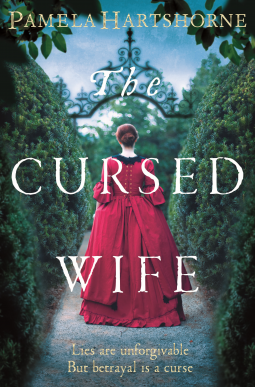
The Cursed Wife by Pamela Hartshorne

Having previously read Pamela Hartshorne’s time-slip novel The Edge of Dark, I found her latest book, The Cursed Wife, both similar and different. Similar in that they both explore the lives of women in Elizabethan England; different because this one is set entirely in the past, with no modern day storyline and no form of time travel.

The Cursed Wife is written from the perspectives of two women, Mary and Cat, who are both friends and rivals. When we first meet Mary in 1590 she appears to be leading a happy and contented life; she is married to the merchant Gabriel Thorne, and lives with him, their children and their servants in a comfortable house in London. Mary is devoted to her family and her household and has almost – but not quite – managed to forget that she was cursed as a child and predicted to die by hanging.

However, Mary’s whole life is built around lies and deception and she knows that if the truth is ever revealed she could lose everything. One rainy day she sets out to do some shopping in Sopers Lane to replenish her stocks of herbs and medicines, and is shocked to see a face from her past – a face she had expected never to see again. It’s Cat, her childhood friend, who was once as close to her as a sister, but who now possesses the secrets that could ruin Mary’s life…

As I’ve said, I found this a very different sort of book from The Edge of Dark; it doesn’t have such an eerie atmosphere and lacks the touches of the supernatural – although Mary does have a very creepy one-armed wooden doll called Peg. Instead the focus is on the relationship between Mary and Cat. It’s a relationship which changes and transforms itself over the years as the roles of the two women in each other’s lives are reversed, but the links between them are seemingly unbreakable and their stories are very closely entwined.

Cat and Mary take turns to narrate in alternating chapters and although their narrative voices are very similar, the author does use a few techniques to distinguish between the two – for example, Cat’s thoughts are often aimed directly at Mary (‘you say this’ and ‘you do that’). Cat is also a more bitter person than Mary, who can often seem quite naive and slow to understand things that are obvious to the reader. Neither woman is very likeable and although Cat is nastier, I can’t really say that my sympathies were with Mary either.

Pamela Hartshorne has written about the Elizabethan period before, not just in The Edge of Dark, but in other novels too, and she obviously knows it well. We are given lots of little details on domestic life in the late 16th century – the food people ate, the clothes they wore, the tasks carried out by servants in the home – and although historical events happening in the wider world have little direct effect on the story, there’s a sense of how precarious life could be in this period when hanging is a punishment for crime and when the most minor of illnesses can result in death. The novel also looks at the roles of women and the expectations that were placed on them regarding marriage.

The Cursed Wife is an interesting read and the storyline was compelling enough to hold my attention until the end, but I did prefer The Edge of Dark and as her earlier books all seem to be time-slip novels like that one I think I’ll have to investigate them at some point.

Thanks to Pan Macmillan for providing a copy of this book for review via NetGalley.

Historical Musings #39: I Spy Historical-Style

Welcome to my monthly post on all things historical fiction. I noticed this I Spy challenge appearing on lots of other blogs a month or two ago and wanted to give it a try, but didn’t get round to it at the time when everyone else was doing it. When I was thinking of a topic for this month’s Historical Musings post I thought it might be fun to put together a historical fiction (and non-fiction) version of the I Spy game which would give me an opportunity to highlight twenty books from my shelves, some of which I’ve read and some that I haven’t.

I’m not sure where this challenge first originated but these are the rules:

Find a book that contains (either on the cover or in the title) an example for each category. You must have a separate book for all 20, get as creative as you want and do it within five minutes!

I decided to ignore the five minutes rule and add a new rule of my own – that all twenty books must be from the historical fiction or non-fiction genres. And here are the results:

1. Food

The Lives of Tudor Women by Elizabeth Norton

I was nearly defeated before I’d even started. I couldn’t find a single historical fiction novel on my shelves with food either on the cover or in the title. Surely, I thought, I would be able to spot an apple or a cake or a plate on a table in the background…but no, nothing. Finally, I discovered some food on the cover of The Lives of Tudor Women by Elizabeth Norton, hence why I had to expand the scope of this challenge to include historical non-fiction as well as fiction! I haven’t read this book yet, but I will think about picking it up next time I’m in a non-fiction mood.

2. Transport

To Lie with Lions by Dorothy Dunnett

This one was also more difficult than I’d expected. I was sure I must have a book with a train on the cover or maybe a plane on a World War II cover, but when I started searching for them I couldn’t find any. There were plenty of pictures of ships, though! To Lie with Lions, set mainly in Scotland and Iceland, is a wonderful book (as are all of Dunnett’s historical novels), but be aware that it is the sixth in her House of Niccolò series and I would strongly recommend beginning with the first.

3. Weapon

The Sunne in Splendour by Sharon Penman

For ‘weapon’ there were a few books with swords on the cover that I could have chosen. I decided to feature The Sunne in Splendour, Penman’s fictional account of the life of Richard III, because it’s another book that I loved and the one that sparked my interest in the Wars of the Roses, which is now one of my favourite periods in English history. The picture on the cover shows, as well as a sword on the ground, what is obviously supposed to be the crown in the hawthorn bush, which is one of the legends surrounding the Battle of Bosworth.

4. Animal

The Fortune Hunter by Daisy Goodwin

I started seeing some overlap between categories at this point. I could have used To Lie with Lions for the animal book, but instead I decided to choose one with a picture of an animal on the cover – in this case, a horse. Horses play an important role in The Fortune Hunter, which tells the story of the 19th century horseman Bay Middleton and his relationships with the heiress Charlotte Baird and the Empress Sisi of Austria.

5. Number

Twenty Years After by Alexandre Dumas

This is the sequel to The Three Musketeers and the ‘twenty years’ in the title refers to the time that has passed between the events of the first book and the second. In this book, d’Artagnan, Athos, Porthos and Aramis become caught up in the conflict between the supporters and opponents of Cardinal Mazarin, are involved in the execution of Charles I in England, and face a new enemy, the sinister Mordaunt. I enjoyed this one as much as The Three Musketeers and went on to read the rest of the series.

6. Something you read

The Story Keeper by Anna Mazzola

You read stories, of course, and the stories in the title of Anna Mazzola’s new novel are folktales from the Isle of Skye which are collected by a young woman who visits the island in 1857. I haven’t read this book yet but it is on my 20 Books of Summer list and I am looking forward to it, having read her first novel, The Unseeing, last year.

7. Body of water

Sea of Poppies by Amitav Ghosh

Another ship on the cover of this book, but also a body of water and the word ‘sea’ in the title. The novel – the first in a trilogy – follows a diverse group of characters who come together on a voyage from India to Mauritius in the 1830s, just before the First Opium War. The second book in the trilogy, River of Smoke, could have been used for this category too and also for the next one…

8. Product of fire

The Fatal Flame by Lyndsay Faye

A surprising number of books to choose from here, with ‘smoke’, ‘ashes’ and even ‘soot’ in the title. I decided on this one because it gives me an opportunity to mention how much I enjoyed Lyndsay Faye’s Timothy Wilde novels, a trilogy of mysteries set in 19th century New York. I particularly loved the relationship between Tim and his brother Valentine. This is the last book, so read The Gods of Gotham and Seven for a Secret first.

9. Royalty

Edwin: High King of Britain by Edoardo Albert

As you might expect, there are many, many historical novels with references to royalty in the title or pictures of royalty on the cover. I simply picked up the first one that caught my eye on my shelf, which happened to be Edoardo Albert’s Edwin: High King of Britain. I loved this book about Edwin, the 7th century King of Northumbria, and the sequel Oswald: Return of the King. There is also now a third book on Oswiu, King of Bernicia, but I haven’t read that one yet.

10. Architecture

Larkswood by Valerie Mendes

I have plenty of books with houses, castles and other architectural structures on the cover too. Again, I just picked up one of the first I came to. Larkswood is the name of an English country house in which family secrets unfold over a period of forty years, taking us up to the beginning of the Second World War. I can’t remember very much about this book, but I know I liked it.

11. Clothing

Fingersmith by Sarah Waters

For ‘clothing’, it was tempting to choose one of the ‘faceless woman in pretty dress’ covers that are used so often by publishers of historical novels, but then I remembered my copy of Fingersmith with its picture of a pair of white gloves. I didn’t love this book quite as much as most people seem to, possibly because the plot reminded me so strongly of a certain Victorian novel, but I did enjoy it, as I have all of Sarah Waters’ books.

12. Family member

Daughter of Siena by Marina Fiorato

Lots of daughter, wife and sister titles – but few, if any, that mention male family members, which could be a discussion for a future Historical Musings post, do you think? Anyway, I haven’t read Daughter of Siena yet. I’ve enjoyed some of Marina Fiorato’s books but had problems with some of her others, so I wonder what I’ll think of this one, set in 18th century Italy.

13. Time of day

The Midnight Rose by Lucinda Riley

Like many of Lucinda Riley’s novels this one is set in two time periods – one historical and the other in the modern day. The historical storyline takes us to India in 1911, where a young girl is befriended by Princess Indira, the daughter of the Maharaja and Maharani of Cooch Behar. I have read most of Lucinda Riley’s books now – I would particularly recommend her Seven Sisters series – and am looking forward to the others.

14. Music

The Long Song by Andrea Levy

I was torn between this book and Songs of Willow Frost by Jamie Ford, but eventually settled on this one. There’s not much of a music connection, apart from the title, though…this is a novel about a girl born as a slave on a Jamaican sugar plantation who lives through the abolition of slavery in the 1830s.

15. Paranormal being

Ghost Light by Joseph O’Connor

This book may have a paranormal being in the title, but it’s not a paranormal story…it’s actually the story of the Irish actress Molly Allgood and her relationship with the playwright John Millington Synge. I’ve forgotten the plot but I remember the beautiful writing – and the unusual second person narration.

16. Occupation

Gutenberg’s Apprentice by Alix Christie

Peter Schoeffer, the protagonist of this novel, is originally a scribe but his father has other plans for him and arranges for him to become apprenticed to Johann Gutenberg, who is working to produce the first printed copy of the Bible. I remember feeling slightly disappointed with the story and characters, but as a book lover I did enjoy learning about the history of the printed word. The conflict between the new and the traditional is a theme I always find interesting too.

17. Season

The Spring of the Ram by Dorothy Dunnett

After I took my photograph I remembered Drums of Autumn by Diana Gabaldon and The Winter Palace by Eva Stachniak, but by then it was too late and I had already chosen this one. Anyway, it gives me another excuse (not that I needed one) to highlight Dunnett’s House of Niccolò series. This book has one of my favourite settings in the series: Trebizond in 1461.

18. Colour

Red Sky at Night by Jane Aiken Hodge

All book covers have a colour on them, I suppose, so I selected one with a colour in the title for this category instead. I have read a few Jane Aiken Hodge books and enjoyed them but haven’t read this one, set in the Regency period, which I found in a second-hand shop a while ago. I have one of her other novels on my NetGalley shelf, though, so I will really need to read that one first.

19. Celestial body

Shadow of the Moon by MM Kaye

This was the first book that came to mind here. I read it last year as part of a readalong and loved it – not quite as much as Kaye’s The Far Pavilions, but almost! I really like the way she writes about India in both of those books, with such a deep understanding, lack of bias and obvious love for the country. Her mystery novels are great too, but I’m really looking forward to reading her other historical novel, Trade Wind.

20. Something that grows

The Rose of Sebastopol by Katharine McMahon

This book has been on my TBR for a long time now, so I will really have to read it soon. It is set during the Crimean War, which is not a setting I have read very much about. It’s also the second book I have mentioned here which has ‘rose’ in the title – another example of books counting towards more than one category.

~

Well, those are my twenty I Spy books. Have you read any of them?
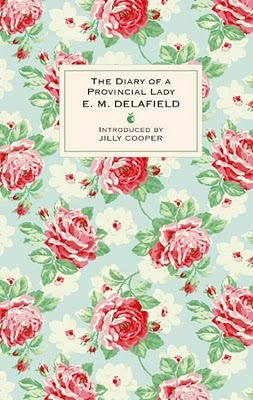
Diary of a Provincial Lady by E M Delafield

Today would have been E M Delafield’s birthday – and she is the next author to be featured in Jane at Beyond Eden Rock’s Birthday Book of Underappreciated Lady Authors. I wasn’t planning to join in with this one but, during last weekend’s Mini Persephone Readathon, having finished Monica Dickens’ The Winds of Heaven, I wanted something else to read and remembered that Diary of a Provincial Lady is also published by Persephone. My copy is not the dove-grey Persephone edition, but I was still pleased to have found a book that would count for both the Readathon and today’s celebrations!

Diary of a Provincial Lady, first published in 1930, is exactly what you would expect from the title: a novel written in the form of the diary of a ‘Provincial Lady’. The Lady, whose name we never learn, lives with her husband Robert in a village in the south of England. Their young son, Robin, is away at school much of the time, but there is also a daughter, Vicky, who is educated at home by Mademoiselle, her French governess. Several more servants, including a temperamental cook and a series of dissatisfied parlourmaids, complete the household.

The Provincial Lady’s days are always busy and varied. As well as being responsible for managing the servants, there are tea parties and garden fetes to attend, dinners to host and visitors to entertain – including the formidable and snobbish Lady Boxe, and Our Vicar’s Wife who, once she arrives, often forgets to leave again! The Provincial Lady records all of these things in her diary over a period of about a year, writing in short, concise sentences interspersed with notes, queries and memos to herself.

I have been putting off reading Diary of a Provincial Lady for a long time, because I wasn’t convinced that it sounded like my sort of book, but I was actually very pleasantly surprised. One of the things that surprised me was how often I found I was able to relate to the Provincial Lady and her problems. In fact, I think a lot of the situations she describes are things that most of us would probably identify with…saying something stupid and then wondering why on earth we said it; pretending we understand what somebody is talking about and then being caught out later in the conversation; agreeing to do something and immediately wishing we hadn’t!

I couldn’t relate to everything, of course. The Lady’s lifestyle is entirely different from my own – I don’t have servants to worry about, for example, and if I found myself in financial trouble my solution wouldn’t be to buy myself some expensive new dresses then go off to the South of France for a holiday. I can appreciate, though, that she belonged to a certain time and a certain class and that her position in society meant that she was expected to behave in a particular way.

I was also surprised by how funny the book was! A sense of humour is often a personal, individual thing and sometimes when someone else says that a book is hilarious I’m disappointed when I don’t find it very funny at all (and I’m sure this probably happens the other way around too). But the Provincial Lady’s observations are so witty and the things that happen to her are so amusing I couldn’t help but laugh.

I am aware that there are more books in the Provincial Lady series. A question to those who have read them – are they as good as this one or is there another E M Delafield book you think I should read instead?

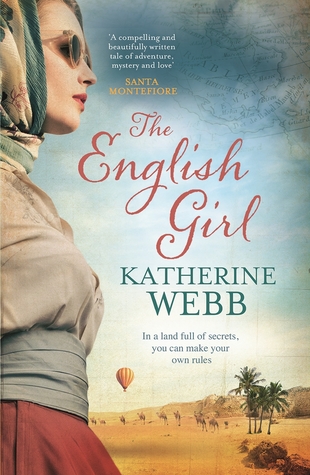
The English Girl by Katherine Webb

One of the things I love about reading is that it gives me the opportunity to learn about places I have never visited and am probably never likely to. Katherine Webb’s The English Girl is set in Oman, which is not a country I’ve ever read about before. Having previously read only The Misbegotten by Webb, I found this one a very different novel, not least because of the fascinating setting.

The ‘English girl’ of the title, Joan Seabrook, has grown up listening to her father’s stories of Arabia and longing to explore this magical, mysterious land for herself. Now, in 1958, her dreams have come true and she is on her way to Oman with her fiancé, Rory. Foreign tourists are not usually welcome in Oman, but Joan has obtained special permission – with the help of a family friend who happens to be the foreign minister – to visit her brother Daniel, who is stationed there with the British army. Having recently finished studying for her degree in archaeology, Joan is looking forward to investigating some of the sites she has heard so much about.

Arriving in the city of Muscat, Joan is disappointed to discover that the places she really wants to see – Fort Jabrin and Jebel Akhdar (the Green Mountain) – are off limits because of the war which is currently being waged in the mountains of Oman between the supporters of the Sultan and the Imam. She consoles herself with visits to Maude Vickery, the famous explorer who was the first woman to cross the desert known as the Empty Quarter and who has made Muscat her home. Maude was Joan’s childhood heroine and she is thrilled to have the chance to get to know her. Now an elderly woman, Maude is bitter, sharp-tongued and resentful, and not at all what Joan had expected, but when Maude asks her to carry out an important mission on her behalf, Joan is unable to refuse – even if it means putting her own life in danger.

As I’ve said, this is the first book I have read set in Oman, and I loved the beautiful descriptions of the deserts, the mountain ranges, the valleys and forts, and the streets of Muscat. It’s the perfect backdrop for Katherine Webb’s story of adventure, mystery and romance! This is also the first time I’ve read about the Jebel Akhdar War of the 1950s and the conflict between the interior of Oman (the Imamate) and the Sultanate of Muscat. The British army supported the Sultan in the war and as Joan’s brother Daniel is a soldier, this gives the characters in the novel a personal connection to events taking place around them.

Although I found a lot to enjoy, it took me a while to really get into this book and I think that was partly because Joan just didn’t appeal to me as a character. I wasn’t very interested in her relationships with Rory and Daniel and I felt that she kept putting herself into dangerous situations unnecessarily. I hoped I would warm to her eventually, but I didn’t. However, this is not just Joan’s story – it is also Maude’s, and while she is not the most likeable of characters either, she is a fascinating one.

As soon as I began to read about Maude, I thought of the real-life explorer Gertrude Bell, and after finishing the book I wasn’t surprised to see that the author’s note at the end confirmed that she had been the inspiration for the character. About half of the novel is written from Maude’s perspective, taking us back in time to her exciting journey through the Empty Quarter and her determination to get across the desert before her friend and rival Nathaniel Elliot. By the time I reached the end of Maude’s story, I admired her for what she had achieved but I also understood what had shaped her into the bitter, unhappy old woman Joan meets in Muscat.

The English Girl could be thought of as a novel of secrets as everyone seems to be hiding something. Maude, betrayed by someone she thought she could trust, has been trying to hide her pain and heartbreak for most of her life, while Nathaniel has also been concealing something that happened on his own expedition. Both Rory and Daniel are keeping secrets from Joan and there are hints of further mysteries as far back as Joan’s childhood too. Most of all, there are the secrets of Oman and of the desert and seeing these unfold as the setting is brought to life will be my lasting memory of this book.

Templar Silks by Elizabeth Chadwick

In her latest novel, Templar Silks, Elizabeth Chadwick returns to the hero of her earlier books The Greatest Knight and The Scarlet Lion: William Marshal, knight, soldier, statesman and adviser to kings of England. Unlike those other two books, which took us right through William’s life and career, from youth to death, Templar Silks concentrates on one specific episode – William’s journey to the Holy Land – which was mentioned only briefly in The Greatest Knight.

The novel opens in April 1219 with William on his deathbed, surrounded by family and friends at his home in England, Caversham Manor. Before he dies, he asks his squire to bring him the silk burial shrouds he was given by the Templars in the Holy Land thirty years ago. As he waits the arrival of the silks, he looks back on the long-ago adventure that shaped the rest of his life.

In 1183, William was in the service of Henry II’s eldest son, known as the Young King. In need of money to pay his soldiers, the Young King gives orders to raid the shrine of Rocamadour, but falls ill with dysentery shortly afterwards. Aware of the sacrilege he has committed, his dying wish is for William to atone for his sins by taking his cloak to Jerusalem and placing it on Christ’s tomb. Still unmarried at this point and free from the greater responsibilities he will hold in later life, William is happy to undertake the pilgrimage, but the journey proves to be even more eventful and dramatic than he had expected.

William spent three years on his pilgrimage but historians know very little about what actually happened during this period of his life. This allows Elizabeth Chadwick to use her imagination to create William’s story – and with her own knowledge of the medieval world and the political situation in 12th century Jerusalem, she is able to make his actions feel plausible and realistic.

William is accompanied on his journey by a small party of fellow knights and squires, two Templar Knights who act as guides, and his younger brother Ancel. There is no historical evidence that Ancel took part in the pilgrimage – in fact, he is barely mentioned in historical records at all – but the relationship between the brothers was one of my favourite aspects of the book. Ancel and William are very different people, with Ancel depicted as more sensitive, more cautious, and not as quick to learn when it comes to fighting, jousting and other knightly pursuits. There are times when they become frustrated with each other, but the love and loyalty between them is always plain to see.

And William needs all the loyal friends he can find if he is going to survive this difficult mission. After a traumatic experience in Constantinople, he and his men arrive in Jerusalem to find this most holy of cities approaching a moment of crisis. King Baldwin is dying of leprosy and his nephew, his only heir, is too young to rule. Baldwin’s brother-in-law, Guy de Lusignan, is the next most logical contender, but Guy has many rivals and Jerusalem desperately needs strong, united leadership to deal with the threat of Saladin. William has more reason than most to dislike Guy, who was responsible for his uncle’s death several years earlier, but choosing to support another claimant could lead him into even more danger.

Due to the nature of the story, the setting and the focus on politics and the military, most of the main characters in this particular novel are male, but there is one female character who has a large role to play during William’s time in Jerusalem. She is Paschia de Riveri, the beautiful concubine of the Patriarch Heraclius. It is never very clear what Paschia’s motives are or how she truly feels, but as William became more entangled in her schemes, I couldn’t help thinking that it would all end unhappily for him – while hoping, for his sake, that I was wrong.

I enjoyed Templar Silks, with all of its adventure and intrigue, but it does feel a bit different from Elizabeth Chadwick’s other recent novels such as her Eleanor of Aquitaine trilogy and Lady of the English, which are more biographical and cover much longer time periods. It seems that Chadwick is not ready to leave the Marshals behind just yet; her next novel, The Irish Princess, is going to be about the parents of William’s wife, Isabelle de Clare.

Thanks to Little, Brown Book Group UK for providing a copy of this book for review via NetGalley.

The Winds of Heaven by Monica Dickens

When I saw that Jessie of Dwell in Possibility was hosting a Mini Persephone Readathon this weekend, I knew I wanted to take part and I knew exactly what I would be reading: The Winds of Heaven, a book published by Persephone which I had originally been planning to read for Jane’s Monica Dickens Day last month but didn’t have time. I wasn’t sure what to expect from Monica Dickens as I’ve never read any of her books before, but I loved this one and will now be looking for more.

The Winds of Heaven (1955) follows the story of Louise Bickford, whose husband, the controlling and oppressive Dudley, dies a year or two before the novel opens. Left alone with no money to support herself, Louise cannot afford anywhere to live, so is forced to rely on the hospitality of her daughters. Although Louise has shown her three daughters nothing but love and affection, they each make it very clear that they don’t really want her staying with them and see her as a burden to be moved on to the next sister as quickly as possible.

Louise is a lovely person – generous, selfless and sensitive to the feelings of others; I had a lot of sympathy for her and for the situation in which she finds herself. The logical solution would be to get a job, but a combination of factors – her age (approaching sixty), her class, her lack of experience at any type of work and the disapproval of her daughters – mean that this is never considered as a realistic option for Louise. All she can do is continue to move from one household to the next, trying to make herself useful but knowing that she is unwanted and unappreciated.

The three daughters seem to have inherited none of their mother’s good qualities. They are three very different people, but in their different ways they are all as unpleasant and selfish as each other. Miriam is a snob, obsessed with appearances and her place in the community. Her marriage is not a particularly happy one, but as Arthur is rich enough to pay for holidays abroad and ponies for the children, she’s not complaining too much! Eva, the middle sister, is an aspiring actress who lives in London and is too preoccupied with her career and her affair with a married man to give any thought to her mother’s problems. Anne, the youngest, is a farmer’s wife but does very little to help out on the farm – she is a lazy, sullen, resentful woman who thinks only of herself and her own comfort.

For a novel with so many unlikeable characters, I found this a surprisingly enjoyable and entertaining read. Louise’s story is obviously a very sad one at times, but Monica Dickens writes with enough humour and lightness that it never becomes completely depressing. And although her relationships with Miriam, Eva and Anne are difficult, Louise does have two special people in her life who make things much more bearable. One is her young granddaughter Ellen, with whom she forms a close bond. Ellen is Miriam’s eldest daughter and, like Louise, she often feels like an outsider in the family. The other is Gordon Disher, a man she meets while sheltering from the rain in a London tea shop.

Mr Disher is the most unlikely of romantic heroes – he is overweight, sells beds in a department store and writes cheap paperback thrillers with titles like The Girl in the Bloodstained Bikini. He is also a lovely, kind, gentle man who sees that Louise is unhappy and does all he can to make things better for her. Their meetings are few and far between – Louise is sure she’s too old for romance and she doesn’t spend a lot of time in London anyway – but I found their relationship quite moving and always looked forward to the moments when they were together.

Towards the end of the book, events take a more dramatic turn and if I have a criticism it would be that I’m not sure whether this was really necessary. The final sentence, though, was perfect! I wish Monica Dickens had written more books about these characters, but I enjoyed this one enough to know that I will be investigating the rest of her novels anyway!

The Winds of Heaven endpapers

Six Degrees of Separation: From The Tipping Point to The Silvered Heart

It’s the first Saturday of the month which means it’s time for another Six Degrees of Separation, hosted by Kate of Books are my Favourite and Best. The idea is that Kate chooses a book to use as a starting point and then we have to link it to six other books of our choice to form a chain. A book doesn’t have to be connected to all of the others on the list – only to the one next to it in the chain.

The first book this month is The Tipping Point by Malcolm Gladwell and, as usual, I haven’t read it! It’s a non-fiction book about “that magic moment when ideas, trends and social behaviour cross a threshold, tip and spread like wildfire”. It sounds interesting, but is probably not something I will ever read.

It can be difficult to think of that all-important first link when you’re not familiar with the starting book. All I could come up with was another book with the word ‘Tipping’ in the title: Tipping the Velvet by Sarah Waters! I have read and enjoyed all of Sarah Waters’ novels, although this one, about two music hall stars in 19th century London, is not a favourite.

There was a BBC adaptation of Tipping the Velvet in 2002, which starred Rachael Stirling and Keeley Hawes as the two main characters, Nan and Kitty. Keeley Hawes also starred as Rachel Verinder in the BBC’s 1996 adaptation of The Moonstone by Wilkie Collins. I usually stick to books I’ve actually reviewed on my blog when I’m choosing links for my chain, but although Wilkie Collins is one of my favourite Victorian authors and The Moonstone is one of his best books, I don’t seem to have re-read it since I started blogging. How can that be? I must read it again soon!

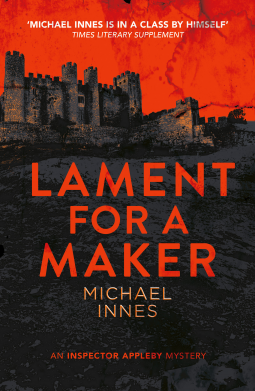
The Moonstone, like some of Collins’ others, has multiple narrators who take turns to tell their part of the story. I think Collins is the master of the ‘multiple narrator novel’, but another book written in the same format which really impressed me was Lament for a Maker by Michael Innes.

The title of this novel was inspired by the William Dunbar poem Lament For The Makers. A lot of books have titles taken from the world of poetry, but one of the first that came to mind when thinking of them was Alan Bradley’s I am Half-Sick of Shadows, which is a line from The Lady of Shalott by Tennyson.

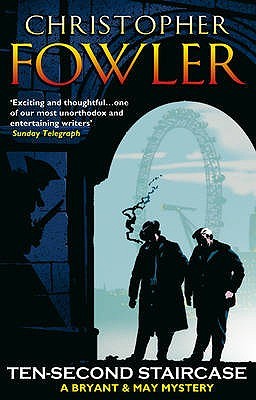
I am Half-Sick of Shadows is the fourth book in Bradley’s Flavia de Luce mystery series. There are now nine books in the series, but I haven’t read all of them yet. For my next link in the chain, I’ve chosen another book which is the fourth in a mystery series I haven’t finished reading: Ten-Second Staircase, a Bryant and May novel by Christopher Fowler. Unlike the Flavia books, which feature a ten-year-old detective, the Bryant and May mysteries have a detective duo who are in their eighties!

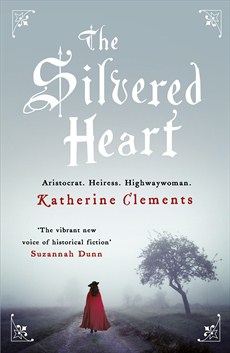
It’s been a few years since I read Ten-Second Staircase, so I had to look at my review to remind myself that it was about a killer known as The Highwayman. This leads me to my final book for this month – a novel about not a highwayman but a highwaywoman. Her name is Katherine Ferrers, or ‘the Wicked Lady’, and she is the heroine of The Silvered Heart by Katherine Clements, set in 17th century England.

I nearly didn’t take part in this month’s Six Degrees of Separation because I just couldn’t see how to get started with the first link, so I’m pleased that I did manage to put a chain together after all! In July, the starting point will be Tales of the City by Armistead Maupin – I haven’t read that book either, but I can already see several possible directions I could go in with that one!