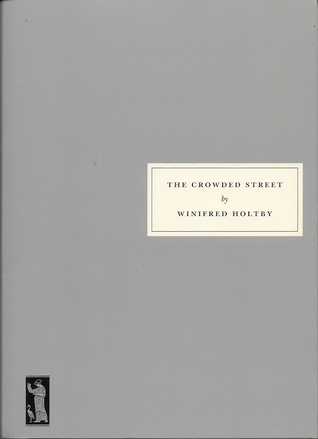
The Crowded Street by Winifred Holtby

The Crowded Street is on my Classics Club list, so when I saw that Jessie of Dwell in Possibility was hosting a Persephone Readathon this week, my choice was obvious. This particular book has also been published as a Virago Modern Classic, but my edition is the Persephone one, with the endpapers pictured below. Having already enjoyed several of Holtby’s books – South Riding, The Land of Green Ginger and Poor Caroline – I’ve been looking forward to this one for a while and I’m pleased to say that I loved it even more than I hoped I would.

The novel was published in 1924, at a time when it was assumed that most young women wanted nothing more than to find a husband and then stay at home to raise their children. In The Crowded Street, Holtby looks at what it was like to be a woman who, for one reason or other, was unable to conform to these expectations. Through the stories of Muriel Hammond, her sister Connie and her friends Clare and Delia, she explores the very different routes through life taken by four very different women.
We first meet Muriel in December 1900 when she is eleven years old and attending her first ‘grown-up’ party. Her excitement soon turns to shame when she finds that none of the boys want to dance with her and her dance card remains almost blank. Muriel is confused: The unforgivable sin at a party is to have no partners. To sit quietly in the drawing-room at home was a virtue. The sense that she has somehow let her mother down is a feeling which will stay with her for the next two decades as she continues to go through life partnerless, waiting and hoping for something to happen. She does initially have ambitions – to study astronomy, to go to college – but she doesn’t pursue these as she receives no encouragement from her mother or from her school teacher, who says:

“Character, my dear, to be a fine womanly woman, that matters so much more than intellectual achievement. To serve first your parents, then, I hope, your husband and your children, to be pure, unselfish and devoted, that is my prayer for each one of my girls.”

As a single woman myself, there were times when Muriel’s story resonated with me, but thankfully not all the time! I may not be married, but nobody ever prevented me from going to university or getting a job. Muriel watches with envy as Delia, another unmarried girl from the same Yorkshire village, goes off to Cambridge University, then heads for London and throws herself into political activism.

“But then, she has her work. Women who have their work have an immense thing, even if they are unfortunate in the people whom they love. It is when you have nothing, neither work, nor love, nor even sorrow, that life becomes rather intolerable.”

Of course, some women today are happy to stay at home with their parents, there are some who find plenty of fulfilment in marrying and having children, while others want to move away to pursue their career. There is no right or wrong way to live, but the point is that we have a choice. What makes Muriel’s story so tragic is that she feels she has no choice. She believes that marriage is the only possible way to escape, but if that doesn’t happen, all she can do is continue to help her mother around the house, doing what she sees as her duty (even though her help isn’t particularly necessary). As a result, she becomes more and more depressed, feeling that life is passing her by but lacking the confidence to do anything about it and making excuses to justify why she can’t.

Her younger sister, Connie, tries to break away from the stifling confines of life in Marshington, but she is so desperate that she makes a bad decision which has disastrous consequences. It seems that the only one who is likely to be happy is Muriel’s old school friend, the cheerful and sophisticated Clare, who goes through life without a care in the world and catches the eye of Godfrey Neale, the one man Muriel dreams of as her own potential husband. Clare, though, has the opposite problem. Having had a very different upbringing from Muriel and Connie, will she be able to adapt to living in a small Yorkshire village?

At one point, Muriel thinks to herself:

“All books are the same – about beautiful girls who get married or married women who fall in love with their husbands. In books things always happen to people. Why doesn’t somebody write a book about someone to whom nothing ever happens – like me?”

Well, Winifred Holtby has written that book and I don’t think it’s quite true that nothing happens to Muriel. She does develop as a person as the novel progresses and, although it takes a long time, she slowly becomes aware that if she is to have any happiness she will have to take matters into her own hands. I loved the way her story ended: she has an important decision to make and in my opinion she does the right thing.

As well as following the characters I’ve mentioned above, we are also given some insights into the effects of the First World War on small communities like the fictional Marshington. I particularly enjoyed the vivid depiction of the bombardment of Scarborough in 1914, something Winifred Holtby could draw on personal experience to describe. The Crowded Street is a wonderful book in so many ways and a great choice for both the Classics Club and the Persephone Readathon!

This is Book 2/50 from my second Classics Club list
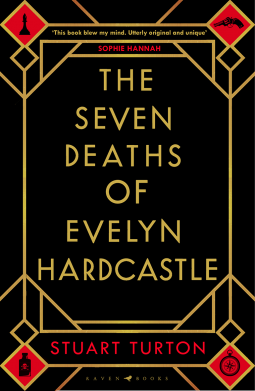
The Seven Deaths of Evelyn Hardcastle by Stuart Turton

I can’t even begin to imagine how much time and effort must have gone into the writing of this novel! I’ve never read anything like it before and I hardly know how to begin to describe it. It has all the elements of a classic murder mystery – but there’s a clue in the title: the same murder happens not just once but seven times.

The novel opens with a man waking up in a forest with no memory of who he is or how he came to be there. He has the name ‘Anna’ in his mind, although he has no idea who Anna might be. Hearing a woman scream, he rushes to help but is stopped by a stranger who pushes a compass into his pocket and whispers ‘East’. Following these instructions, he finds his way out of the woods and into the grounds of nearby Blackheath House, where the situation becomes even more bizarre. He discovers that he is a doctor called Sebastian Bell and that he is a guest at Blackheath where the Hardcastle family are throwing a party to mark the nineteenth anniversary of their son’s death.

All through the long and bewildering day which follows, Bell tries to make sense of what is happening, only to end up more confused than ever. Eventually, he is approached by a man wearing the costume of a Plague Doctor, who appears to have some of the answers. It seems that the Hardcastles’ daughter, Evelyn, is going to be murdered later that night and Bell’s task is to solve the murder. Should he fail, he will have the chance to live through the day again…but this time he will be someone else. Eight days and eight different ‘host bodies’; if at the end of that time he can provide a solution, he will be allowed to leave Blackheath. If not, he will go back to day one and the whole sequence will begin again…as it already has, many times before.

Everything I’ve said so far is explained to our narrator early in the novel. Once he begins waking up as the other hosts, however, things quickly become very complicated, with new clues and pieces of information coming to light on almost every page. I won’t say any more about the story itself, then, other than in general terms. I won’t even tell you who the other hosts are, as part of the fun is in wondering who the narrator is going to be next. Each host, though, has different strengths and weaknesses and is connected to the murder in a different way. It’s fascinating to see how each of them alone sees only a small part of the picture, and the truth only begins to emerge when all of their collective experiences and observations are taken into account.

This is an incredibly clever novel and so intricately plotted I have no idea how Stuart Turton managed to keep track of it all. Although it’s a long book, my recommendation is to read it in as few sittings as possible so you can try to hold on to all the threads of the story in your head. If your experience is anything like mine you’ll quickly become so engrossed that you won’t want to stop anyway. And experience is the right word for it. This doesn’t feel like a normal novel at all. It reminded me in some ways of one of those ‘choose your own adventure’ books I loved as a child where you could make choices that led to different routes through the story. That’s how I felt as the narrator lived through the same events again and again, trying to decide what he did wrong last time.

The novel is written in the first person present tense – a style I usually dislike but which is used very effectively here. It gives the reader a sense of being dropped directly into the middle of the action and sharing the narrator’s panic and disorientation. I don’t think it would have worked had it been written any other way. I thoroughly enjoyed this unusual and wonderfully imaginative novel!

Thanks to Raven Books for providing a copy of this book for review via NetGalley.

Top Ten Tuesday: Books that have been on my TBR the longest

This week’s Top Ten Tuesday, hosted by That Artsy Reader Girl, asks us to list the ten books that have been on our TBR the longest. I keep track of my TBR through Goodreads so I decided that the easiest way to approach this week’s topic was simply to take the first ten books on my Goodreads ‘to-read’ shelf, which were all added in 2010/2011. Before I started blogging I was very good at reading the books that I’d bought before buying more, so I don’t have any very old books on my TBR.

***

1. The Rose of Sebastopol by Katharine McMahon

Historical fiction set during the Crimean War. I remember buying this on a visit to my favourite bookshop, Barter Books; I did start to read it once but didn’t get very far with it.

2. The House at Riverton by Kate Morton

I added this to my TBR – and then read two other Kate Morton books instead. Because I was disappointed by The Distant Hours, I never went back to read this one. Maybe I should.

3. The Blasphemer by Nigel Farndale

A dual timeline novel divided between the First World War and the modern day. I won this one in a giveaway by the publisher, so I feel very guilty that I still haven’t read it!

4. Mornings in Jenin by Susan Abulhawa

I don’t know much about this one except that it’s set in Palestine, but I remember reading some glowing reviews from other bloggers a few years ago, which was why it was added to my TBR.

5. Year of Wonders by Geraldine Brooks

This novel about a 17th century village ravaged by plague has been recommended to me many times, but every time I’ve picked it up I’ve found that I was in the wrong mood for it.

6. Annie Dunne by Sebastian Barry

I love Sebastian Barry’s writing and have read several of his other books about the Dunne and McNulty families, but this one has been languishing on my shelf for years while I’ve been drawn to the newer ones instead.

7. Trespass by Rose Tremain

I added this to the TBR at a time when I hadn’t read anything else by Rose Tremain and I wasn’t sure whether or not I would like her writing. I’ve now read three of her other books and enjoyed them, so I think it could be time to try Trespass!

8. Oscar and Lucinda by Peter Carey

The Booker Prize winner from 1988. It has never felt like the right time to read it, but I said recently that I wanted to read more books set in Australia, so perhaps the time has now come.

9. Blood Harvest by Sharon Bolton

This is the only one of Sharon Bolton’s crime novels that I still haven’t read. I’ve no idea why not as I’ve loved all of her other books and her standalones, like this one, tend to be my favourites.

10. Beloved by Toni Morrison

I included this book on my original Classics Club list but removed it to replace it with something else. I do still want to read it and will hopefully find time for it soon.
***

Have you read any of these? Which books have been on your TBR the longest?

Six degrees of separation: Lincoln in the Bardo to The Ashes of London

I took part in Six Degrees of Separation hosted by Kate of Books are my Favourite and Best for the first time last month and enjoyed it, so I thought I’d try it again this month. The idea is that Kate chooses a book to use as a starting point and then we have to link it to six other books of our choice to form a chain. A book doesn’t have to be connected to all of the others on the list – only to the one next to it in the chain.

The first book this month is Lincoln in the Bardo by George Saunders, last year’s Booker Prize winner, which I read just before Christmas. With its unusual and experimental structure it wasn’t really my sort of book, but I did appreciate the originality and creativity.

In Lincoln in the Bardo, Abraham Lincoln visits Oak Hill Cemetery to grieve over the body of his eleven-year-old son, Willie. This brings to mind another book set in a cemetery: Pure by Andrew Miller. Pure is the story of a young engineer from Normandy who arrives in Paris to begin work on the destruction of the overcrowded and unsanitary cemetery of Les Innocents.

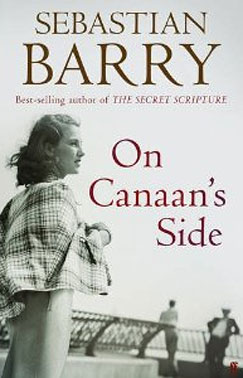
Pure appeared on the shortlist for the Walter Scott Prize in 2012. Another book shortlisted in the same year – the eventual winner, in fact – was On Canaan’s Side by Sebastian Barry. This beautifully written novel is narrated by Lilly, an elderly woman looking back on the eighty-nine years of her life.

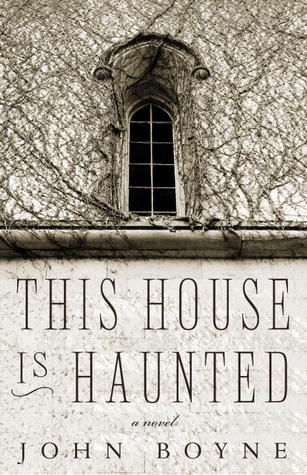
Sebastian Barry is one of my favourite Irish authors. Another Irish author I love is John Boyne and the first of his books that I read was This House is Haunted.

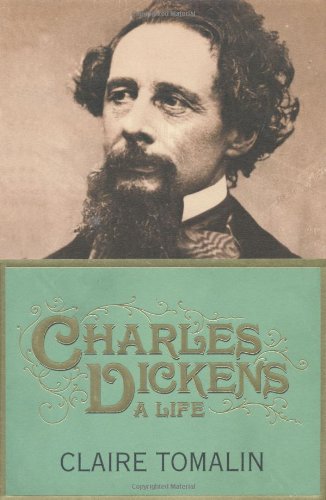
This House is Haunted is a wonderfully entertaining and atmospheric ghost story set in Victorian England. At the beginning of the book the narrator and her father go to watch a public reading by Charles Dickens. I could have chosen a Dickens novel as my next link, but instead I’m going to highlight Claire Tomalin’s biography, Charles Dickens: A Life.

Claire Tomalin has written several other biographies on subjects including Thomas Hardy, Jane Austen and Mary Wollstonecraft, but apart from the Dickens book the only other one I’ve read so far is Samuel Pepys: The Unequalled Self.

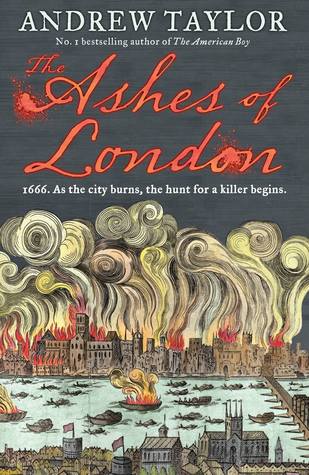
In his diary, Samuel Pepys famously wrote about the Great Fire of London of 1666. The fire provides the setting for The Ashes of London by Andrew Taylor. It’s the first in a series of historical mysteries, with the second book, The Fire Court, due to be published soon.

~

Have you read any of the books in my chain? What did you think of them?

Next month’s chain will begin with a book I haven’t read and know nothing about – The Beauty Myth by Naomi Wolf.

Persephone Readathon: Some past reviews

This is just a quick post to let you know, if you don’t already, that Jessie of Dwell in Possibility is hosting a Persephone Readathon which runs from 1-11 February. I should have posted about this yesterday but haven’t been very organised recently!

You can find everything you need to know at Jessie’s blog, but the idea of the Readathon is to read and write about books published by Persephone (there’s a complete list on the Persephone website here). I am currently reading The Crowded Street by Winifred Holtby, which also happens to be on my Classics Club list.

For now, though, here are the Persephones I have already read and reviewed on my blog:

~

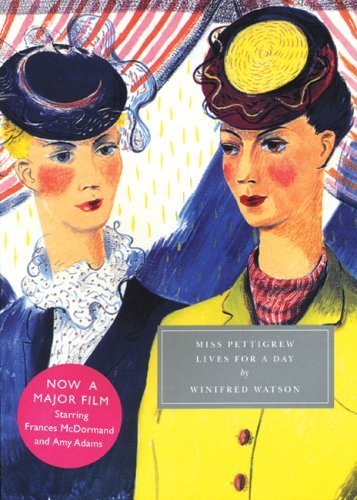
Miss Pettigrew Lives for a Day by Winifred Watson

From my review: “I found Miss Pettigrew Lives for a Day very easy to read, and with the entire story taking place in a day, it moved along at a fast pace. The perfect choice if you’re in the mood for something light hearted, fun and frivolous. Although it didn’t immediately become a favourite book, it was a lively, entertaining read full of amusing scenes and witty dialogue that made me smile.”

Alas, Poor Lady by Rachel Ferguson

From my review: “I loved this book but I know it won’t appeal to everyone. It’s slow and detailed, doesn’t have a lot of plot, and it did seem to take me a long time to read it. And yet without anything really ‘happening’ there’s still so much going on in this book that this post could easily have been twice as long as it is. So, for anyone with an interest in feminism and the differing roles of men and women in society, I can’t recommend Alas, Poor Lady highly enough.”

The Blank Wall by Elisabeth Sanxay Holding

From my review: “The pages of The Blank Wall are filled with tension and suspense. The plot is exciting and fast-paced and I could never guess what might happen next…I haven’t read many stories of the American Home Front during the war, so this was another interesting aspect of the book for me. A great story and one of my favourite Persephones so far.”

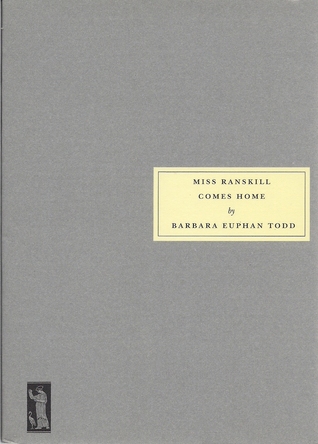
Miss Ranskill Comes Home by Barbara Euphan Todd

From my review: “I thought the whole idea of someone being cut off from the world and returning home only to find themselves suddenly thrown into the middle of a war was absolutely fascinating. This book has the perfect blend of humour and poignancy and gives us an opportunity to explore World War II from a unique perspective.”

Good Evening, Mrs Craven: The Wartime Stories of Mollie Panter-Downes

From my review: “These stories are not particularly dramatic or sensational in any way. They are realistic stories that focus not so much on the war itself, but on the effects of the war on the women (and a few of the men) who were left behind at home. We read about women attending sewing parties, worrying about loved ones who are away fighting, preparing for their husbands to go to war, coping with being pregnant during the war and experiencing almost any other wartime situation you can think of.”

The Victorian Chaise-longue by Marghanita Laski

From my review: “I’ve seen this book described as a horror story – ‘a little jewel of horror’. For me, though, it wasn’t so much frightening as unsettling and creepy… At only 99 pages, this book can easily be read in an hour, but there’s so much packed into those 99 pages that the story will stay in your mind for a lot longer than that.”

Princes in the Land by Joanna Cannan

From my review: “This novel has very little plot but like most Persephone books it raises a lot of interesting issues including marriage, parent/child relationships and class differences. The book itself is well written and I liked the setting and the time period, but unfortunately this is the first Persephone I’ve read that I didn’t enjoy much at all.”

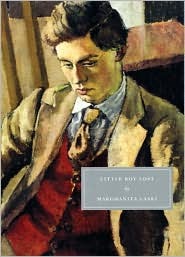
Little Boy Lost by Marghanita Laski

From my review: “There are so many great books that are let down by a weak ending, but this is certainly not one of them. The tension throughout the final few chapters was nearly unbearable, so much so that I was almost afraid to reach the end. And I imagine most readers, like I did, will have tears in their eyes when they reach the very last sentence. Nicholas Lezard of The Guardian, who is quoted on the back cover, says it best: If you like a novel that expertly puts you through the wringer, this is the one.

Family Roundabout by Richmal Crompton

From my review: “Family Roundabout is a very character-driven novel and fortunately almost every character in the story is well drawn and interesting. There were some that I didn’t like (Belle has to be one of the most horrible, vile people I’ve come across in fiction for quite a long time) but I enjoyed following all of their stories through to the end of the book. I loved the portrayal of the self-absorbed author, Arnold Palmer, and I thought the child characters were very well written too, which is maybe not surprising from a writer who wrote so many successful children’s books!”

And two more which are also available as Persephones, although my editions were from other publishers:

Miss Buncle’s Book by DE Stevenson

From my review: “Delightful, charming, warm, cosy – those are the type of words I would use to describe Miss Buncle’s Book. Written in the 1930s, D.E. Stevenson captures perfectly the atmosphere of life in a small English village at that time – a place where everybody knows everybody else, where freshly baked breakfast rolls are delivered to the villagers every morning, where people meet for tea parties or musical evenings and gossip with the neighbours over the garden fence.”

Flush by Virginia Woolf

From my review: “Flush is a wonderfully creative combination of fiction and non-fiction. For factual information, Woolf draws on Elizabeth Barrett Browning’s two poems about her dog and also the letters of Elizabeth and Robert, some of which she quotes from in the text. From a fictional point of view, the book is written from Flush’s perspective, imagining how a dog might feel and behave in a variety of different situations. The result is a book which is fascinating, unusual and a delight to read!”

~

Have you read any of these? I know many of you have read a lot more Persephone books than I have!

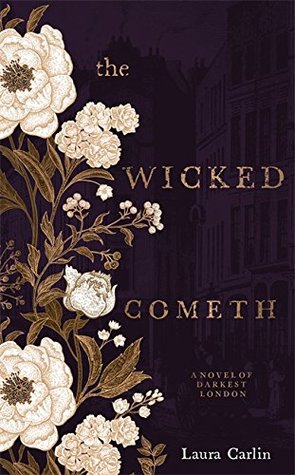
The Wicked Cometh by Laura Carlin

With such a beautiful cover and with the enticing subtitle “A novel of darkest London”, Laura Carlin’s The Wicked Cometh was impossible to resist. I was looking forward to reading it but, having seen a mixture of reviews over the last few weeks, some very positive and others less so, by the time I started it my expectations weren’t as high as they had been.

The novel is set in the early 1830s, during the reign of William IV, and opens with The Morning Herald reporting on the increasing number of men, women and children being declared missing in London. One young woman who has been following the news reports closely is Hester White; she is growing concerned about her cousin Edward who had arranged to meet her at Smithfield three weeks ago and has failed to arrive. Hester’s life has not been easy since the death of her parents a few years earlier; finding herself alone in the world she has been living with her father’s former gardener, Jacob, and his wife, Meg. Their home is a London slum, very different from the parsonage in rural Lincolnshire where Hester grew up, and she has been hoping that Edward can offer her an opportunity to start a new life away from the city.

When Hester is knocked down and injured by a carriage belonging to Calder Brock, suddenly another way of escape presents itself. Calder, who is a doctor, takes her to his family’s country estate, Waterford Hall, to recuperate, and explains to her that he would like her to stay and be educated by his sister Rebekah. With his interest in social reform, he hopes this experiment will show that even those from the poorest slums are capable of learning and improving themselves. Hester can already read and write, but is happy to pretend otherwise to avoid having to go back to Jacob and Meg. And so her lessons with Rebekah begin and a special friendship starts to form…

Everything I’ve described so far happens in the first half of the book and up to that point I found that I was really enjoying it. I liked Hester and although present tense first-person narration isn’t my favourite, her voice was strong and compelling. Her relationship with Rebekah felt natural and right, and I was pleased that it took time to develop. I was curious about the disappearances in London too and wanted to know more.

Then, in the middle of the book, there was a change of pace. As Hester and Rebekah began to investigate and uncover the truth, I felt that the author was trying too hard to incorporate every possible trope of the 19th century sensation novel, from family secrets to hidden documents to clandestine marriages. The story began to feel very melodramatic and contrived and lost its effectiveness. There were aspects of the plot that reminded me of Fingersmith by Sarah Waters, as well as one or two developments that made me think of The Woman in White, and I suspect that if I hadn’t read so many similar books I would probably have enjoyed this one a lot more. This was a particular problem at the very end of the novel where something which should have been a big surprise was too easy to predict.

I did like Laura Carlin’s writing and the atmosphere she creates; The Wicked Cometh is already receiving a lot of attention and as a debut novelist I’m sure she has a successful career ahead of her. For me, though, this is a novel of two very different halves. Some readers will prefer, as I did, the slow scene-setting of the first half and others the dramatic revelations of the second. If it sounds like your sort of book, give it a try – maybe you’ll love it more than I did!

Thanks to Hodder and Stoughton for providing a copy of this book for review via NetGalley.

My Commonplace Book: January 2018

A selection of words and pictures to represent January’s reading:

commonplace book
noun
a book into which notable extracts from other works are copied for personal use.

~

It dawned on me then that I stood at the junction of two cultures which were still struggling to come to terms with each other two hundred years on. Australia – and I – were only young and trying to work ourselves out. We were making progress, but then making mistakes, because we didn’t have centuries of wisdom and the experience of age to guide us.

The Pearl Sister by Lucinda Riley (2017)

~

“‘Tis you who are kind, Phibae. In truth, you know me so little, and yet you have done this. I have seen so much that is wicked this past year, but when there are people such as you…the compassion you show – truly, it humbles.”

“No, my lady.” Phibae glanced up. “‘Tis only how people should be.”

Traitor by David Hingley (2018)

~

Mermaids, by Jean Francis Aubertin (circa 1920)

We fill their minds even when we are far away. They fancy they see us even when they do not. They tell one another stories about us.
The stories are of men who, walking on the shore, hear sweet voices far away, see a soft white back turned to them, and – heedless of looming clouds and creaking winds – forget their children’s hands and the click of their wives’ needles, all for the sake of the half-seen face behind a tumble of gale-tossed greenish hair.

The Mermaid and Mrs Hancock by Imogen Hermes Gowar (2018)

~

“My dear Miss Gregory,” said Syme gently, “there are many kinds of sincerity and insincerity. When you say ‘thank you’ for the salt, do you mean what you say? No. When you say ‘the world is round,’ do you mean what you say? No. It is true, but you don’t mean it. Now, sometimes a man like your brother really finds a thing he does mean. It may be only a half-truth, quarter-truth, tenth-truth; but then he says more than he means – from sheer force of meaning it.”

The Man Who Was Thursday by GK Chesterton (1908)

~

“Oh, yes, slums,” said Adelaide.

Agatha Yates groaned. “Please don’t call them that. They’re Courts, or Mews, or Alleys. It’s like calling people ‘the poor’ instead of by their names. That’s the whole point of our method – dealing with people individually. And it’s working.”

Britannia Mews by Margery Sharp (1946)

~

“Vasya,” he said again, low and – almost ragged, into her ear. “Perhaps I am not so wise as you would have me, for all my years in this world. I do not know what you should choose. Every time you take one path, you must live with the memory of the other: of a life left unchosen. Decide as seems best, one course or the other; each way will have its bitter with its sweet.”

The Girl in the Tower by Katherine Arden (2017)

~

James Scott, Duke of Monmouth and Buccleuch by William Wissing

“Not necessarily. I think that learning is essential for everyone – rich, poor, male, female – because it’s only through books that most people can discover the world, and be shaken out of all their prejudices and complacencies and forced to think for themselves. And of course, people who form their own opinions are not always welcome to those who govern them – or to the churches.” His face became suddenly serious. “I believe in tolerance above all, and freedom. I don’t want anyone, whether priest or parson or presbyter, telling me how to think or where to worship. My beliefs are my own business…”

A Falling Star by Pamela Belle (1990)

~

Perhaps sometimes we allow life to suppress us, let our pride be eroded. Perhaps it is a state of our own consciousness, not truly driven by circumstances at all, simply a gradual shifting of the sands as life’s sorrows swell and break over us. Then something changes – the meeting of a kindred spirit, the potency of mutual trust – and the tender graces of self-belief once more visit themselves upon us and we are as complete as ever we may be.

The Wicked Cometh by Laura Carlin (2018)

~

He paused a moment; his soul was full of an agreeable feeling and of a lively disposition to express it. His sister, to his spiritual vision, was always like the lunar disk when only a part of it is lighted. The shadow on this bright surface seemed to him to expand and to contract; but whatever its proportions, he always appreciated the moonlight.

The Europeans by Henry James (1878)

~

The Court of the Lions, Alhambra, Granada.

The Alhambra was lovely, that much was true: it had been the scene of many atrocities, yet the serene pillars and elegant towers, oblivious to all the blood spilled, soared away from it into the night, indifferent to the sufferings of mere men. These buildings would outlive us all, I thought.

Court of Lions by Jane Johnson (2017)

~

Favourite books read in January:
The Girl in the Tower, Britannia Mews, A Falling Star

Where did my reading take me in January?
Spain, Australia, Thailand, Russia, USA, England

Authors read for the first time in January:
Laura Carlin, Imogen Hermes Gowar, Henry James, David Hingley

~

Have you read any of these books? What have you been reading in January?