 I was drawn to this book first by the cover – and then by the mention of Russian fairy tales and folklore. It seemed a little bit different from the usual books I read and I hoped it would prove to be an enchanting, magical read, perfect for the winter months.
The story is set in the 14th century in Lesnaya Zemlya, a village in northern Rus’. The village is home to Pyotr Vladimirovich who, since losing his beloved wife in childbirth several years earlier, has lived alone with his five children and their elderly nurse, Dunya. The youngest child, Vasilisa (or Vasya, as she is known), is becoming wild and rebellious and it is partly because of the need to provide a mother figure for her that Pyotr decides to marry again. Unfortunately, though, his new wife – Anna – turns out to be a wicked stepmother who dislikes and distrusts Vasya and believes she can see demons hiding all over the house.
Vasya, who has inherited special abilities from her mother, can also see Anna’s ‘demons’, but she knows that they are not evil spirits – they are household guardians watching over the people of Lesnaya Zemlya. When Father Konstantin arrives in the village, believing he is on a mission from God to stamp out the old traditions and beliefs, the powers of the household spirits begin to fade. Harvests start to fail, winters seem colder and harder than ever before and the evil forces that lurk in the forest grow stronger. Can Vasya find a way to protect her family and restore happiness and prosperity to the village?
The Bear and the Nightingale is a story steeped in Russian myth, legend and fairy tale. Although I loved fairy tales as a child, I seem to have missed out on most of the Russian ones, but that wasn’t a problem at all – and I was surprised to discover how much I was actually familiar with. I particularly enjoyed being reminded of the story of Frost which Dunya is telling the children as the novel opens:
“But what did he look like?” Olga demanded.
Dunya shrugged. “As to that, no two tellers agree. Some say he is naught but a cold, crackling breeze whispering among the firs. Others say he is an old man in a sledge, with bright eyes and cold hands. Others say he is like a warrior in his prime, but robed all in white, with weapons of ice. No one knows.”
Frost, or Morozko to give him his Russian name, is an important presence throughout the whole novel, although he only appears to the characters on a few occasions and we are made to wait until near the end of the book before his true significance becomes clear. Other aspects of the story are slow to unfold too – such as the role of the Bear and Nightingale of the title – which is why I’m not going to say any more about the plot or the characters, even though I would love to! I would prefer to leave some of the novel’s secrets and surprises for you to discover for yourself.
What I will mention is the setting, which I loved. Most of the action takes place in and around Vasya’s village, with lots of vivid descriptions of the harsh living conditions and the bleak, relentless winter weather, but there are also a few sections set in Moscow at the court of the Grand Prince Ivan II. I have very little knowledge of 14th century Russia (or Rus’, as the region was known at that time) so I wasn’t sure how much of this was based on fact, but as this is historical fantasy I tried not to worry too much about that. I was more interested in the portrayal of the conflict between the old ways and the new, the changing beliefs of the people and the loss of old traditions.
The Bear and the Nightingale is apparently the first in a trilogy – I hadn’t been aware of this when I first started to read, but on reaching the end of the book I was happy to discover that there will be another two and that the next one will take us away from the forests of Rus’ and into medieval Moscow. I hope we won’t have to wait too long for it as I’m looking forward to it already!
Thanks to the publisher Del Rey for providing a copy of this book via NetGalley for review.


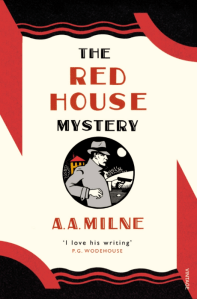 I don’t think I would have ever read The Red House Mystery if it hadn’t been for seeing other bloggers reading and reviewing it. I had always thought of A.A. Milne solely as the author of the Winnie the Pooh stories and it had never occurred to me to wonder what else he had written. It turns out that The Red House Mystery, originally published in 1922, was his first and only detective novel – which is a shame, because it’s excellent.
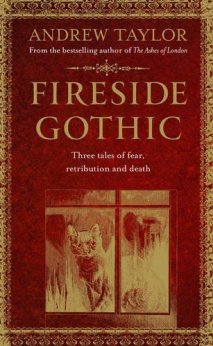 Having read and enjoyed some of Andrew Taylor’s historical crime novels, I was immediately intrigued when I heard about Fireside Gothic, a hardback collection of three novellas which had originally been published separately in ebook form as ‘Kindle Singles’. The stories are all quite different but, as Taylor says in his author’s note, they do share some common themes.
 My first introduction to Margery Sharp’s work came this time last year when I read
 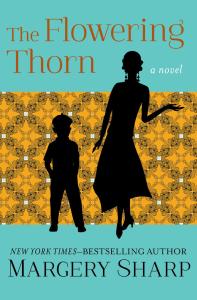 The Flowering Thorn introduces us to Lesley Frewen, a twenty-eight-year-old socialite living in London. Lesley’s days and nights are a whirl of bridge parties, lunch engagements, shopping trips, hair appointments and visits to matinees and art exhibitions. Despite all of this, there’s still something missing from her life: love. Having discovered that the one man she really wants appears to be the one man she can’t have, Lesley is still in low spirits when she joins her aunt for afternoon tea the next day. This could explain why, when her aunt introduces her to Patrick, the orphaned child of a servant who has recently died, Lesley finds herself volunteering to adopt the boy.

 She Reads Novels