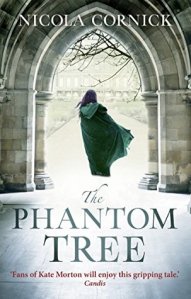
 I have always found the concept of time-travel fascinating – and equally fascinating are the number of ways in which various authors choose to approach the subject when writing time-travel fiction. The Phantom Tree is one of many dual time period time-slip novels I have read over the last few years, but I found it refreshingly different in that it deals not with the usual idea of a modern day character going back in time but a woman from the past coming forward to the present time.
The name of our time traveller is Alison Bannister (or Banastre, as she was known in her previous life) and she has been trapped in the 21st century for ten years, unable to find a way to get back. We first meet Alison walking through the streets of Marlborough one day just before Christmas. Stopping to look through the window of an art gallery, she is surprised to see a painting of a woman she once knew. Investigating further, she learns that this is apparently a newly discovered portrait of Anne Boleyn – but she’s sure it isn’t; it’s Mary Seymour, who lived with Alison at Wolf Hall in the 1500s. To complicate things further, the historian hoping to build his career around the discovery of Anne Boleyn’s portrait is Adam Hewer, Alison’s ex-boyfriend. Without telling him the truth about her journey through time, how can she convince him that he’s wrong?
The historical sections of the novel are written mainly from Mary Seymour’s perspective. Unlike Alison, who is fictional, Mary is a real historical figure – but one whose story has been lost in the mists of time. Mary is the daughter of Henry VIII’s sixth wife, Katherine Parr, and Thomas Seymour, whom Katherine married following Henry’s death. Katherine dies shortly after giving birth and Thomas is executed a year later, leaving Mary an orphan in the care of the Duchess of Suffolk. Mary disappears from historical records in 1550, but Nicola Cornick suggests that she was sent to live with her Seymour cousins at Wolf Hall. This allows plenty of scope to create a storyline for Mary which is both imaginary and historically plausible.
Of the two time periods, I found the sections set in the past more interesting – in particular, I enjoyed the supernatural elements of Mary’s story. Almost from the moment she arrives at Wolf Hall rumours begin to circulate that she is a witch, especially after she has a vision which seems to come true. She also has a telepathic connection with a secret friend called Darrell and this reminded me instantly of Mary Stewart’s Touch Not the Cat, (which may have been intentional, as Darrell’s nickname for Mary is ‘Cat’).
The present day story was enjoyable too, though. I couldn’t help thinking that Alison had adapted remarkably quickly to modern life, which wasn’t at all convincing, but otherwise I was kept entertained by her attempts to find a gateway back to her own time and to decipher a set of clues sent by Mary through the centuries.
The Phantom Tree does require disbelief to be suspended on many occasions, which I know is not something that appeals to all readers, but I think anyone who likes reading time-slip novels by authors like Susanna Kearsley or Barbara Erskine should find plenty to enjoy here. I will now be looking out for Nicola Cornick’s previous book, House of Shadows!
Thanks to the publisher for providing a copy of this book via NetGalley for review.
 Well, it may be only January but I think I already know one book which will be appearing on my books of the year list this December! Having read and enjoyed all of Alexandre Dumas’ d’Artagnan novels over the last few years (beginning with a re-read of

 Night’s Dark Secrets (first published in 1936 as The Golden Violet, The Story of a Lady Novelist) was the first of the two books that I read. The novel opens with the marriage of Angel Cowley, an author of romance novels, to Thomas Thicknesse, the owner of a sugar plantation in Jamaica. Angel has been busy preparing her latest novel, The Golden Violet, for serialisation in a magazine, but this has to be postponed when Thomas insists that the newly married couple leave England and return to his plantation, Venables Penn.
 Having said all of that, I did still find the story itself compelling and kept reading to the end. And I was happy to go on to try a second Shearing novel, Forget-Me-Not. This novel, published in 1932, also appeared under the title The Strange Case of Lucile Clery, and Bowen claimed it was based on true events which led to the downfall of Louis Philippe I, King of the French, in the revolution of 1848.
 This is only the second book I’ve read by E.M. Forster – the first one being
 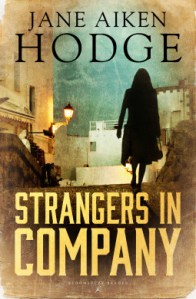 Published in 1973, Strangers in Company reminds me of Mary Stewart’s romantic suspense novels, or maybe M.M. Kaye’s Death In… series. It is set in Greece and follows the story of Marian Frenche, who is looking for a new job after finding herself at a loose end when her children move away to live with her ex-husband. Marian finds work with an agency who arrange for her to accompany a troubled young woman called Stella Marten on a coach tour of the major Greek archaeological sites. She is given very little information about Stella and her background, apart from a warning that she should be left on her own as little as possible, but after only a few hours in Stella’s company, Marian finds her to be rude, angry and irritable. It’s going to be a difficult trip!

 This is the third book in Lucinda Riley’s Seven Sisters series based loosely on the mythology of the Pleiades (or ‘seven sisters’) star cluster. There will eventually be seven novels each telling the story of one of the adopted daughters of an enigmatic millionaire known as Pa Salt. The girls, who are all from very different backgrounds and who grew up together in Switzerland on Pa Salt’s Lake Geneva estate, are named after the stars in the cluster – Maia, Alycone (Ally), Asterope (Star), Celaeno (CeCe), Taygete (Tiggy) and Electra. There should have been a seventh sister, whose name would have been Merope, but for some reason which has not yet been revealed only six girls were adopted rather than seven.
 She Reads Novels