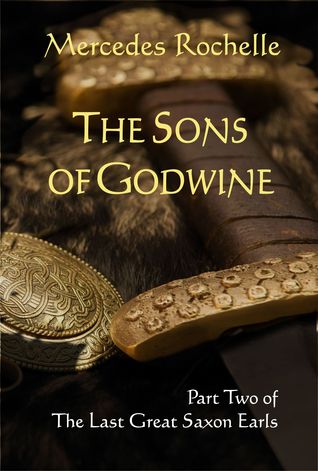
 This is the second of Mercedes Rochelle’s Last Great Saxon Earls novels which tell the story of the Godwinesons in the years leading up to the Norman Conquest. The first book, Godwine Kingmaker, follows Godwine, Earl of Wessex, as he rises to become one of the most powerful men in 11th century England. In this second novel we get to know the Earl’s family as his children take turns to narrate their own stories, each from his or her own unique viewpoint.
We begin with a prologue in which Queen Editha, daughter of Godwine and wife of Edward the Confessor, explains that the book she commissioned on the life of her husband – the famous Vita Ædwardi Regis – was originally intended to be a history of her own family and that she had asked her brothers to write down their memories to be included in the manuscript. The Sons of Godwine is presented as a collection of the brothers’ memoirs (fictional but based closely on historical fact).
Editha’s brother, Harold – the future King Harold II of England – is naturally the most famous member of the family and much of the novel revolves around him, but we also hear from Tostig, Gyrth, Leofwine and Wulfnoth (though not from the eldest brother, Swegn) and through their alternating narratives the story of the sons of Godwine gradually unfolds.
Having read several other novels set during this period over the last year or two I feel that I’m beginning to know and understand it (though not as well as other periods, such as the Tudors or the Wars of the Roses). The Sons of Godwine takes us through all of the famous events and incidents of the time, including Harold’s marriage to Edith Swanneck, Swegn’s abduction of the Abbess of Leominster, and the violence in Godwine’s town of Dover during the visit of Eustace of Boulogne. These are all things that have been written about before, but what makes this book different is that we hear about them or see them happen through the eyes and ears of the Godwinesons themselves. I really liked this approach as it made the story feel more intimate and personal; the only problem was that there didn’t seem to be much difference between the narrative voices of the brothers.
As I’ve mentioned, Harold is given a lot of attention, but the other brothers have interesting stories of their own too, especially Tostig, who is made Earl of Northumbria, and Wulfnoth, held hostage by first King Edward and then by William, Duke of Normandy. They also each offer a different perspective on Harold’s character, viewing him with a mixture of admiration, irritation and envy. There is a particularly intense rivalry between Harold and Tostig, which slowly grows throughout the novel. Their relationship is going to be explored further in the third book in this series – Fatal Rivalry.
Thanks to the author for providing a review copy of this book.






 She Reads Novels