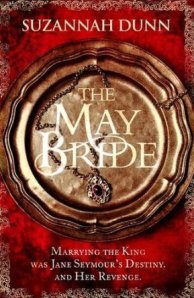
The May Bride by Suzannah Dunn

The May Bride One day in May 1536, Jane Seymour became Henry VIII’s third wife – but she is not the only May bride in Suzannah Dunn’s new novel. The other is Katherine Filliol, the wife of Jane’s elder brother, Edward. Jane is only fifteen when Edward first brings Katherine to Wolf Hall, the Seymour family home, and she is instantly captivated by her beautiful new sister-in-law. Jane and Katherine become close friends – or so Jane thinks, but gradually she discovers that Katherine has been keeping secrets from her and that her marriage to Edward may not be as perfect as it first appeared.

I had my doubts about this book before I started reading it because I had tried to read another of Dunn’s books a few years ago, The Confession of Katherine Howard, and didn’t get very far with it before giving up, not having connected with the writing style or the characters at all. I wondered if I would have the same experience with this book, but luckily that didn’t happen; I found this one much more enjoyable and easier to get into.

I’ve read a lot of novels set during the Tudor period, but this one is slightly different, for several reasons. First, it is a very domestic story, being set almost entirely at Wolf Hall with only the final, shortest section of the book covering Jane’s time at court as lady-in-waiting to Katherine of Aragon and Anne Boleyn. Until that last section there are so few mentions of politics, court intrigues or famous people of the period (apart from the Seymours themselves) that it could almost have been a story about any other wealthy Tudor family going about their daily lives.

I also found it intriguing that although Jane is the most famous Seymour and the one who is narrating, this novel is actually about Katherine Filliol as much as it is about Jane. I didn’t know anything about Katherine before reading the book and although Suzannah Dunn admits in her author’s note that there is very little historical information available on Katherine (and no record of what eventually happened to her) I still appreciated the fact that she had chosen to focus on a little-known character who is not usually the subject of historical fiction.

Finally, this book is written in a style that feels very modern and there is no real attempt to use language appropriate to the period. This is something that usually irritates me, but in this case I think it actually worked quite well once I got used to it. Because this is a family drama, with the emphasis on exploring the relationships between Katherine, Jane and the other Seymours, the fresh and contemporary feel made it easy to identify with the characters. I thought Jane’s brothers, Edward and Thomas, with their very different personalities, were particularly well drawn.

Compared with some of Henry VIII’s other wives, Jane Seymour as queen is often portrayed as quiet and uninteresting but here the young Jane comes to life as a loyal and loving person who is able to see the best in everyone. Unfortunately I didn’t share her fascination with Katherine, but I suppose that’s because I was able to pick up on clues and nuances that wouldn’t have been obvious to an innocent fifteen-year-old girl who is dazzled and enchanted by her new friend.

Although I maybe haven’t learned as much about Jane as I would have done from a more conventional historical novel, I did enjoy reading about her early life and the experiences that shaped the woman and queen she would become.

I received a copy of this book for review from the publisher via NetGalley
And my Classics Club Spin book is…

The Classics Club

Number 1

Last week I decided to take part in the sixth Classics Club Spin. The rules were simple – list twenty books from your Classics Club list, number them 1 to 20, and the number announced today (Monday) represents the book you have to read before 7th July 2014.

The number that has been selected is 1, which means the book I’ll be reading is:

The Mayor of Casterbridge

The Mayor of Casterbridge by Thomas Hardy

I’m happy with this. There were some other titles on my list that I would have preferred, but I do love Thomas Hardy and I haven’t read any of his books for a while.

If you participated in the spin too, were you pleased with your result?

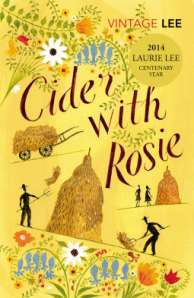
Cider with Rosie by Laurie Lee

Cider with Rosie Laurie Lee was a British novelist and poet most famous for his autobiographical trilogy which begins with Cider with Rosie and continues with As I Walked Out One Midsummer Morning and A Moment of War. Published in 1959, this first volume looks back on Lee’s childhood in the small Cotswold village of Slad in Gloucestershire. Lee moved there at the age of three with his mother and siblings at the end of the First World War. In Cider with Rosie he writes about his family and friends, his school days and the eccentric characters who lived and worked in Slad.

I had never considered reading this book until now, partly because it reminded me of being at school (we never actually read the whole book, but I remember having to study excerpts from it for English comprehension exercises) and I think that was enough to put me off! The scene that I particularly remembered was the one where Laurie’s sisters send him off for his first day at school wrapped in scarves with a hot potato in his pocket. When he comes home he tells the family about his disappointing day:

“They never gave me the present!”
“Present? What present?”
“They said they’d give me a present.”
“Well, now, I’m sure they didn’t.”
“They did! They said: ‘You’re Laurie Lee, ain’t you? Well, just you sit there for the present.’ I sat there all day but I never got it. I ain’t going back there again!”

I’m glad I waited until now to read this book, as I don’t think I would have appreciated it when I was younger. It’s not the most exciting book to read – it doesn’t seem that anything particularly dramatic happened to Lee in his early years and being an autobiographical work (or semi-autobiographical, as Lee admits at the start that “this is a recollection of early boyhood and some of the facts may be distorted by time”), it is not a book with a ‘story’ or a plot. However, it is still worth reading for the beauty of Lee’s descriptions and imagery and because it paints a portrait of a world that has gone and will never come back again.

The book has quite an interesting structure with each chapter devoted to a different theme with titles such as ‘Village School’, ‘The Kitchen’ and ‘Mother’. Laurie does age gradually throughout the book, so that the earlier chapters are seen through the innocent eyes of a small child and the later ones are more mature (including the famous scene drinking cider under a hay wagon with the Rosie of the title), but otherwise the book doesn’t follow strict chronological order.

Some chapters are more enjoyable than others (I loved ‘Grannies in the Wainscot’, which describes two of the Lees’ elderly neighbours) but my favourite is actually the final chapter, which shows how life in the village starts to change with the coming of progress. With the arrival in Slad of cars and electricity, for example, the world suddenly becomes a different place and the simple life Laurie Lee has always known begins to disappear forever.

Cider with Rosie has been reissued by Vintage Classics in a beautiful new edition and I received a copy for review via NetGalley. The book includes drawings by John Ward and although I don’t think you really get the full benefit of them when you’re reading an ebook version, it’s always nice to see illustrations!

The Gondola Maker by Laura Morelli

The Gondola Maker The Gondola Maker is set in Venice in the 16th century and tells the story of Luca Vianello, the son of a gondola maker. As the novel opens in 1581, Luca’s future seems secure – he will marry Annalisa Bonfante, the blacksmith’s daughter, and on his father’s death he will inherit the family business. However, when a tragedy unexpectedly tears the Vianello family apart, Luca is forced to leave the squero (boatyard) behind to seek a new life and career for himself.

I was lucky enough to visit Venice for the first time last year and reading The Gondola Maker reminded me of what a beautiful, unique city it is and how I would love to go again. The author’s descriptions are so vivid that whether or not you’ve been to Venice you’ll be able to picture the grand palazzos of the rich merchants and noblemen lining the Grand Canal, the sun setting behind the basilica of San Marco, the view across the lagoon to the island of San Giorgio Maggiore, and the inside of a prison cell in the Doge’s palace.

Being a novel about a family of gondola makers, it’s no surprise that we are given lots of information on the art of gondola making. And it really is an art! As we accompany Luca on a mission to restore one of his grandfather’s old gondolas, we see how many different people are involved in the process, from the remèri who make the oars and the fórcole (rowlocks which secure the oar) to the blacksmiths who construct the ferri (the metal decorations at the prow). Each of these artists pours their skill, knowledge and love into their work so that each complete gondola is an object of beauty and perfection.

This was all much more interesting to read about than I had expected, but of course there is more to this story than just the making of boats. While it’s true that most of Luca’s time is spent among fellow craftsmen and gondoliers, after he leaves the family squero his adventures also bring him into contact with a successful portrait painter, a maker of costumes for balls and carnivals, and a beautiful young woman who becomes his love interest. Luca himself is a character I found easy to like, which is fortunate as he is narrating his story in the first person, meaning we spend the entire novel in his company.

This is not a particularly fast-paced book and Luca’s story is not always very dramatic, but despite this I did enjoy The Gondola Maker. I found the ending of the book too abrupt and the conclusion of the romantic storyline wasn’t very satisfying which was a bit disappointing, but this didn’t spoil the rest of the novel for me. It was good to have an opportunity to learn about the creation of gondolas, a subject I had never read about or even thought about before – and I loved visiting Venice again, albeit through fiction this time, instead of in person!

1-iRead Button small(1) I read The Gondola Maker as part of an iRead Book Tour. For more reviews, interviews and giveaways please see the tour schedule.

The Classics Club Spin #6 – My list

The Classics Club

I was hoping the Classics Club would be hosting another spin this month as I haven’t been making much progress with my Classics Club list recently, so today’s announcement couldn’t have been more welcome!

Here are the rules:

* List any twenty books you have left to read from your Classics Club list.
* Number them from 1 to 20.
* Next Monday (May 12th) the Classics Club will announce a number.
* This is the book you need to read during May and June!

And here is my Spin List:

1. The Mayor of Casterbridge by Thomas Hardy
2. Family Roundabout by Richmal Crompton
3. A Country Doctor’s Notebook by Mikhail Bulgakov
4. The Day of the Triffids by John Wyndham
5. The Vicomte de Bragelonne by Alexandre Dumas
6. The Heir of Redclyffe by Charlotte M. Yonge
7. The Hunchback of Notre Dame by Victor Hugo
8. The Idiot by Fyodor Dostoevsky
9. The Cloister and the Hearth by Charles Reade
10. The Remains of the Day by Kazuo Ishiguro
11. The Glass-Blowers by Daphne du Maurier
12. Around the World in Eighty Days by Jules Verne
13. The Sea Hawk by Rafael Sabatini
14. David Copperfield by Charles Dickens
15. Excellent Women by Barbara Pym
16. Romola by George Eliot
17. Lorna Doone by R.D. Blackmore
18. The Charterhouse of Parma by Stendhal
19. The Leopard by Giuseppe Tomasi di Lampedusa
20. Vanity Fair by William Makepeace Thackeray

I can’t wait for next Monday to find out which book I’ll be reading! Are there any numbers you think I should be hoping for – or hoping to avoid?

Americanah by Chimamanda Ngozi Adichie

Americanah Americanah is the story of Ifemelu and Obinze, two Nigerian people who have very different experiences of immigration. Ifemelu leaves Nigeria as a young woman to complete her studies in America. Thirteen years later she is still there, having established a successful career for herself as a blogger, but she has now made the decision to go home. Before she returns to Lagos, Ifemelu goes to an African hair salon in Trenton, New Jersey, to have her hair braided – a process which takes six hours, giving her time to reflect on all the things she has learned and observed during her years in America.

Obinze, who was Ifemelu’s boyfriend before she left Nigeria, also has dreams of going to America but is unable to obtain a visa and ends up working in London as an illegal immigrant. Obinze and Ifemelu are eventually reunited in Lagos, but will their love have survived so many years of separation?

As promised on the book cover, there is a love story to be found in Americanah, but this is not the main focus of the novel. The focus is on Ifemelu and her life in America, with several chapters following Obinze and his experiences in England. On arriving in the country that will be her home for the next thirteen years, Ifemelu faces a lot of challenges and difficulties, ranging from finding a job to learning how to cook hot dogs! She has many encounters with examples of racism (sometimes very subtle and sometimes much more obvious) and at the other end of the scale, people who are trying too hard to avoid talking about race because they’re afraid that they might cause offence. All of this gives Ifemelu plenty of material for her blog, which she calls Raceteenth, or Various Observations About American Blacks (Those Formerly Known as Negroes) by a Non-­American Black.

Some excerpts from Ifemelu’s blog posts are included in the book and are fascinating to read, particularly when she writes about the differences between being a black American and a non-American black person. Something I found interesting was Ifemelu’s comment that “I came from a country where race was not an issue; I did not think of myself as black and I only became black when I came to America.” This is in contrast to her cousin, Dike, who leaves Nigeria with his mother as a very young child and so has a very different perspective on life.

While I didn’t love Americanah quite as much as I’d hoped to, it was full of insightful observations and it’s a book that I would recommend to everyone, whatever your race, nationality or skin colour. As a white person, I confess that many of the aspects of race discussed in the novel are things that have never even occurred to me. So, as a commentary on race and immigration, I thought this book was excellent – the best I’ve read on these subjects. The various devices Adichie uses (blog posts, discussions at dinner parties, the conversations of the women working in the hair salon) give her an opportunity to explore important issues in an interesting and often witty way rather than just lecturing the reader.

Purely as a novel, though, I thought Americanah was less successful. It felt a lot longer than it really needed to be, considering the plot is not a particularly complex one, and while I was interested in following Ifemelu’s and Obinze’s separate storylines, I found I didn’t really care whether they got back together at the end of the book or not. I think for me personally this is a book I enjoyed on an intellectual level rather than an emotional one, which is not necessarily a negative thing, but probably the reason why, of the two books I’ve now read by Adichie, I prefer Half of a Yellow Sun to this one.

Madame Bovary by Gustave Flaubert

Madame Bovary I read Madame Bovary during April as part of a readalong hosted by Juliana of Cedar Station and CJ of ebookclassics. It was a book I’d been thinking about reading for a while anyway so the announcement of the readalong couldn’t have come at a better time for me.

Madame Bovary is a French realist novel published in 1856. The title character, Emma Bovary, longs to experience the drama and excitement she has read about in romantic novels but she is unlikely to find it in her marriage to Charles Bovary, an unambitious country doctor. Charles loves his wife and is not unkind to her, but Emma finds him boring and her life dull and meaningless. After she and Charles attend a ball hosted by the Marquis d’Andervilliers, Emma becomes depressed and miserable; she has had a glimpse of a more glamorous world and it has left her even more disillusioned and dissatisfied with her own situation.

Charles wonders whether a move to a larger town will make her happy but Emma is no more content in their new home in Yonville-l’Abbaye than she was in the small village they’ve left behind. Seeking an escape from her unhappy existence, Emma has affairs and spends money she can’t afford, but as she becomes more reckless in both her romantic and financial entanglements, her life begins to spiral out of control.

It has been interesting to read the opinions of other readalong participants, because while I think we all agree that Emma’s behaviour is silly and self-destructive, the amount of sympathy we have for her seems to vary widely. Some readers can relate to Emma and admire her for doing something to try to change her life and find some happiness; other readers find her very selfish and annoying.

I’m one of those readers who didn’t like Emma at all, though I did have some pity for her, because I know there weren’t many options open to women in the 19th century, particularly those living in provincial areas, who wanted more from life than just to be a wife and mother. I can see why she may have felt that adultery was a way of escape and a way to find the passion she’d read about in books. I thought it was sad that Emma couldn’t even take any pleasure in her daughter (when Berthe is born, her first emotion is disappointment that the baby isn’t a boy). Later, when Berthe comes up to her hoping for affection Emma pushes the little girl away so that she falls and hurts herself. Poor Berthe – and life doesn’t get any better for her later in the book either.

I don’t think Charles was entirely blameless as he could have made more effort to understand his wife’s feelings and he was so naïve that he seemed completely oblivious to what was going on, but my sympathy was definitely with him and with Berthe more than with Emma. I noticed, though, that Flaubert himself seems to stay neutral throughout the novel, reporting on his characters’ thoughts and actions without actually passing judgment on them and telling us what we should think.

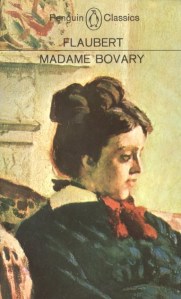
There were parts of this book that I really enjoyed, but I’ll have to be honest and say that much as I wanted to love this book I just didn’t. I think my dislike of Emma was part of the problem, but not the whole problem, as I didn’t find the writing style very engaging either. The version of Madame Bovary that I read was an older Penguin edition (pictured above) translated by Alan Russell – I had no reason for choosing this translation other than that it happened to be the one I already had on my shelf, which seemed as good a reason as any. I didn’t really have any problems with it and found it easy enough to read, but having since read that Flaubert prided himself on always searching for the perfect word, in this case it’s possible that the translation did affect my enjoyment. I didn’t like the book enough to want to read it again in a different translation to find out, though!

While this has not become a favourite classic, I’m still glad I’ve read it. If nothing else, I can now see where Mary Elizabeth Braddon’s inspiration for her novel The Doctor’s Wife came from!