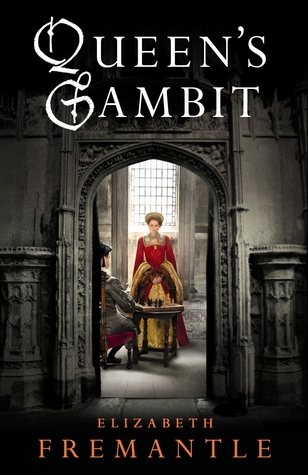
 So many novels have been written about the six wives of Henry VIII I wasn’t sure if I really wanted to read another one. Queen’s Gambit seemed to be getting such good reviews, though, so I thought I would give it a chance. I was intrigued by the comparisons to both Philippa Gregory and Hilary Mantel, two very different authors, (though now that I’ve read it, I can tell you I found it more similar to the former than the latter) and I also liked the fact that, at least with this edition, the publisher has avoided the usual front cover image of a ‘headless/faceless woman in a pretty dress’ which most recent Tudor court novels seem to have.
Queen’s Gambit tells the story of Katherine Parr. If you’re familiar with the rhyme used to remember the fates of Henry VIII’s six wives (Divorced, beheaded, died; divorced, beheaded, survived), Katherine Parr was the sixth and final wife – the one who ‘survived’. While Katherine’s story may not have been covered in historical fiction as often as some of the other wives, particularly Anne Boleyn, I have read about her before so already knew the basic facts about her life.
Katherine comes to the court of Henry VIII after her husband Lord Latimer dies leaving her a widow for the second time at the age of thirty-one. Soon after her arrival, she falls in love with Thomas Seymour, one of the brothers of the late queen, Jane Seymour. However, Katherine has also caught the eye of the King, who plans to make her his sixth wife. By this stage of his life, Henry is no longer the handsome prince he once was: he has grown fat, he’s suffering from an ulcerated leg, and added to the fact that his previous wives have met such unhappy fates, Katherine has no desire to marry him. She doesn’t dare defy the King’s wishes and accepts his proposal of marriage, but during the years that follow she is unable to forget Thomas Seymour, even after he is sent away from court on a diplomatic mission. Meanwhile, life at court is growing increasingly dangerous for Katherine and as she becomes more deeply involved in the reformed religion she realises that she needs to be very careful if she’s going to survive.
This story is told from two very different perspectives: one is Katherine’s and the other is Dorothy Fownten’s. Katherine is a dignified, mature and intelligent person which makes her easy to like and sympathise with as she learns to cope with life in the treacherous, unpredictable Tudor court, never being sure who can and cannot be trusted, and knowing that two of her predecessors have already lost their heads. Dorothy, known as Dot, is Katherine’s maid and while Katherine moves in the innermost circles at court, Dot is on the outside and can take a more observant and unbiased view of things. I liked both women but I found Dot a more engaging character. Having read a few books about Katherine now, I don’t think she’s really a great subject for historical fiction – there are a lot of other queens’ lives that are much more dramatic and interesting to read about – so some of my favourite parts of the book were actually those that concentrated on Dot’s personal story rather than Katherine’s. When I read the author’s note at the end I was surprised to discover that there really was a maid of that name who served Katherine Parr, though the way she is portrayed in the book is largely fictional.
Another character I enjoyed reading about was Dr Robert Huicke, the King’s physician who becomes a good friend of Katherine’s. Through Huicke we also meet Nicholas Udall, the playwright most famous for writing one of the first English comedies, Ralph Roister Doister. Huicke’s relationship with Udall, as well as his friendship with Katherine, adds another interesting angle to the story.
As I mentioned at the start of this post, I thought this book felt more like a Philippa Gregory novel than a Hilary Mantel and I don’t think the comparisons with Wolf Hall are justified, but I did still enjoy it. Queen’s Gambit is apparently the first in a Tudor trilogy – the second one will explore the lives of Lady Jane Grey’s two sisters, Catherine and Mary, and the third is going to be set in the Elizabethan court. I’m looking forward to reading both.
I received a copy of this book through Netgalley for review.






 She Reads Novels