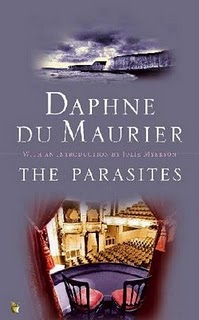
The Parasites by Daphne du Maurier

After reading the first few chapters of Daphne du Maurier’s The Parasites I had a feeling I wasn’t going to enjoy this book. I was finding the story very difficult to get into and I didn’t like any of the characters. But because Du Maurier is one of my favourite authors I decided I didn’t want to give up on the book just yet…and guess what? I ended up loving it! I should have known Daphne wouldn’t let me down.

The Parasites is a study into the lives of the Delaney family: Mama, a famous dancer, and Pappy, a successful singer, and their three children, Maria, Niall and Celia. The story begins one day in the 1940s when Niall and Celia, now adults, are spending the weekend at the home of Maria and her husband, Charles. It’s Charles, losing his temper with them, who refers to the three siblings as ‘parasites’…

“You always have been and you always will be. Nothing can change you. You are doubly, triply parasitic; first, because you’ve traded ever since childhood on that seed of talent you had the luck to inherit from your fantastic forebears; secondly, because you’ve none of you done a stroke of ordinary honest work in your lives, but batten upon us, the fool public who allow you to exist; and thirdly, because you prey upon each other, the three of you, living in a world of fantasy which you have created for yourselves and which bears no relation to anything in heaven or on earth.”

He then leaves the house in a rage, and Maria, Niall and Celia are left alone to wonder what his words meant and if it’s true that they really are ‘parasites’. Through a series of flashbacks and memories, the Delaneys spend the rest of the novel looking back at their childhoods and the things that turned them into the adults they are today.

One of the striking things about this book was the lack of one distinct narrator. Sometimes the three siblings seem to be narrating together, all speaking with one single voice, which was very unusual. It’s difficult to explain, but if you read the book you’ll see what I mean! As I read, I couldn’t help thinking that Maria, Niall and Celia must represent three different sides to Daphne du Maurier’s own personality; she writes so convincingly about all three characters and really gets inside their heads. And of course, her own father was the actor Gerald du Maurier and her mother the actress Muriel Beaumont, so she would have known what it was like to be the child of famous parents and could bring some of her personal experiences into this novel.

Maria, who becomes a famous actress, and Niall, who finds success as a songwriter, are stepbrother and stepsister and have a very strong bond. In her introduction to the book, Julie Myerson compares Maria and Niall with Cathy and Heathcliff from Wuthering Heights. I don’t think this would have occurred to me, but after it was pointed out I could definitely see the parallels.

Celia is half-sister to the other two, sharing a mother with Niall and a father with Maria. Although she also has a strong bond with them both, Celia often feels left behind. Despite her own talent for drawing and writing, she puts other people before herself and stays at home while her brother and sister go off to pursue their dreams. Of the three main characters in the book Celia was the only one who I liked and understood; some of the chapters where she takes a central role are very moving. I really disliked both Maria and Niall, who seemed to me to be very selfish characters who only ever thought about themselves. I found it difficult to feel any sympathy for either of them.

The Parasites may sound like a very serious novel, but there’s actually a good balance of drama and comedy. Some of the scenes are quite funny – in one of my favourite chapters, the Delaney family visit Charles and his parents at their country estate for the first time after Maria’s wedding and completely embarrass themselves! It was nice to see du Maurier’s sense of humour really shining through in this novel.

There are other du Maurier books that I’ve enjoyed more than this one, but after a slow start The Parasites turned out to be much better than I expected. It reminded me a lot of I’ll Never Be Young Again, one of her earlier novels, which was also very character-driven and personal. If you prefer her gothic, suspense-filled novels you may be disappointed, but if you want to try a different type of du Maurier book then hopefully you’ll enjoy this one as much as I did.

Passion by Jude Morgan

Passion is a historical fiction novel which tells the story of four women and their relationships with the Romantic poets, Byron, Shelley and Keats. There’s Lady Caroline Lamb, a married woman who has an affair with Lord Byron, and Augusta Leigh, his half-sister who also becomes his lover. Then there’s Mary Godwin, future wife of Percy Bysshe Shelley and author of Frankenstein, and finally, Fanny Brawne, John Keats’ fiancée. This long and ambitious book takes us through the lives of all of these characters, describing the passionate and unconventional relationships that scandalised the public during the early years of the 19th century.

Although the book concentrates on the four women I’ve already mentioned, there are several other women who also play an important part in the story. One of these is the writer and feminist Mary Wollstonecraft (Mary Shelley’s mother) and in the prologue we learn a lot about her life and death. We also meet Byron’s wife, Annabella Milbanke, and Claire Clairmont, Mary’s stepsister, who becomes involved with both Byron and Shelley. All of the female characters in the book are portrayed as interesting and complex people in their own right, not just because of the men they loved.

As well as providing information on the historical and political background of the late 18th and early 19th centuries, Morgan also shows exactly what it was like to be a woman living during those times. It was this attention to detail that made me really believe in the story. And he takes us right inside the minds of Mary, Caroline, Augusta and Fanny, imagining what they might have thought and how they might have felt. I thought the characterisation of Lady Caroline Lamb, with her excitable, emotional personality was particularly well done. I also enjoyed reading about Augusta Leigh’s relationship with her half-brother, Byron – the dialogue between them felt completely believable and the scenes where the two of them were together were some of my favourite parts of the book.

At over 600 pages long and with its variety of narrative styles and techniques this is not the easiest of books to read. The story is told from several different perspectives, there are shifts from past to present tense, and from the third person to first person, sometimes with the characters (particularly Caroline) talking directly to the reader. I had an idea of what to expect as I recently read one of Jude Morgan’s other books, The Taste of Sorrow, and although his writing style does take a while to get used to, I really like it.

Of the three poets, Byron comes across as the most charismatic and colourful character, which I expect was also true in real life, but Shelley was fascinating to read about too. He had such interesting ideas about vegetarianism, religion and marriage. Keats, however, doesn’t appear until near the end of the book and although he and Fanny Brawne do take more of a central role in the final chapters, the focus is definitely on the other characters. Keats’ and Fanny’s story felt disconnected from the others and this is the one thing that disappointed me about the book. I do understand though that Keats was slightly younger than Byron and Shelley and their paths didn’t really cross until later, so maybe it would have been difficult to incorporate him into the earlier parts of the book.

The last few chapters are very sad, with one tragedy and death following another. The scenes towards the end of the book which take place in Keats’ house at the bottom of the Spanish Steps in Rome were particularly poignant as I had visited the house a few years ago and so could picture his final days very vividly. (I would highly recommend visiting the Keats-Shelley House to anyone thinking of going to Rome, by the way.)

Although Morgan’s book about the Brontës, The Taste of Sorrow, had more personal appeal for me because I’m more interested in the Brontës than I am in the Romantic poets, I thought this book was equally impressive. Now that I’ve read it and know a lot more about Byron, Shelley and Keats, maybe I should have another attempt at actually reading their poetry!

Winter King: The Dawn of Tudor England by Thomas Penn

Winter King: The Dawn of Tudor England is a biography of Henry VII, England’s first Tudor king – a king of whom Francis Bacon said, “he were a dark prince, and infinitely suspicious, and his times full of secret conspiracies and troubles”.

I previously knew very little about Henry VII and was drawn to this book in the hope that it would be a good introduction to the subject. The book opens with a prologue which details the years of unrest and uncertainty that accompanied the Wars of the Roses and explains how Henry VII came to the throne in 1485. Penn then takes us through all the important moments of Henry’s life and reign, including the marriage of his eldest son Arthur to Catherine of Aragon and Arthur’s subsequent death which led to Henry’s second son (the future Henry VIII) becoming his heir.

Henry VII himself is portrayed as a complex and secretive person, clever and shrewd, manipulative and controlling (especially where money and power are concerned). Something that is emphasised throughout the book is that Henry knew his claim to the throne had not been a strong one and that he went to great lengths to convince his subjects to accept him as a legitimate king of England and to prove to them that the rival houses of York and Lancaster had been reconciled under the Tudor name. Despite his efforts, though, he found himself the constant target of plots and conspiracies. The book goes into a lot of detail in recounting some of these planned rebellions and the reasons why they failed.

As someone who doesn’t read a lot of historical non-fiction and who is not an expert on the Tudors, I still had no problems understanding any part of this book. Although it does require some concentration, I found it a very interesting and absorbing read from beginning to end. For those of you who do already have a good knowledge of Henry’s reign, there might not be anything new here but I’m sure you’ll still find plenty to enjoy. Penn’s descriptions of royal weddings, funerals, court pageants etc are particularly well-written and vivid.

The book is very thorough and detailed, with all sources and references provided in the notes. It’s not what you could describe as a quick and easy read, but it’s still very enjoyable and I would highly recommend it to anyone who is interested in learning about the reign of Henry VII and the early life of his son, Henry VIII. Thomas Penn appears to have stayed objective and resisted the temptation to let his own opinions and theories get in the way of the facts, giving us a balanced and unbiased view of a fascinating period of history. I hope he goes on to write more books as he’s definitely a name to look out for.

I have to admit, before I started reading this book I already had a very negative impression of Henry VII due to the way he is portrayed in novels such as The Sunne in Splendour by Sharon Kay Penman and The Daughter of Time by Josephine Tey. Winter King hasn’t done much to change my opinion of him, but I’m pleased that at least I’ve now had the chance to fill in some of the gaps in my knowledge.

Full Dark House by Christopher Fowler

One of the books I hope to be reading soon for the Transworld Book Group challenge is The Water Room, the second in Christopher Fowler’s Bryant and May series. As I already had a copy of the first in the series waiting to be read and I would prefer not to read them in the wrong order, I decided to read Full Dark House first. And I’m glad I did, because Full Dark House definitely has a ‘first in the series’ feel about it.

Arthur Bryant and John May are two elderly detectives who work for the Peculiar Crimes Unit, a branch of the London Metropolitan Police created to deal with unusual cases. When the PCU office is destroyed in an explosion, Bryant, who was inside the building, is presumed dead. His partner, May, who has worked with him for over sixty years, is determined to find out who killed Bryant and why.

In order to understand who may have been responsible for Bryant’s death, we are taken back in time to November 1940, when Bryant and May worked together on their very first case during the London Blitz. While bombs fell on the city night after night, the two young detectives were investigating the murders of several cast members of a controversial new play at the Palace Theatre. As the story moves backwards and forwards between 1940 and the present day, May searches for a connection between the ‘Palace Phantom’ and Arthur Bryant’s death.

With their different strengths and weaknesses, Arthur Bryant and John May complement each other perfectly and each of them approaches the investigation in his own way. Bryant has unconventional ideas, an active imagination and an interest in the paranormal, whereas May is the more logical and methodical of the two. Setting the story in two time periods sixty years apart was a good idea because it allowed us to watch the two detectives meeting each other for the first time in 1940 and to see how their relationship had developed over the intervening years. I liked both of them and am looking forward to getting to know them better throughout the rest of the series.

I loved the descriptions of black-outs, bomb shelters, rationing and other aspects of daily life in London during the Blitz – it all felt very convincing and realistic. In fact, of all the books I’ve read recently set in wartime London, this is probably the one that evokes the era best, which was something I hadn’t expected. I can tell Christopher Fowler must have researched every part of his book very thoroughly, because as well as all the little details that make his portrayal of London so believable, there are also some very detailed descriptions of the backstage layout of the theatre and lots of information on Greek mythology too.

Apart from a section in the middle of the book where the plot moved forward very slowly and nothing seemed to happen for a while, I really enjoyed my first introduction to Bryant and May. With two mysteries to solve, lots of plot twists, and a large cast of colourful characters both within the Peculiar Crimes Unit and at the theatre, Full Dark House is a great opening to the series.

The Observations by Jane Harris

After I read (and loved) Gillespie and I, I knew I would have to find a copy of the first book by Jane Harris, The Observations, as soon as possible. Luckily my library had a copy so I didn’t have to wait too long to read it! I found this book just as entertaining and enjoyable as Gillespie and I, which puts Jane Harris firmly on my list of favourite authors.

The Observations is set in Scotland during the 19th century. Bessy Buckley, a young Irish girl, is on the run from her troubled past when she arrives at the estate of Castle Haivers near the village of Snatter. The lady of the house, Arabella Reid, offers her a job as maid and Bessy jumps at the chance. But Bessy is puzzled by the series of bizarre tasks which Arabella orders her to perform – and when she discovers that a previous maid, Nora, may have died under suspicious circumstances, it becomes obvious that things at Castle Haivers are not quite what they seem.

The Observations is a long book but was so gripping I read it in half the time it would normally take me to read a book of similar length. What makes this novel so different from all the others I’ve read set in the Victorian era is Bessy Buckley herself. Bessy is a fabulous character and narrator: funny and witty, poorly educated but bright and intelligent, tough and outspoken yet sensitive and warm hearted. When you first begin to read you might come across some unusual language and slang, not to mention some unconventional grammar and punctuation, but don’t worry about that – it’s all part of Bessy’s unique voice and her narration was a delight to read. The only thing that irritated me slightly was seeing numbers written as figures rather than words (1/2 instead of ‘half’, for example).

The relationship between Bessy and her mistress forms a big part of the story, but there are a few other interesting sub-plots, as well as the story of Bessy’s own childhood which emerges slowly throughout the book. There are shades of other Victorian novels, as well as some elements of the gothic novel and the ghost story, but the overall result is something completely original. The one criticism I have is that, after a very strong start, the story seems to lose momentum in the second half and the ending was slightly disappointing in comparison to the rest of the book.

Finally, I want to say how impressed I am that Jane Harris could take two such different narrators as Bessy Buckley and Harriet Baxter (from Gillespie and I), who are complete opposites in almost every way imaginable, and make them both so convincing! That’s a sign of a talented author in my opinion.

The Champion by Elizabeth Chadwick

Considering how much I enjoy historical fiction, Elizabeth Chadwick is one of those authors I feel I should probably love. Until recently though, I had only tried to read one of her books – which I think was Lords of the White Castle – and couldn’t get into it at all. On a visit to the library a couple of weeks ago I decided it was time to give her another chance and as I don’t know much about any of her books, I chose this one almost at random.

The Champion is set in France, Wales and England towards the end of the 12th century. Our hero is Alexander de Montroi, a seventeen-year-old novice monk who runs away from the monastery after being abused by the sub-prior. Deciding to swap the religious life for the battlefield, Alexander asks his older brother, Hervi, to help him become a knight. He proves to be a skilled fighter and is soon an important member of Hervi’s camp, jousting and taking part in tourneys (tournaments).

It’s here that Alexander meets and falls in love with Monday de Cerizay, the daughter of Hervi’s friend and fellow knight. Despite having wealthy relatives in England, Monday has spent her whole life travelling around the tourney circuit. Having seen what this lifestyle has done to her parents, Monday longs to better herself. So when Alexander asks her to marry him, she panics and leaves the camp without letting him know where she is going. Years later, Monday and Alexander meet again and have to begin rebuilding their relationship all over again, despite the attempts of Monday’s rich and powerful grandfather to split them up – and the reappearance of Alexander’s sworn enemy, Eudo Le Boucher.

The medieval world Elizabeth Chadwick has created in The Champion is amazingly vivid and believable. The amount of detail she goes into when describing clothes, fabrics, food and drink etc is very impressive. In particular I thought the descriptions of the knights’ camps at the tourneys were very well written and felt realistic. Chadwick shows us the less glamorous side of a knight’s life: worrying about money, searching for a rich man to sponsor them in the tourneys, looking for work in the winter, as well as the constant travelling around from camp to camp, running the risk of being defeated in battle and losing their horse, their possessions or even their life.

There are a few real historical figures who appear in the book, including Richard Coeur de Lion (Richard the Lionheart), his brother John, Count of Mortain (the future King John of England) and the knight, William Marshal. But it’s not really necessary to be familiar with the history of this period, as the focus is very much on the fictional lives of Alexander and Monday. I liked Alexander from the beginning, though I wasn’t so fond of his brother Hervi (maybe because his first appearance in Chapter One doesn’t really endear him to the reader) but as the story progressed I loved watching his relationship with Alexander develop, playing the role of the protective older brother. In fact, I thought the male characters in this book were stronger overall than the female ones. I didn’t find Monday a very memorable character and I didn’t always agree with or understand her actions either.

Once I got into this book, I really enjoyed it. I didn’t think the romantic storyline was very original or imaginative, but the wonderful medieval setting more than made up for it. I feel more like giving Elizabeth Chadwick’s other books a chance now that I know I do enjoy her work and my failure with Lords of the White Castle was probably just a case of the wrong book at the wrong time. Any suggestions as to which one I should try next?

The Sandalwood Tree by Elle Newmark

This is my first book for the Transworld Book Group. I was immediately drawn to The Sandalwood Tree as I love historical fiction set in India – and I’m pleased to say that it didn’t disappoint me at all.

This novel consists of two storylines, both of which take place during an important period of India’s history. In 1947 we meet an American woman, Evie Mitchell, who has moved to India with her husband, Martin, and five-year-old son Billy. Martin, a historian, is planning to study the end of British rule and the process of Partition (the separation of Hindus and Muslims which led to the creation of Pakistan). As the Mitchells try to settle into their new life it becomes obvious that there are big problems in their marriage. Martin, who served in the US army during World War II, is still haunted by some of the things he experienced in Germany and is suffering from what we might now call post-traumatic stress disorder.

Soon after moving into their new house in the village of Masoorla, Evie discovers some old letters hidden behind a loose brick in the wall. The letters were written by two British women, Felicity Chadwick and Adela Winfield, who lived in the same house during the 1850s – a time of rising tension between the British and Indian people, leading to the Sepoy Rebellion of 1857. Evie is intrigued and begins to search for more information about the two Victorian women. As she slowly uncovers Felicity and Adela’s story through a series of letters, diaries and historical documents, she starts to see some similarities between her own life and theirs.

Elle Newmark’s descriptions of India are filled with colour and detail. Whether she’s writing about the food prepared by Habib, the Mitchells’ cook, a monkey swinging from the branches of a tree, or a perfume stall at the bazaar, her images really help to bring the book’s setting to life. Because most of the story is told from Evie’s perspective and she is new to India, seeing everything for the first time, we can experience all the sights, sounds and smells along with her. We also share Evie’s fascination with Adela and Felicity and we feel her frustration every time she attempts to address the problems with her marriage.

Reading The Sandalwood Tree is an excellent way to learn about India’s history and culture and Elle Newmark makes everything easy to understand. But it’s also a great story with a beautiful setting, fascinating plot and complex characters who grow and change over the course of the novel. The transitions between the two periods are handled perfectly, moving smoothly from Evie’s story to Felicity and Adela’s, and it was interesting to see the parallels and connections between them. I found I enjoyed both storylines equally – each one would have been strong enough to form a complete novel on its own, but it’s the way the two are interwoven that makes this book special.