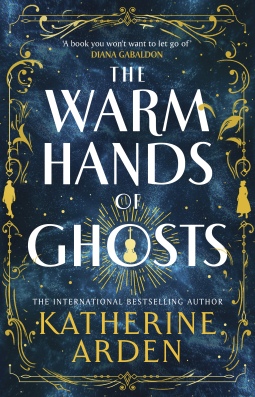
 I loved Katherine Arden’s Winternight Trilogy, set in medieval Russia and drawing on elements of Russian history, folklore and fairytales. I’ve been waiting for her to write another adult novel for five years and my patience has finally been rewarded with The Warm Hands of Ghosts. Taking us to the battlefields of the First World War, this is very different in terms of setting, atmosphere and scope, but I’m pleased to say that it’s another great book.
Laura Iven has been serving as a military nurse in Belgium but in January 1918, when the novel begins, she is back at home in Halifax, Canada, having been wounded and discharged. It has not been a happy homecoming for her, as not only has she left behind a brother, Freddie, still fighting on the front line, but soon after her return to Halifax a ship exploded in the harbour, destroying part of the city and killing her parents. When Laura receives a box containing Freddie’s belongings and a note telling her that he is missing in action, she is reluctant to believe that he has also died and decides to return to Belgium as a volunteer at a private hospital where she can search for more information on his disappearance.
A second thread of the novel is set several months earlier and follows Freddie, who awakens on the battlefield to find himself wounded and alone with an enemy soldier – a German, Hans Winter, who is also badly injured. Lost in no man’s land, together they try to make their way to a place of safety, knowing that depending on whom they encounter first, one or both of them could be shot as either an enemy or deserter. It’s here that they first meet Faland, a fiddler who seems to offer them a way of escape. When Laura arrives at the hospital a few months later and hears tales of the mysterious musician who can give soldiers the gift of oblivion – if they are prepared to pay a price for it – she begins to wonder whether this is what has happened to her brother.
As I said above, this book is quite different from the Winternight Trilogy and I wouldn’t really describe it as fantasy – although it does contain some elements of the supernatural, mainly surrounding the appearances of Faland the fiddler. I don’t want to say too much about him but as Katherine Arden explains in her author’s note, if he reminds you of Woland from Bulgakov’s The Master and Margarita it’s not a coincidence! Faland is one representation of evil in the novel; the vast horror of the battlefield is another and the tired, desperate soldiers face a difficult choice between the two.
I found the opening chapters set in Halifax very interesting as I previously knew so little about life on the Canadian homefront during the First World War. This is the first time I’ve read about the explosion of the Mont Blanc and the massive loss of life it caused (nearly two thousand people were killed and thousands more injured). In Flanders, meanwhile, the details of the Battle of Passchendaele and its aftermath and the conditions faced by nurses and patients in the field hospitals are equally interesting to read about.
This is not my favourite Katherine Arden book – I preferred the characters in the Russian trilogy and the more magical setting – but I still enjoyed it very much.
Thanks to Century for providing a copy of this book for review via NetGalley.

Book 8/50 for the Historical Fiction Reading Challenge 2024





 She Reads Novels