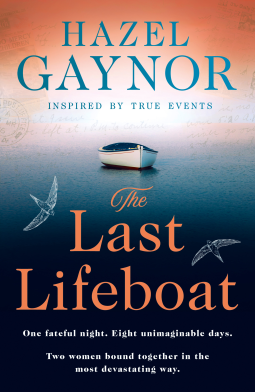
 We hear a lot about children being evacuated from the cities to the British countryside during World War II, but not so much about those who were sent away to safety overseas. Hazel Gaynor’s new novel, The Last Lifeboat, explores this often overlooked aspect of the war, taking as its inspiration the real life tragedy of the SS City of Benares, a British evacuee ship which was torpedoed by a German U-boat in September 1940 with almost 100 children on board.
The novel follows the stories of two women: Alice King and Lily Nicholls. Lily, who lives in London, is a widow and the mother of two young children, Georgie and Arthur. All she wants is to keep her children safe, but as bombs begin to rain down on the city, Lily starts to fear for their lives and when she hears about a new government scheme to evacuate children to other countries, she has a difficult decision to make. Meanwhile, schoolteacher Alice King is looking for a way to ‘do her bit’ for the war effort and has signed up with CORB (the Children’s Overseas Reception Board) as a volunteer escort who will accompany a group of children on a ship sailing for Canada.
These two separate storylines connect when Lily entrusts Arthur and Georgie to Alice’s care as parents are not allowed to accompany their children overseas. The ship on which they set sail – the SS Carlisle – is part of a large convoy so everyone assumes they will be protected from the German U-boats, but once out in the Atlantic things go badly wrong. The ship is hit by a torpedo and begins to sink, leaving the passengers and crew to pile into the lifeboats. Some are rescued, others are thrown into the waves, but one lifeboat drifts out of range with Alice King on board. The days that follow will be a traumatic period for Alice, as she and the others in the boat find themselves lost at sea with little hope of rescue and limited supplies of food and water, but it will be equally traumatic for Lily as news of the disaster reaches London and she discovers that one of her children is missing.
I think this is the best of the three Hazel Gaynor books I’ve read so far (the others are The Lighthouse Keeper’s Daughter, about Grace Darling, and The Cottingley Secret, the story of the Cottingley fairies). I liked both Lily and Alice and found each of their stories very moving. Alice’s is more dramatic as the days go by and she and the other lifeboat passengers struggle to survive while adrift in the Atlantic, but I could also feel Lily’s heartbreak and anger as she waits for news of her lost child and makes the shocking discovery that the evacuee ships were not being escorted to Canada as promised but left to fend for themselves after passing a certain point. Knowing that the book is based on a true story and that real people did have to go through the things that Alice and Lily went through just makes it even more powerful.
Thanks to HarperCollins for providing a copy of this book for review via NetGalley.
This is book 22/50 read for the 2023 Historical Fiction Reading Challenge.
 She Reads Novels
Good review–you’ve convinced me to move it up my TBR. I was disappointed in her last joint effort with Heather Webb–Three Words for Good-bye, but otherwise she’s been steady.
I hope you enjoy it, Lisa. I haven’t read any of her books with Heather Webb yet.
I don’t think I’ve read anything about these particular evacuations. And how sad that ships carrying children to safety got torpedoed! I can’t imagine how terrifying it must be to be stuck in a lifeboat in the middle of the ocean. This sounds like a very interesting and compelling read!
Yes, it was very compelling. It was so sad that the parents thought they had made the right decision in sending their children away.
My father was in the merchant navy in the South China Sea during the last war, and all that he ever divulged to me was that it was horrendous being in a convoy, seeing people in the water after their boat had been torpedoed and unable to rescue anybody because the convoy had to stick together and sail on. I’m fairly sure he was traumatised by the experience but he never mentioned it again. War is horrible, horrible to combatants and innocent civilians alike.
I can’t imagine what it must have been like to have to go through things like that. I don’t think you could avoid being traumatised by those experiences.
An interesting review. I haven’t read anything by Hazel Gaynor. I might try one of her earlier books. Thanks for posting.
She’s definitely worth trying. I’ve enjoyed all of the three that I’ve read.
I’m hopping over from the Historical Fiction Reading Challenge. I enjoy WWII stories and I haven’t read one like this.
It’s a very different topic – certainly not an aspect of WWII I’ve read about in fiction before.
This sounds SO good! I was hoping to get the ARC, but I guess I will have to buy a copy!
I’m sorry you didn’t get an ARC, but I think it will be worth the money. It’s the best I’ve read by her so far.
This sounds really well done. I liked The Cottingley Secret a lot, I think I had it from NetGalley.
Yes, I really enjoyed The Cottingley Secret too. This one is obviously a very different subject and time period, but I think it’s even better.
This sounds moving, I do like Hazel Gaynors ability to pick different aspects of history to focus on. I have enjoyed all her novels.
Yes, she picks such interesting subjects for her novels! This one is very moving and I think you would enjoy it.
A true to live thriller.
Yes, it is!