The Crowded Street by Winifred Holtby

The Crowded Street is on my Classics Club list, so when I saw that Jessie of Dwell in Possibility was hosting a Persephone Readathon this week, my choice was obvious. This particular book has also been published as a Virago Modern Classic, but my edition is the Persephone one, with the endpapers pictured below. Having already enjoyed several of Holtby’s books – South Riding, The Land of Green Ginger and Poor Caroline – I’ve been looking forward to this one for a while and I’m pleased to say that I loved it even more than I hoped I would.

The novel was published in 1924, at a time when it was assumed that most young women wanted nothing more than to find a husband and then stay at home to raise their children. In The Crowded Street, Holtby looks at what it was like to be a woman who, for one reason or other, was unable to conform to these expectations. Through the stories of Muriel Hammond, her sister Connie and her friends Clare and Delia, she explores the very different routes through life taken by four very different women.

We first meet Muriel in December 1900 when she is eleven years old and attending her first ‘grown-up’ party. Her excitement soon turns to shame when she finds that none of the boys want to dance with her and her dance card remains almost blank. Muriel is confused: The unforgivable sin at a party is to have no partners. To sit quietly in the drawing-room at home was a virtue. The sense that she has somehow let her mother down is a feeling which will stay with her for the next two decades as she continues to go through life partnerless, waiting and hoping for something to happen. She does initially have ambitions – to study astronomy, to go to college – but she doesn’t pursue these as she receives no encouragement from her mother or from her school teacher, who says:

“Character, my dear, to be a fine womanly woman, that matters so much more than intellectual achievement. To serve first your parents, then, I hope, your husband and your children, to be pure, unselfish and devoted, that is my prayer for each one of my girls.”

As a single woman myself, there were times when Muriel’s story resonated with me, but thankfully not all the time! I may not be married, but nobody ever prevented me from going to university or getting a job. Muriel watches with envy as Delia, another unmarried girl from the same Yorkshire village, goes off to Cambridge University, then heads for London and throws herself into political activism.

“But then, she has her work. Women who have their work have an immense thing, even if they are unfortunate in the people whom they love. It is when you have nothing, neither work, nor love, nor even sorrow, that life becomes rather intolerable.”

Of course, some women today are happy to stay at home with their parents, there are some who find plenty of fulfilment in marrying and having children, while others want to move away to pursue their career. There is no right or wrong way to live, but the point is that we have a choice. What makes Muriel’s story so tragic is that she feels she has no choice. She believes that marriage is the only possible way to escape, but if that doesn’t happen, all she can do is continue to help her mother around the house, doing what she sees as her duty (even though her help isn’t particularly necessary). As a result, she becomes more and more depressed, feeling that life is passing her by but lacking the confidence to do anything about it and making excuses to justify why she can’t.

Her younger sister, Connie, tries to break away from the stifling confines of life in Marshington, but she is so desperate that she makes a bad decision which has disastrous consequences. It seems that the only one who is likely to be happy is Muriel’s old school friend, the cheerful and sophisticated Clare, who goes through life without a care in the world and catches the eye of Godfrey Neale, the one man Muriel dreams of as her own potential husband. Clare, though, has the opposite problem. Having had a very different upbringing from Muriel and Connie, will she be able to adapt to living in a small Yorkshire village?

At one point, Muriel thinks to herself:

“All books are the same – about beautiful girls who get married or married women who fall in love with their husbands. In books things always happen to people. Why doesn’t somebody write a book about someone to whom nothing ever happens – like me?”

Well, Winifred Holtby has written that book and I don’t think it’s quite true that nothing happens to Muriel. She does develop as a person as the novel progresses and, although it takes a long time, she slowly becomes aware that if she is to have any happiness she will have to take matters into her own hands. I loved the way her story ended: she has an important decision to make and in my opinion she does the right thing.

As well as following the characters I’ve mentioned above, we are also given some insights into the effects of the First World War on small communities like the fictional Marshington. I particularly enjoyed the vivid depiction of the bombardment of Scarborough in 1914, something Winifred Holtby could draw on personal experience to describe. The Crowded Street is a wonderful book in so many ways and a great choice for both the Classics Club and the Persephone Readathon!

This is Book 2/50 from my second Classics Club list
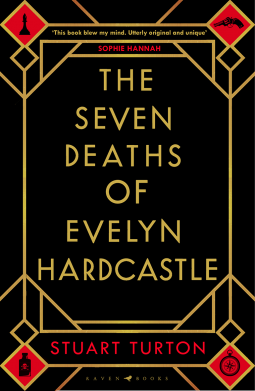
The Seven Deaths of Evelyn Hardcastle by Stuart Turton

I can’t even begin to imagine how much time and effort must have gone into the writing of this novel! I’ve never read anything like it before and I hardly know how to begin to describe it. It has all the elements of a classic murder mystery – but there’s a clue in the title: the same murder happens not just once but seven times.

The novel opens with a man waking up in a forest with no memory of who he is or how he came to be there. He has the name ‘Anna’ in his mind, although he has no idea who Anna might be. Hearing a woman scream, he rushes to help but is stopped by a stranger who pushes a compass into his pocket and whispers ‘East’. Following these instructions, he finds his way out of the woods and into the grounds of nearby Blackheath House, where the situation becomes even more bizarre. He discovers that he is a doctor called Sebastian Bell and that he is a guest at Blackheath where the Hardcastle family are throwing a party to mark the nineteenth anniversary of their son’s death.

All through the long and bewildering day which follows, Bell tries to make sense of what is happening, only to end up more confused than ever. Eventually, he is approached by a man wearing the costume of a Plague Doctor, who appears to have some of the answers. It seems that the Hardcastles’ daughter, Evelyn, is going to be murdered later that night and Bell’s task is to solve the murder. Should he fail, he will have the chance to live through the day again…but this time he will be someone else. Eight days and eight different ‘host bodies’; if at the end of that time he can provide a solution, he will be allowed to leave Blackheath. If not, he will go back to day one and the whole sequence will begin again…as it already has, many times before.

Everything I’ve said so far is explained to our narrator early in the novel. Once he begins waking up as the other hosts, however, things quickly become very complicated, with new clues and pieces of information coming to light on almost every page. I won’t say any more about the story itself, then, other than in general terms. I won’t even tell you who the other hosts are, as part of the fun is in wondering who the narrator is going to be next. Each host, though, has different strengths and weaknesses and is connected to the murder in a different way. It’s fascinating to see how each of them alone sees only a small part of the picture, and the truth only begins to emerge when all of their collective experiences and observations are taken into account.

This is an incredibly clever novel and so intricately plotted I have no idea how Stuart Turton managed to keep track of it all. Although it’s a long book, my recommendation is to read it in as few sittings as possible so you can try to hold on to all the threads of the story in your head. If your experience is anything like mine you’ll quickly become so engrossed that you won’t want to stop anyway. And experience is the right word for it. This doesn’t feel like a normal novel at all. It reminded me in some ways of one of those ‘choose your own adventure’ books I loved as a child where you could make choices that led to different routes through the story. That’s how I felt as the narrator lived through the same events again and again, trying to decide what he did wrong last time.

The novel is written in the first person present tense – a style I usually dislike but which is used very effectively here. It gives the reader a sense of being dropped directly into the middle of the action and sharing the narrator’s panic and disorientation. I don’t think it would have worked had it been written any other way. I thoroughly enjoyed this unusual and wonderfully imaginative novel!

Thanks to Raven Books for providing a copy of this book for review via NetGalley.

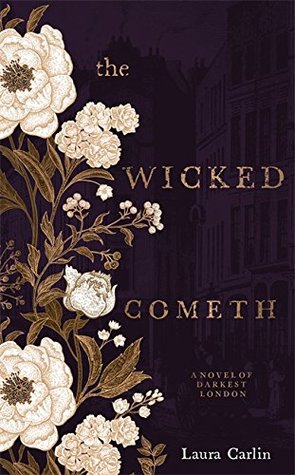
The Wicked Cometh by Laura Carlin

With such a beautiful cover and with the enticing subtitle “A novel of darkest London”, Laura Carlin’s The Wicked Cometh was impossible to resist. I was looking forward to reading it but, having seen a mixture of reviews over the last few weeks, some very positive and others less so, by the time I started it my expectations weren’t as high as they had been.

The novel is set in the early 1830s, during the reign of William IV, and opens with The Morning Herald reporting on the increasing number of men, women and children being declared missing in London. One young woman who has been following the news reports closely is Hester White; she is growing concerned about her cousin Edward who had arranged to meet her at Smithfield three weeks ago and has failed to arrive. Hester’s life has not been easy since the death of her parents a few years earlier; finding herself alone in the world she has been living with her father’s former gardener, Jacob, and his wife, Meg. Their home is a London slum, very different from the parsonage in rural Lincolnshire where Hester grew up, and she has been hoping that Edward can offer her an opportunity to start a new life away from the city.

When Hester is knocked down and injured by a carriage belonging to Calder Brock, suddenly another way of escape presents itself. Calder, who is a doctor, takes her to his family’s country estate, Waterford Hall, to recuperate, and explains to her that he would like her to stay and be educated by his sister Rebekah. With his interest in social reform, he hopes this experiment will show that even those from the poorest slums are capable of learning and improving themselves. Hester can already read and write, but is happy to pretend otherwise to avoid having to go back to Jacob and Meg. And so her lessons with Rebekah begin and a special friendship starts to form…

Everything I’ve described so far happens in the first half of the book and up to that point I found that I was really enjoying it. I liked Hester and although present tense first-person narration isn’t my favourite, her voice was strong and compelling. Her relationship with Rebekah felt natural and right, and I was pleased that it took time to develop. I was curious about the disappearances in London too and wanted to know more.

Then, in the middle of the book, there was a change of pace. As Hester and Rebekah began to investigate and uncover the truth, I felt that the author was trying too hard to incorporate every possible trope of the 19th century sensation novel, from family secrets to hidden documents to clandestine marriages. The story began to feel very melodramatic and contrived and lost its effectiveness. There were aspects of the plot that reminded me of Fingersmith by Sarah Waters, as well as one or two developments that made me think of The Woman in White, and I suspect that if I hadn’t read so many similar books I would probably have enjoyed this one a lot more. This was a particular problem at the very end of the novel where something which should have been a big surprise was too easy to predict.

I did like Laura Carlin’s writing and the atmosphere she creates; The Wicked Cometh is already receiving a lot of attention and as a debut novelist I’m sure she has a successful career ahead of her. For me, though, this is a novel of two very different halves. Some readers will prefer, as I did, the slow scene-setting of the first half and others the dramatic revelations of the second. If it sounds like your sort of book, give it a try – maybe you’ll love it more than I did!

Thanks to Hodder and Stoughton for providing a copy of this book for review via NetGalley.

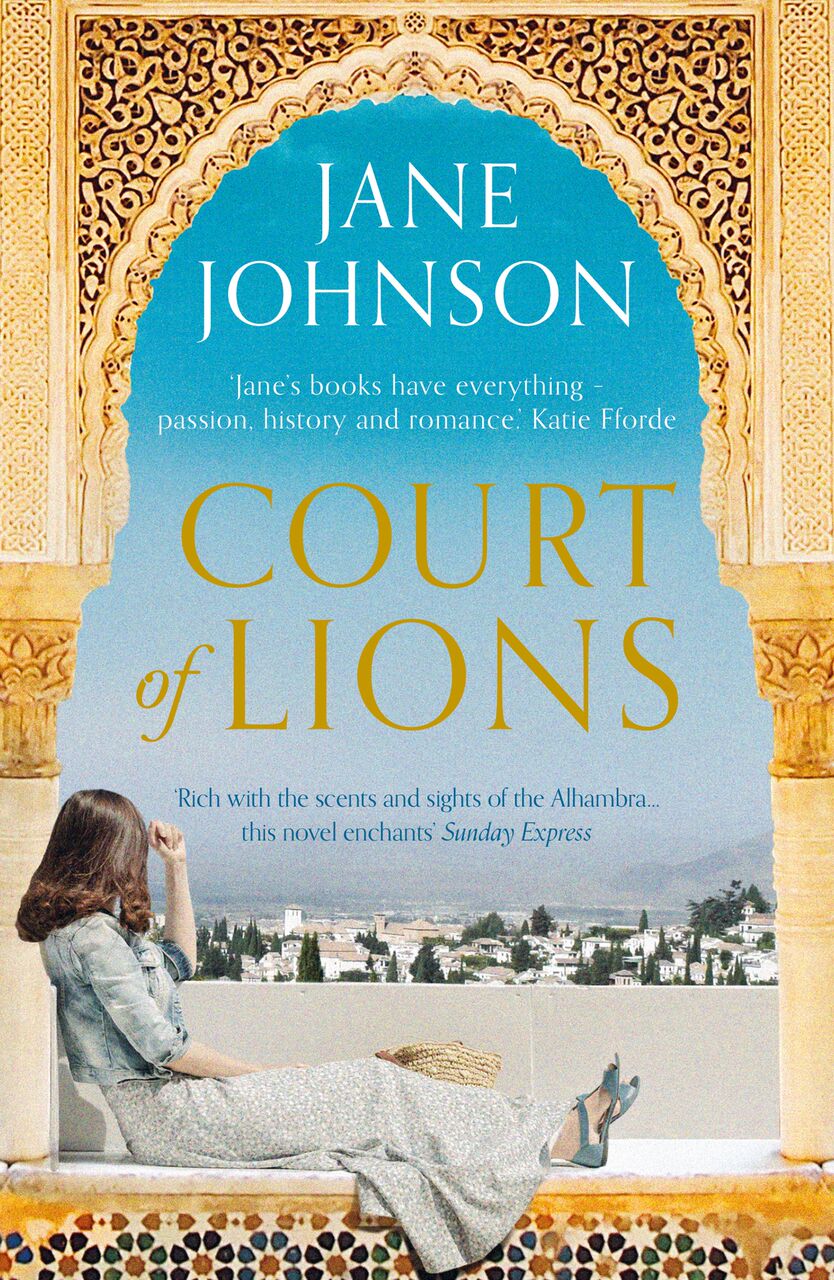
Court of Lions by Jane Johnson

The Court of the Lions is part of the Alhambra, the magnificent palace and fortress in the Spanish city of Granada which forms the setting for Jane Johnson’s latest novel. Having read and enjoyed one of her previous books (The Sultan’s Wife, set in 17th century Morocco), I’m pleased to have had the opportunity to read Court of Lions as part of a blog tour organised by publisher Head of Zeus. You can see the schedule for the other stops on the tour at the end of this post.

Court of Lions is a novel set in two different time periods. First, in the present day, we meet Kate Fordham, who has fled from a troubled marriage in England and is working in a bar in Granada, hoping she has done enough to prevent her husband from finding her. One day, exploring the gardens of the Alhambra, she discovers a scrap of paper pushed into a crack in a wall. Written on it is a message in an unfamiliar language and although Kate is unable to translate it, she senses that it could be important. And she is right, because her discovery leads her to form new relationships and to find the strength she needs to move on.

Alternating with Kate’s story is another story, set in the late 15th century and introducing us to Abu Abdullah Mohammed, the last Sultan of the Emirate of Granada, given the name Boabdil by the Spanish, but referred to in the novel as Momo. We get to know Momo from the point of view of a fictional character, Blessings, a slave child brought from Morocco to be his companion. Growing up together at the Alhambra, Momo and Blessings become close friends – and a loyal friend is what Momo desperately needs as he prepares to face the challenges which await him: a struggle for the throne against his own father and uncle, and war with Catholic Spain, led by King Ferdinand and Queen Isabella.

I found the 15th century storyline completely fascinating and compelling. I have read a little bit about the fall of Granada before, but not from this perspective, so most of it was new to me. The sequence of events leading up to the surrender of the city is described in just the right amount of detail and left me wanting to explore the period further, which is something all good historical fiction should do. Momo’s personal life, his marriage and the fates of his children are also given some attention, all seen through the eyes of Blessings – who is not exactly an unbiased observer as it quickly becomes clear that what he feels for the young Sultan is more than just friendship. Blessings himself is also an interesting character and although I don’t want to say too much here, there are revelations later in the book which answered some of the questions I had about him.

The modern day sections of the novel were slightly less successful. I did like Kate and enjoyed watching as she made new friends in Granada and learned about their culture and lifestyle, but I found the storyline involving her disastrous marriage very melodramatic (again I don’t want to give too much away). Although some of the threads linking the two time periods together are a bit too coincidental to be convincing, I liked the fact that the two share common themes such as religious conflict, prejudice and tolerance – things which were relevant in Momo’s day and are still just as relevant in ours.

The descriptions of Spain and the Alhambra itself are beautifully written. One of my aims for 2018 is to read more fiction set in countries other than my own so I have taken a step towards achieving that aim by reading Court of Lions. Thanks to Head of Zeus for providing a copy for review.

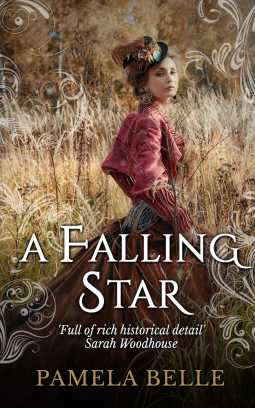
A Falling Star by Pamela Belle

The third book in Pamela Belle’s Wintercombe series moves on to the next generation of the St Barbe family. Having enjoyed both Wintercombe and Herald of Joy last year, I decided to wait a little while before beginning A Falling Star; I think that was the right decision as it meant I could approach it with a mind open to meeting new characters and embarking on new storylines, rather than just wanting more of Silence and Nick.

A Falling Star is set in the 1680s, several decades after Herald of Joy ended. It opens with the return to Wintercombe of Sir Alexander St Barbe, who has been living in exile in the Low Countries but has come home to take up his inheritance following his father’s death. Alexander (or Alex as we will now call him) brings with him a reputation for drunkenness and debauchery, but this doesn’t deter his cousin Louise, another new arrival at Wintercombe. Louise, who was brought up in France, has been sent to England in the hope that she will find a nice Protestant husband there. Alex is presumably not the sort of man her mother has in mind, but Louise is instantly drawn to him and it seems that the attraction is mutual.

Not everyone is pleased to have Alex home, though. Another cousin, Charles St Barbe, still hasn’t given up hope of inheriting Wintercombe himself. After all, he had been helping Alex’s father to run the estate for several years, and unless Alex can produce a legitimate child of his own, Charles is the next heir. If only Alex had stayed away, Wintercombe could have been his. Unfortunately, Alex does nothing to endear himself to Charles and what begins as a natural resentment quickly develops into hatred. Outside the walls of Wintercombe, meanwhile, rebellion is brewing as the Duke of Monmouth prepares to launch his attempt to overthrow James II. There’s a lot of support for Monmouth’s cause throughout Somerset and its neighbouring counties, but which side will the St Barbes choose?

I have read about the Monmouth Rebellion before, but it has only been touched on briefly in other novels I’ve read. This is the first fictional account I’ve read that has gone into so much detail and I found it all fascinating, from the views of the people of South West England and their reasons for supporting (or not supporting) the Duke, to the descriptions of the battles and the fate of the men who fought in them. Because two of Silence’s grandchildren – Bram and Ben – are directly involved, the reader is pulled into the heart of the action rather than just hearing about events from a distance.

We do see quite a lot of Silence and a little bit of Nick as well, but this is definitely the story of the younger generation. If you have read the previous books, you will remember that Silence and Nick had quite a few children and stepchildren between them – and now those children each have families of their own. I felt slightly overwhelmed by the number of new characters at first, and the relationships between them, but it quickly became clear which ones were going to have a significant role in the story and which I didn’t need to worry about too much. I have already mentioned Bram and Ben, Louise, Alex and Charles, all of whom are interesting characters in their different ways; the other St Barbe cousin with an important part to play is Phoebe, Alex’s sister. I loved Phoebe, whose strength of character more than makes up for her physical weaknesses.

The way the book ends sets things up nicely for the finale, Treason’s Gift, which I’m sure I’ll be reading soon!

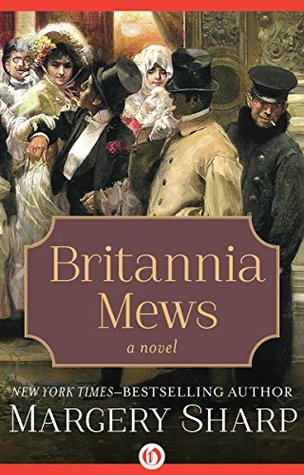
Britannia Mews by Margery Sharp

I discovered Margery Sharp through Jane of Beyond Eden Rock who, for the last few years, has been hosting an annual Margery Sharp Day on the author’s birthday. This year, Jane is doing something slightly different: she has put together a Birthday Book of Underappreciated Lady Authors to celebrate the work of some of her favourite writers throughout the year. Margery Sharp is first on the list and as I’ve enjoyed her books in the past, I wanted to join in.

Britannia Mews (1946) is my fourth Margery Sharp novel and probably my favourite so far. Beginning in the 1870s and taking us through to the 1940s, it follows the story of Adelaide Culver from childhood to old age. We first meet Adelaide as a curious ten-year-old exploring Britannia Mews, a London street inhabited by servants and coachmen – a street which is considered less than respectable and off limits to middle-class children like Adelaide. Returning to the Culver’s comfortable townhouse in nearby Albion Place, Adelaide has no idea that in just a few years’ time Britannia Mews will be her home.

It’s all cousin Alice’s fault; if she hadn’t been suffering from a cold and missed their drawing lesson, Adelaide would never have been left alone with their drawing master, Henry Lambert, and then he might never have told her that he loved her. But Alice does have a cold and Mr Lambert does declare his love for Adelaide – and Adelaide, despite knowing that her parents will disapprove, does agree to marry him.

Their marriage takes place on the day the rest of the Culver family move away to a lovely new house in the countryside. Adelaide, meanwhile, is moving into Mr Lambert’s rooms above a coach house in Britannia Mews. Estranged from her family, living in what is rapidly becoming a slum and finding that her new husband is not quite the person she thought he was, married life proves to be very challenging for Adelaide. When she finally has the opportunity to escape from Britannia Mews, however, she must decide whether she really wants to leave the street that has become her home.

Britannia Mews is very different from the other books I’ve read by Margery Sharp – The Nutmeg Tree, The Flowering Thorn and Cluny Brown. All three of those are lovely novels but they are much lighter in tone and, although Britannia Mews is not entirely without its moments of wit and humour, in general this is a darker and more serious story. I don’t want to give the impression that it’s a depressing one, though, because it isn’t. Yes, Adelaide’s life is difficult, at least at first, but it’s her own life – she has made her own choices and had to live with them, made her own mistakes and had to find her own solutions. Unlike her cousin Alice, who represents the ideal of what a Victorian woman should be, Adelaide is unconventional, independent and, by the time the twentieth century arrives, an inspiration to the younger generation.

One woman in particular who belongs to the younger generation is Dorothy – Dodo – Baker, daughter of Adelaide’s cousin Alice. Like Adelaide before her, Dodo feels stifled by the middle-class circles in which her parents move and she knows she wants something different out of life. Britannia Mews, which by the 1920s has become a lively and fashionable address, is, for Dodo as well as for Adelaide, a symbol of freedom and the opportunity to be who you want to be. The second half of the novel is very much Dodo’s story rather than Adelaide’s; it took me a while to adjust to the change of heroine but once I did I found Dodo just as interesting to read about. I enjoyed watching her get to know the Lamberts and waiting to see whether she would uncover the secret they had kept hidden for so many years.

Of course, the most important character of all is Britannia Mews itself, a street which seems to cast a spell over those who live there, pulling them back every time they might think about leaving. I loved reading about the changing nature of the street over the years and the people who inhabited it at various times in its history. I was also fascinated by the descriptions of the Puppet Theatre which Adelaide opens in one of the old coach-houses and the magnificent hand-made puppets created by Henry Lambert.

This was a wonderful choice of book to celebrate Margery Sharp’s birthday this year and I’m hoping to join in with some of Jane’s other Birthday Book authors in the months to come.

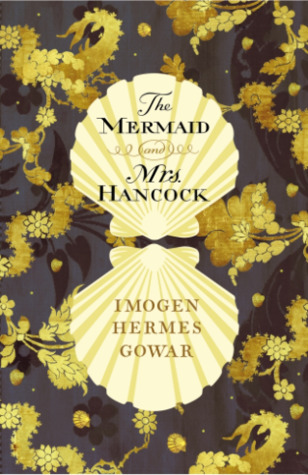
The Mermaid and Mrs Hancock by Imogen Hermes Gowar

The Mermaid and Mrs Hancock opens in 1785 with merchant Jonah Hancock sitting in his London counting house waiting for his ship to return. Imagine his horror when his captain arrives at the door and confesses that he has sold the ship in exchange for a mermaid. The captain assures him that people will come from all over the world to see the mermaid and that it will make him a fortune, but Mr Hancock is not at all convinced…

Angelica Neal has been living in comfort as the mistress of a rich duke. When the duke dies, leaving her with nothing, Angelica needs to find another way to support herself. The obvious solution is to return to her former employment in Mrs Chappell’s brothel, but Angelica is more ambitious these days and decides to make her own way in the world instead. Her path crosses with Mr Hancock’s when his mermaid is exhibited at a party she is attending and an unlikely friendship begins to form between these two very different people.

The first thing to say about The Mermaid and Mrs Hancock is that although mermaids and the legends surrounding them are symbolically important to the story, the part they play in the novel is relatively small. This could be a good or a bad thing depending on how you feel about magical realism, but be aware that the mermaid element of the story might not be what you are expecting. Their role is similar, in some ways, to the role of the serpent in Sarah Perry’s The Essex Serpent, one of several books to which this one has been compared.

As for the humans, I thought Angelica and Mr Hancock were both interesting, well drawn characters. Whenever the ambitious, strong-willed Angelica appeared on the page I was reminded of Becky Sharp from Vanity Fair and Sugar from The Crimson Petal and the White. It took me a while to warm to her and I still can’t say whether I actually liked her, but I did have some sympathy for her and, by the end, some admiration as well. Jonah Hancock is a very different type of character – a quiet, humble, middle-aged widower who is haunted by memories of his wife and son. Since their deaths, he has allowed his sister Hester and niece Sukie to take charge of his life, but his relationship with Angelica introduces another dynamic into the household.

There’s a colourful cast of secondary characters too, particularly the girls from the ‘nunnery’ as they ironically call it, and their grotesque ‘abbess’, Mrs Chappell, but I found that I was less interested in finding out what would happen to these characters than I was in reading about Mr Hancock and Angelica. One of them, Polly – a prostitute from a mixed race background who finds herself, like the mermaid, viewed as a sort of curiosity by the men who visit the brothel – had a lot of potential but her storyline was not really developed until late in the book.

The novel’s setting (Georgian England) is one I usually like and I was quite impressed by the author’s attention to detail and her attempts to recreate an 18th century world. The language and dialogue generally feels suited to the period, although I think Francis Spufford’s wonderful Golden Hill does this more effectively. Actually, it’s difficult to read this book without drawing comparisons with Golden Hill and if you enjoy one of them I think there’s a good chance you’ll enjoy the other!

The Mermaid and Mrs Hancock will be published in the UK on Thursday and although I didn’t love it as unreservedly as I’d hoped, I predict it will be a big success for Imogen Hermes Gowar.

Thanks to Harvill Secker for providing a copy of this book for review via NetGalley.