Historical Musings #71: Do you agree?

Welcome to my monthly post on all things historical fiction!

I was struggling for inspiration for something to write about this month, until I came across a quote shared by Waterstones on Twitter:

“History tells us what people do; historical fiction helps us imagine how they felt”
– Guy Vanderhaeghe.

This quote resonates with me because it perfectly describes why I prefer reading historical fiction to reading historical non-fiction. Guy Vanderhaeghe is not an author I have come across, but it seems he has written several historical novels set in Canada and the American West. I decided that for this month’s post I would find some more interesting quotes by authors on the subject of historical fiction, beginning with these two on the overlapping of genres:

Historical fiction is actually good preparation for reading SF. Both the historical novelist and the science fiction writer are writing about worlds unlike our own.
– Pamela Sargent

I have always regarded historical fiction and fantasy as sisters under the skin, two genres separated at birth.
– George R.R. Martin
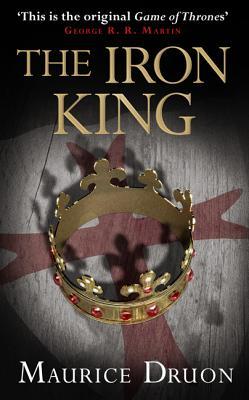
I don’t read a lot of science fiction, but I’ve often felt that there are parallels between historical fiction and fantasy, mainly in the level of detailed worldbuilding required and, as Pamela Sargent says, a sense of unfamiliarity and strangeness. Sometimes fantasy can almost feel like historical fiction and vice versa; in fact, George R.R. Martin’s own A Song of Ice and Fire series is inspired by Maurice Druon’s Accursed Kings, a series of seven historical novels telling the story of Philip IV of France and his descendants, a line of kings “cursed to the thirteenth generation” by the Grand Master of the Knights Templar, whom Philip sent to burn at the stake. Then there are authors who blend history and fantasy together in the same novel, such as Katherine Arden in her Winternight trilogy, or Guy Gavriel Kay in books like Tigana and Under Heaven.

However, I don’t really agree with this next quote, also by Martin…

As much as I love historical fiction, my problem with historical fiction is that you always know what’s going to happen.
George R.R. Martin

I understand that writing historical fiction must be more restrictive for an author than writing fantasy, but for the reader, unless they have studied the time period or have read about the same subject many times before, they’re not necessarily going to know what will happen. I love reading about historical periods, settings and people I know absolutely nothing about – it’s a good way to learn something new and I try to resist googling things as I read so that I can be surprised by the twists and turns of the story. On the other hand, reading about something unfamiliar to you can cause other problems, as described here by Hilary Mantel:
What really disconcerts commentators, I suspect, is that when they read historical fiction, they feel their own lack of education may be exposed; they panic, because they don’t know which bits are true.
– Hilary Mantel

How can you know ‘which bits are true’? Unless you have time to look everything up, sometimes you have to trust that the author will have done their research and ensured that their novel is as accurate as they could possibly make it. It’s frustrating when you spot something that is clearly wrong or anachronistic, because it makes you wonder if there are other inaccuracies in the book that you haven’t noticed. I agree with what Kate Mosse says here:

I am not a fan of historical fiction that is sloppy in its research or is dishonest about the real history.
– Kate Mosse

I’ll leave you with two more opinions from Barry Unsworth, author of the Booker Prize winner Sacred Hunger, and historical romance author Stephanie Laurens:

Writers of historical fiction are not under the same obligation as historians to find evidence for the statements they make. For us it is sufficient if what we say can’t be disproved or shown to be false.
– Barry Unsworth

Overall, I adhere to the one guiding rule any author writing historical fiction should follow: whatever you describe has to be possible. It may not be common, obvious, or even all that probable, but it absolutely has to be possible.
– Stephanie Laurens

What do you think? Do you agree with any or all of what these authors have to say?

Quotes courtesy of BrainyQuote.com

I, Mona Lisa by Natasha Solomons

Many of us will, on a trip to Paris, have stood in the Louvre in front of Leonardo da Vinci’s Mona Lisa. We may also know some of the details of the painting’s history – its creation in Renaissance Italy, its theft from the Louvre in 1911. However, this new novel by Natasha Solomons adds a whole new dimension to the Mona Lisa story, taking us inside the mind of the painting itself and showing us the world through the eyes that look out from the portrait. Whether or not you enjoy this book will probably depend on whether you can accept that a painting is narrating the story. If you’re happy with that idea, then I think you’ll find I, Mona Lisa an interesting and entertaining read.

Most of the novel is set in 16th century Florence, during the period when Leonardo is working on his most famous masterpiece. From the painting’s own perspective, we get to know some real historical figures such as Lisa del Giocondo, the woman who sits for the portrait; Michelangelo and Raphael, da Vinci’s rivals; Niccolò Machiavelli, who approaches da Vinci with a scheme to divert the Arno River; and Salaì, a student in Leonardo’s workshop who is jealous of his master’s relationship with Mona Lisa. Although Mona is an inanimate object, she is portrayed in the novel as having the thoughts and feelings of a real woman, with an emotional attachment to her creator Leonardo.

When Leonardo eventually dies, leaving her vulnerable and unprotected, Mona embarks on the journey that will lead her to France. As the centuries go by, she spends time at the court of the Sun King in Fontainebleau and then at Versailles during the French Revolution, before finding her way to the Louvre where, as the 20th century dawns, she forms a new friendship with another great artist.

I, Mona Lisa is an unusual novel and a unique way of exploring some key moments in history. However, because so much time is spent in Renaissance Italy, the parts of the novel set in France feel more rushed and the characters less well developed. This was maybe the author’s intention, as Mona finds it difficult to bond with the people she meets after Leonardo’s death and makes it clear that her heart will always be in Florence, but it also meant that I felt less engaged with these sections of the book.

I do think that if you’re going to write a book about a painting with human emotions, the Mona Lisa is a perfect choice as it’s such a realistic and iconic portrait. The Mona of the novel is obviously very limited in what she can see and experience (and with whom she can communicate – just Leonardo and a handful of other painters and paintings), but Natasha Solomons does a great job of bringing Mona and her world to life. This is the third of her books I’ve read – the others are The Novel in the Viola and House of Gold. Three very different books, but I would recommend any or all of them.

Thanks to Hutchinson Heinemann for providing a copy of this book for review via NetGalley.

This is book 4/50 read for the Historical Fiction Reading Challenge 2022.

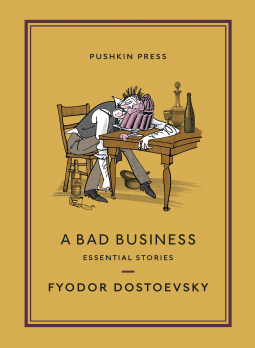
A Bad Business by Fyodor Dostoevsky

Translated by Nicolas Pasternak Slater and Maya Slater

This is the second collection of classic short stories I’ve read from the Pushkin Press Essential Stories series. The first was I Would Prefer Not To by Herman Melville, an author I had never tried before, and I found it a good introduction to his work. In the case of Dostoevsky, I have previously read two of his novels (Crime and Punishment and The Idiot) but was curious to see what his shorter fiction would be like. This collection contains six stories, all in new translations by Nicolas Pasternak Slater and Maya Slater. They are all quite different in subject and style and I think they would give new readers a good idea of what his writing is like, while also being of interest to readers like myself who are only familiar with his full-length novels.

I think my favourite of the six stories was The Crocodile (1865), in which a civil servant, Ivan Matveich, is swallowed alive by a crocodile being exhibited in St Petersburg. There’s not much more to the plot than that, as the rest of the story revolves around the conversations Matveich has with various people from inside the crocodile, but I found it entertaining and surprisingly funny, not something I’ve really associated with Dostoevsky’s work before. It also takes a satirical look at the economic situation in Russia at that time – the German owners of the crocodile refuse to have its stomach slit open to free Matveich because they would be losing their investment, particularly as the crocodile has now increased in value due to becoming so famous!

Conversations in a Graveyard (1873), also published as Bobok, is another satire in which the narrator is sitting in a cemetery after attending a funeral and hears the disembodied voices of the recently buried telling each other their stories. The literary critic Mikhail Bakhtin describes this story as “almost a microcosm of Dostoevsky’s entire creative output,” because it involves many of the themes, ideas and character types that appear in his other work. I probably haven’t read enough of Dostoevsky to be able to fully appreciate this, but I did still find the story interesting – and it reminded me very much of Lincoln in the Bardo!

The title story, A Bad Business (1862), follows a general in the civil service who, after discussing his political ideals with friends, decides to test one of his theories by being nice to people from lower social classes. Unfortunately, when he arrives, uninvited and unwelcome, at the wedding feast of one of his subordinates, things quickly begin to go wrong. A very different type of story is A Meek Creature (1876), about the relationship between a pawnbroker and one of his customers, a girl who pawns items to earn money so that she can advertise in the newspaper for work as a governess. This is a darker story than most of the others in the book and not one of my favourites.

The four stories mentioned so far take up more than 90% of the book, which means that the final two are much shorter. One is The Heavenly Christmas Tree (1876), a sentimental and poignant little story with a fairy tale feel, and the other is The Peasant Marey (also 1876), in which the narrator recalls a childhood memory of being comforted by a peasant after convincing himself there was a wolf in the woods. I liked both of these stories but felt that they suffered from being placed at the end of the collection; I would have preferred the shorter stories to alternate with the novella-length ones to provide more variety.

Although I don’t think any of these are stories I would want to read again, apart from maybe The Crocodile, it was good to have the opportunity to explore Dostoevsky further. I’m hoping to read my copy of The Brothers Karamazov soon.

Thanks to Pushkin Press for providing a copy of this book for review via NetGalley.

Walter Scott Prize Longlist 2022

The longlist for the 2022 Walter Scott Prize for Historical Fiction has been announced today! Thanks to this prize, I have discovered lots of great books and authors over the last few years and always look out for the longlists and shortlists; in fact, trying to read all of the shortlisted titles since the prize began in 2010 is a personal project of mine (you can see my progress here).

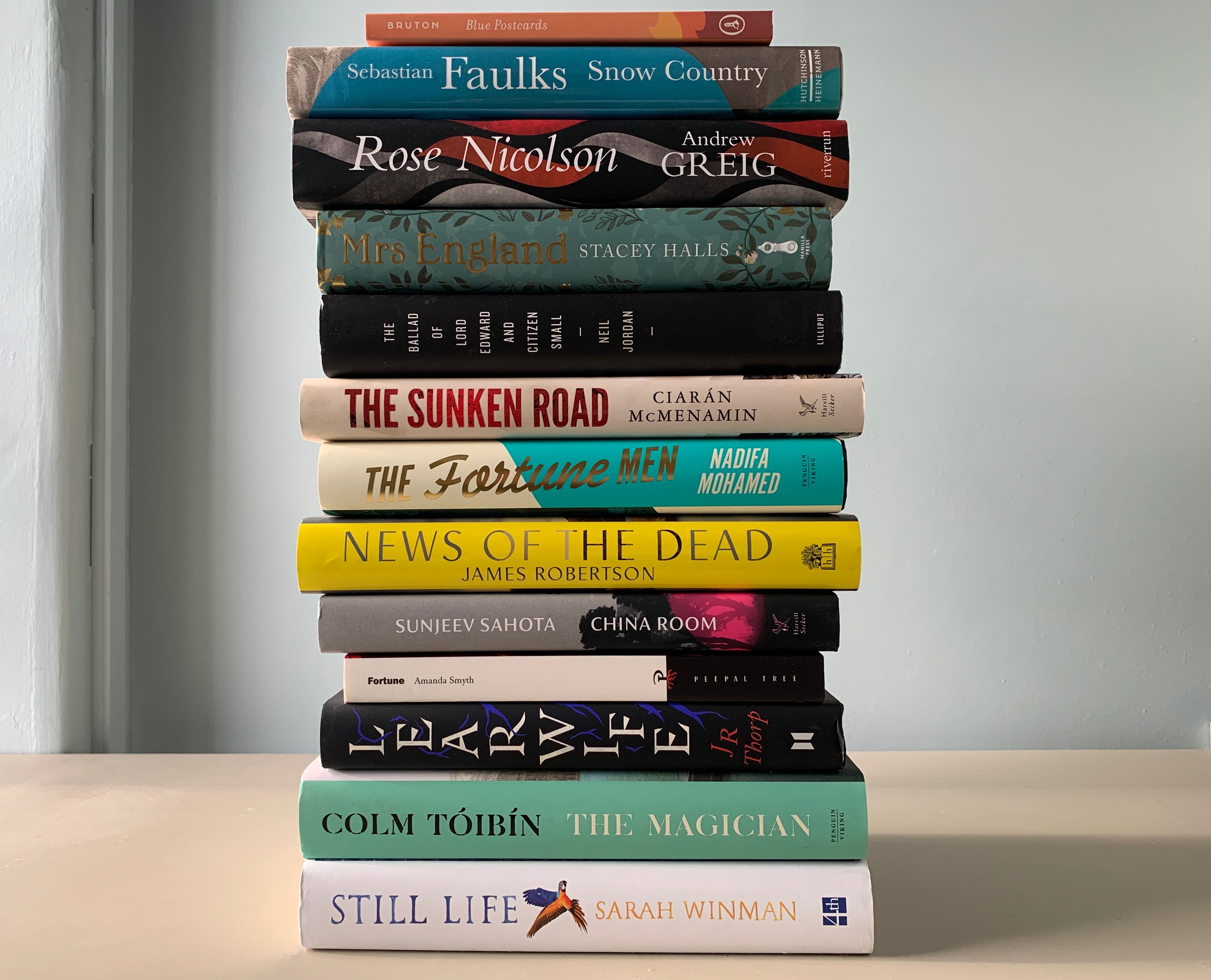
There are thirteen books on this year’s longlist:

Blue Postcards by Douglas Bruton (Fairlight Books)

Snow Country by Sebastian Faulks (Hutchinson Heinemann)

Rose Nicolson by Andrew Greig (Riverrun)

Mrs England by Stacey Halls (Manilla Press)

The Ballad of Lord Edward and Citizen Small by Neil Jordan (Lilliput Press)

The Sunken Road by Ciarán McMenamin (Harvill Secker)

The Fortune Men by Nadifa Mohamed (Viking)

News of the Dead by James Robertson (Hamish Hamilton)

China Room by Sunjeev Sahota (Harvill Secker)

Fortune by Amanda Smyth (Peepal Tree Press)

Learwife by J.R Thorp (Canongate)

The Magician by Colm Tóibín (Viking)

Still Life by Sarah Winman (Fourth Estate)

~

I have only read two of the books on the longlist so far. I loved Rose Nicolson and am not surprised to see it included here and I also enjoyed Still Life (apart from the lack of speech marks, which was annoying). Mrs England has been on my TBR since last year and I will definitely try to read it before the shortlist is revealed, while The Fortune Men and Snow Country are also books that I was already thinking about reading. Of the others, I’m familiar with Learwife and The Magician but haven’t been tempted to read either, and the rest are completely new to me. I’m always surprised when I haven’t heard of half of the longlisted titles, considering how much historical fiction I read!

Have you read any of these books? Which ones would you recommend?

The shortlist will be announced in April and the winner in June at the Borders Book Festival in Melrose, Scotland.

Six Degrees of Separation: From No One is Talking About This to A Moment of Silence

It’s the first Saturday of the month which means it’s time for another Six Degrees of Separation, hosted by Kate of Books are my Favourite and Best. The idea is that Kate chooses a book to use as a starting point and then we have to link it to six other books of our choice to form a chain. A book doesn’t have to be connected to all of the others on the list – only to the one next to it in the chain.

This month we’re starting with No One is Talking About This by Patricia Lockwood. Here’s what it’s about:

As this urgent, genre-defying book opens, a woman who has recently been elevated to prominence for her social media posts travels around the world to meet her adoring fans. She is overwhelmed by navigating the new language and etiquette of what she terms “the portal,” where she grapples with an unshakable conviction that a vast chorus of voices is now dictating her thoughts. When existential threats–from climate change and economic precariousness to the rise of an unnamed dictator and an epidemic of loneliness–begin to loom, she posts her way deeper into the portal’s void. An avalanche of images, details, and references accumulate to form a landscape that is post-sense, post-irony, post-everything. “Are we in hell?” the people of the portal ask themselves. “Are we all just going to keep doing this until we die?”

~

I haven’t read No One is Talking About This and probably never will, but as soon as I saw the title I knew that my first link this month was going to be to a book about someone who doesn’t talk: The Silent Boy by Andrew Taylor (1). This historical mystery set during the French Revolution features a boy who witnesses a murder and, having been told by the culprit never to say a word, takes this warning literally and refuses to speak to anyone at all.

Gervase Frant, the hero of Georgette Heyer’s The Quiet Gentleman (2), is not a silent man but he is a quiet one (and his cousin Theo is even quieter). This is not really a typical Heyer novel – it’s classed as one of her Regency romances, but it has a strong mystery element and the romance is quite a subtle one. It’s also one that I particularly enjoyed – although I wished we had seen more of the heroine!

Another book with ‘quiet’ in the title is Death on a Quiet Day by Michael Innes (3). This book from 1956 is one of Innes’ series of Inspector Appleby novels. I’ve found the books in this series quite varied; Death on a Quiet Day is more thriller than mystery, with the protagonist being chased through the Dartmoor countryside after discovering a dead body.

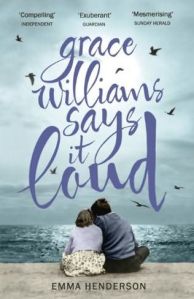
The opposite of quiet is loud, so the next book in my chain is Grace Williams Says it Loud by Emma Henderson (4). This very moving novel tells the story of a young girl in the 1950s who has difficulty communicating verbally and her experiences after being sent to live at the Briar Mental Institute. Although I found this an uncomfortable book to read at times due to the subject, there were still some moments of warmth and humour and it’s a book that I’m very glad I decided to read.

‘Saying it loud’ can cause echoes, so the next book in my chain is Echoes from the Dead by Johan Theorin (5). This is the first in a series of crime novels set on the Swedish island of Öland; there are four books (although I’ve only read three of them) and each one takes place during a different season of the year. I loved the atmosphere and the elderly Gerlof, one of the recurring characters, and I should really find time to read the last of the four books.

Another book which is the first in a crime series (and has a sound-related title) is A Moment of Silence by Anna Dean (6), an entertaining murder mystery set in an English country house in the early 19th century. I loved the heroine, Miss Dido Kent, and had fully intended to continue with the series but never did.

~

And that’s my chain for February! My links have included silent boys and quiet gentlemen, quiet days, loud voices, echoes and crime novels. In March we’ll be starting with the modern classic, The End of the Affair by Graham Greene.

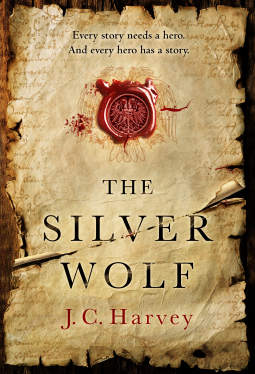
The Silver Wolf by JC Harvey

The Silver Wolf is the first in a new series, Fiskardo’s War, set in Europe during the Thirty Years’ War. This conflict, which took place between 1618 and 1648, is one I’m not very familiar with, so I thought it would be interesting to read a book set in a period that I don’t know much about.

This novel has quite a simple premise: an orphan, Jack Fiskardo (also known as Jacques or Jag to various people at various times) sets out on a quest to find his father’s killers and take revenge. However, the plot is anything but simple! Jack’s adventures take him from the French countryside to the home of an Amsterdam merchant and then to the battlefields of Germany and along the way we meet a huge cast of characters ranging from army scouts and soldiers to tavern keepers, farmers and noblemen. All of these people interact with Jack in one way or another and many of them have intriguing stories of their own, but it’s a lot to keep track of, so be aware that this is certainly not a quick, light read.

The Silver Wolf is divided into three sections: in the first, which begins in 1619, we meet Jack for the first time on the docks of Amsterdam; the second part takes us back several years to fill in some of the details of Jack’s childhood in the village of Belle-Dame near La Rochelle; and finally, in the third section we find Jack in Germany, playing his part in the events of the war while carrying out his private mission of revenge. My favourite was the middle section as it answered some of my questions and gave me a better understanding of what was going on. But although I thought the way the book was structured was quite effective, it did mean that lots of new characters were still being introduced very late in the novel, which I found slightly overwhelming.

The book is written in a lively, often playful style, and the author has opted to use modern speech and slang; I personally prefer dialogue in historical fiction to feel more ‘historical’, but I can see that the choice of language here probably suited the gritty, sometimes brutal, wartime setting. As for the Thirty Years’ War itself, as I’ve said, I previously knew very little about it, so it was good to learn more. The author’s note at the beginning of the book provides a basic outline of the war, why it was fought and the effect it had on the population of Europe, which I found very helpful!

Although I didn’t enjoy The Silver Wolf as much as I’d hoped to, for the reasons I’ve described above, I do think it’s an impressive and ambitious debut novel. I’m not sure whether I will read the second book, but I suspect it will be easier to follow than this one now that the scene has been set, so maybe I’ll be tempted!

Thanks to Allen & Unwin for providing a copy of this book for review via NetGalley.

This is book 3/50 read for the Historical Fiction Reading Challenge 2022.

Top Ten Tuesday: Classics with names in the titles

This week’s topic for Top Ten Tuesday (hosted by That Artsy Reader Girl) is “Books with Names/Character Names in the Titles”.

I have decided to focus on classic novels and have listed five female characters and five male – interestingly, I had much more choice when it came to the women! As usual with my Top Ten Tuesday posts, I have tried to stick to books that I’ve read and reviewed on my blog.

1. Ann Veronica by HG Wells – This novel about a young woman’s struggle for independence and her involvement with the suffrage movement isn’t something you would normally associate with science fiction author HG Wells, but I thought it was an interesting read.

2. My Cousin Rachel by Daphne du Maurier – Du Maurier liked using names in her titles! As well as the most obvious choice, Rebecca, there’s also Julius, Mary Anne – and this one, My Cousin Rachel, a dark and atmospheric novel which is one of my personal favourites by du Maurier.

3. Lorna Doone by RD Blackmore – Set in 17th century England, I loved this novel about a man who falls in love with a woman from a clan of violent outlaws. Although Lorna is the title character, I actually found some of the minor characters more interesting, and I could probably say the same about a few of the other books on this list too.

4. Sylvia’s Lovers by Elizabeth Gaskell – I’ve read several of Gaskell’s novels and this is one that I particularly liked. Set on the North Yorkshire coast during the Napoleonic Wars it’s a beautifully written novel but I agree with Gaskell when she said it’s “the saddest story I ever wrote”.

5. Shirley by Charlotte Brontë – I’ve chosen to highlight this one rather than Charlotte’s more popular Jane Eyre. Although it’s not one of the strongest novels by the Brontë sisters, I think it deserves to be more widely read. It’s an interesting fact that Shirley was seen as a male name rather than a female one until the publication of this book.

6. Lord Jim by Joseph Conrad – I thought this was a fascinating book, but also a difficult one to read and understand because of the structure and the complex, morally ambiguous title character. I can’t really say that I enjoyed it, but I was pleased to at least make it to the end.

7. David Copperfield by Charles Dickens – Another author who used a lot of names in titles! I haven’t read all of them, but those I have read and could have chosen from include Oliver Twist, The Mystery of Edwin Drood and Dombey and Son. I decided on this one because it’s a book I particularly enjoyed, with a selection of fascinating characters – apart from the very annoying Dora Spenlow!

8. Jude the Obscure by Thomas Hardy – If Sylvia’s Lovers is sad, this book is heartbreaking. It follows the story of a young man from a humble background whose attempts to gain an education and live with the woman he loves leads to tragedy. I love Hardy but can see why he doesn’t appeal to everyone!

9. Uncle Silas by Sheridan Le Fanu – This Victorian classic has everything you could wish for in a Gothic novel and after a slow start, I loved it. A good choice for a Halloween reading list or to curl up with on a dark winter’s night.

10. Phineas Finn by Anthony Trollope – Phineas Finn is a young Irish politician who appears in Trollope’s Palliser series. His name actually features in two of the books from this series – this one and Phineas Redux, both of which I enjoyed.

Have you read any of these? Which other classics can you think of with character’s names in the title?