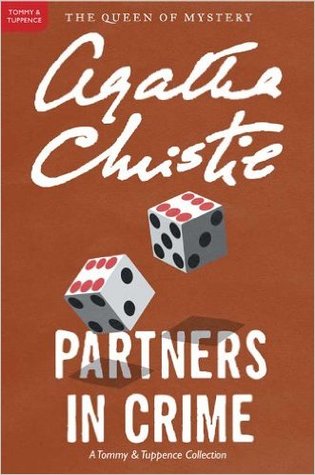
Partners in Crime by Agatha Christie

I have completely fallen behind with the monthly reads for the 2019 Read Christie challenge. I started to read this one in July, when we were challenged to read a Tommy and Tuppence book, but with one thing and another I didn’t get very far with it and ended up reading most of it last weekend. I’ll have to catch up with the August and September books at a later date.

Anyway, having already read Christie’s first Tommy and Tuppence book, The Secret Adversary, a few years ago, I decided to continue to work through the series in order and read Partners in Crime next. First published in 1929, this book is set about six years after the previous one and Tommy and Tuppence are now a happily married couple. Not too happily, though…Tuppence is getting bored and longing for adventure. As luck would have it, at this point their old friend Mr Carter, who works in government intelligence, arrives with a proposition that will provide all the adventure anyone could wish for.

Mr Theodore Blunt of Blunt’s International Detective Agency is under arrest for spying and Mr Carter wants Tommy and Tuppence to take over the running of the agency, with Tommy posing as Mr Blunt. This will allow them to intercept any more enemy messages and letters that are sent to the office – especially those written on blue paper and bearing a Russian stamp – and in the meantime, they can take on cases and investigate crimes. Joined by their young assistant, Albert, whom we met in The Secret Adversary, they rename themselves ‘Blunt’s Brilliant Detectives’ and then sit back and wait for their first case to begin…

What follows is a series of short stories, each dealing with a separate investigation, loosely linked by the spying storyline in the background. With cases of missing women, stolen jewels, suspected forgeries, poisoned chocolates and buried treasure to solve – and, of course, several murderers to identify – Tommy and Tuppence have more than enough to keep themselves busy, but to entertain themselves further they decide to investigate each crime in the style of one of their favourite fictional detectives. This is where my own knowledge of early 20th century crime fiction let me down as with the exceptions of Sherlock Holmes, Hercule Poirot and Baroness Orczy’s Old Man in the Corner, I was unfamiliar with most of the detectives being parodied. It didn’t really matter – the stories can still be enjoyed and understood anyway, but I did feel as though I was missing something at times.

Some of the plots are stronger than others; there was one story in particular (The Unbreakable Alibi) where I guessed the solution immediately and was surprised that it took Tommy and Tuppence so long to work it out! All of the stories are fun to read, though, which is partly due to the characters of Tommy and Tuppence themselves; there’s certainly never a dull moment when they are around! My only disappointment is that there are only another three books in this series to read. I am looking forward to the next one, N or M?, but first I’m hoping I might be able to squeeze in this month’s Read Christie selection, Five Little Pigs, before the end of September.
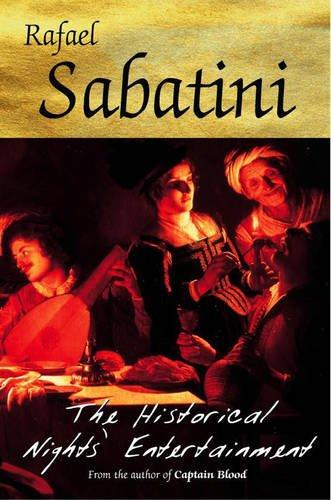
The Historical Nights’ Entertainment by Rafael Sabatini

Having read and loved several of Rafael Sabatini’s books in the past (I particularly recommend Scaramouche, The Sea Hawk and Captain Blood), I decided to try this one next, mainly because I was intrigued by the title, The Historical Nights’ Entertainment. First published in 1917, this is a collection of thirteen stories each giving an account of a dramatic historical event. The stories are difficult to classify as they are not exactly fiction but not quite non-fiction either. This is how Sabatini himself describes the book in his preface:

In approaching “The Historical Nights’ Entertainment” I set myself the task of reconstructing, in the fullest possible detail and with all the colour available from surviving records, a group of more or less famous events. I would select for my purpose those which were in themselves bizarre and resulting from the interplay of human passions, and whilst relating each of these events in the form of a story, I would compel that story scrupulously to follow the actual, recorded facts without owing anything to fiction, and I would draw upon my imagination, if at all, merely as one might employ colour to fill in the outlines which history leaves grey, taking care that my colour should be as true to nature as possible.

It seems that some of these stories involve a lot more ‘filling in’ than others so, although the ones that I was already familiar with do seem to stick quite closely to the facts, I wouldn’t assume that the others are completely historically accurate. Each story is probably best approached as just a basic introduction to a fascinating episode from history and used as a starting point to explore the topic in more depth later.

So what are the stories about? I’ve mentioned that a few were already familiar to me, so I will talk about those first. Two of them – The Night of Holyrood and The Night of Kirk O’Field – are set in 16th century Scotland and deal with the murders of David Rizzio and Lord Darnley (Mary, Queen of Scots’ private secretary and alleged lover and her husband, respectively). Another, The Night of Betrayal, tells the story of Antonio Perez, Philip II of Spain and Ana, Princess of Eboli – a story of particular interest to me as I read Kate O’Brien’s That Lady, on the same subject, last year. This version is narrated by Perez, rather than concentrating on Ana’s side of the story as O’Brien’s book did, so gave me a different perspective on the same events.

The Night of Witchcraft and The Night of Gems cover, respectively, the 17th century French scandal known as The Affair of the Poisons and the fate of a diamond necklace thought to be one of the factors that discredited the French monarchy and led to the French Revolution. I have read about both of these before but, this time, these stories didn’t add much to my existing knowledge.

What else is there? Well, there’s a dramatic account of Casanova’s escape from the Piombi prison in Venice, a tale set during the St Bartholomew’s Day Massacre, and several more stories based on historical murder cases, including the assassination of King Gustav III of Sweden at a masked ball and the death of the Duke of Gandia (also known as Giovanni Borgia). But my favourite was probably The Night of Nuptials, in which Sapphira Danvelt tries to obtain justice from Charles the Bold of Burgundy following the wrongful hanging of her husband. I loved the twist at the end of that one! Sabatini must have liked this story as well because he apparently returns to it in his 1929 novel The Romantic Prince, a book I haven’t yet read.

There are two more volumes in the Historical Nights’ Entertainment series but I’m not sure whether I’ll be reading them. Although most of the stories in this collection were interesting, there were only two or three that I really enjoyed; I will continue to read Sabatini’s longer novels, but the format of this particular book didn’t appeal to me as much.

Six Degrees of Separation: From A Gentleman in Moscow to Poor Miss Finch

It’s the first Saturday of the month which means it’s time for another Six Degrees of Separation, hosted by Kate of Books are my Favourite and Best. The idea is that Kate chooses a book to use as a starting point and then we have to link it to six other books of our choice to form a chain. A book doesn’t have to be connected to all of the others on the list – only to the one next to it in the chain.

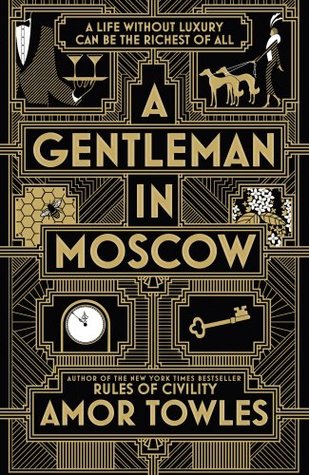
This month we are starting with A Gentleman in Moscow by Amor Towles, a book I read a few years ago – it’s not often that I’ve read the starting book in one of these chains and it does make things slightly easier! It tells the story of a Russian Count who is sentenced to spend the rest of his days under house arrest in Moscow’s Metropol Hotel. I really enjoyed this book and found it quite inspiring that the Count managed to lead such a fulfilling life during his confinement.

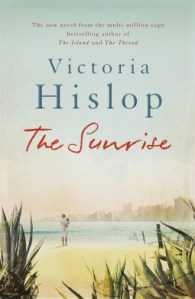
Another novel set in and around a hotel, this time in Cyprus, is The Sunrise by Victoria Hislop (1). The story takes place in Famagusta in 1974, when the Sunrise Hotel is evacuated during a Greek military coup and Turkish invasion. I found the book a bit uneven, but loved the setting and the vivid descriptions of the abandoned city.

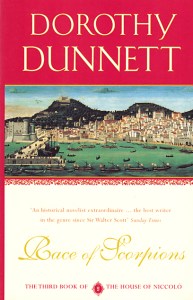
Famagusta already had a troubled history, long before the events of The Sunrise. In Dorothy Dunnett’s Race of Scorpions (2), the third in her House of Niccolò series, our hero Nicholas arrives in Cyprus in the early 1460s just as the island is torn apart by the conflict between Queen Carlotta and her half-brother James de Lusignan and the city of Famagusta finds itself under siege.

The Niccolò series takes us all over 15th century Europe and Africa, but the first book, Niccolò Rising, is set mainly in Bruges. I can’t think of many other books I’ve read that have Bruges as a setting, apart from an obvious one: The Master of Bruges by Terence Morgan (3). This novel is presented as the fictional memoirs of the 15th century artist Hans Memling who becomes acquainted with Edward IV and the future Richard III during their exile in Flanders.

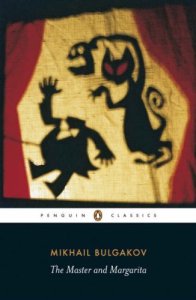
My next link is to another book with Master in the title. There were a few I could have chosen, but I decided on The Master and Margarita by Mikhail Bulgakov (4). I remember feeling intimidated by this book before I started to read it, but I needn’t have worried because I absolutely loved this weird and wonderful Russian classic.

A famous phrase from the book is “manuscripts don’t burn”, which makes my next link a very easy one. A Burnable Book by Bruce Holsinger (5) follows the poet John Gower as he searches 14th century London for a missing book of prophecies which predicts the death of the King of England. John Gower was a real person and although there’s not much biographical information on him available, we do know that he became blind in later life and in the sequel, The Invention of Fire, we see him trying to cope with his loss of sight.

Poor Miss Finch by Wilkie Collins (6) is a novel with a blind heroine and it handles the subject of blindness in a way that is both sensitive and fascinating. It’s not quite as ‘sensational’ as some of his other novels (and has a very strange subplot involving twins with blue skin), but I still enjoyed it!

And that’s my chain for this month. In October we’ll be starting with Three Women by Lisa Taddeo.

The Second Sleep by Robert Harris

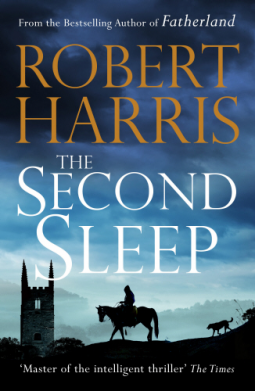
Robert Harris has become a favourite author of mine in recent years; I loved An Officer and a Spy, the Cicero trilogy and Conclave, and so far only Archangel has disappointed me. When I received a copy of his new novel, The Second Sleep, a few weeks ago, I was so excited about reading it that I dropped several other books I was in the middle of so I could start it immediately. But would it live up to my high expectations?

The first thing to say is that, if I had started to read this book without knowing the author’s name, I would probably never have guessed it was by Robert Harris as it’s so different from all of the others I’ve read! Whether or not you think that’s a good thing or a bad thing will depend on whether you prefer to know what to expect from an author or whether you like a lot of diversity. Personally I found this a bit too different and it took me quite a long time to settle into the story. Once I did, I started to enjoy it, but I can’t say that this has become a favourite by Harris.

At first The Second Sleep appears to be a conventional historical mystery. We are told that the year is 1468 and we are introduced to a young priest, Christopher Fairfax, who has just arrived in a small, remote village in the south-west of England to conduct the funeral of parish priest Father Lacy. Fairfax expects to return to Exeter Cathedral within a day or two, but when he discovers that there may have been suspicious circumstances surrounding the death of Father Lacy, he ends up staying in the village for much longer than planned. It seems that the old priest had been putting together a collection of forbidden books and artefacts and it was this which may have led to his death.

And that’s really all I can tell you about the plot. After a few chapters it becomes obvious that there is nothing conventional at all about this story, so I would hate to give too much away and spoil things for other readers. All I will say is that the central idea on which the novel is based is both fascinating and frightening, as well as having a lot of relevance to today’s society.

The Second Sleep is a very atmospheric novel and Harris carefully builds a sense of time and place, describing the landscape, the lives of the villagers and the sense of isolation that comes with living in such a remote location. Up in the hills, an unusual construction known as the Devil’s Chair – where Father Lacy fell to his supposedly accidental death – becomes the focus of the strange occurrences taking place in and around the village. It’s a bleak and eerie setting which perfectly suits this unusual and unsettling story.

Although this book never quite reached page-turner status for me, the pace did pick up after a while and the ideas the novel explored were intriguing enough to keep me interested. The story seemed to be building towards something dramatic and I expected more twists and revelations at the end. When the ending came, however, I was left thinking, ‘is that it?’ I wondered if I had missed something, so I read the final chapter again but found it no more satisfying the second time. Looking at other early reviews of this novel (the book is published today here in the UK), most people have loved it, so although I did find a lot to enjoy I’m sorry that I couldn’t quite manage to love it too. I do have both Munich and Pompeii on my shelf, though, and am still looking forward to reading both of those sooner rather than later.

Thanks to the publisher Hutchinson for providing a copy of this book for review via NetGalley.

20 Books of Summer 2019: The End!

This is the last day of this year’s 20 Books of Summer challenge hosted by Cathy at 746 Books. It’s the third time I’ve participated and the third time I’ve failed to complete it!

20 Books of Summer is a simple idea – to make a list of twenty books at the start of the summer and then read them between 1st June and 3rd September – but not as easy as it sounds. I have actually read exactly twenty books this summer, but only ten of them were on my list; I was tempted by too many other books in June, and then in July and August I found I was too busy to read very much at all.

Anyway, here are the ten books from my list that I managed to read, with links to my reviews:

1. The Island of Sea Women by Lisa See
2. The Woman in the Lake by Nicola Cornick
3. Gun Island by Amitav Ghosh
4. The Devil’s Slave by Tracy Borman
5. Wakenhyrst by Michelle Paver
6. The Lighthouse Keeper’s Daughter by Hazel Gaynor
7. Decoding the Bayeux Tapestry by Arthur C. Wright
8. Murder in the Crooked House by Soji Shimada
9. Just One Damned Thing After Another by Jodi Taylor
10. The Canary Keeper by Clare Carson

Of these, my favourites were The Island of Sea Women and The Devil’s Slave.

I am currently reading the following two books but couldn’t finish them in time:

11. A Tapestry of Treason by Anne O’Brien
12. The Butterfly Room by Lucinda Riley

And these are the eight I haven’t had time for, but do still want to read soon:

13. The Horseman by Tim Pears
14. Those Who Are Loved by Victoria Hislop
15. Anna of Kleve, Queen of Secrets by Alison Weir
16. The Doll Factory by Elizabeth Macneal
17. The Anarchist’s Club by Alex Reeve
18. Mrs Whistler by Matthew Plampin
19. A Thousand Ships by Natalie Haynes
20. Henry VI and Margaret of Anjou by Amy Licence

They will have to be autumn or winter reads instead of summer ones!

Did you take part in 20 Books of Summer this year? How did you do?

My Commonplace Book: August 2019

A selection of words and pictures to represent August’s reading:

commonplace book
noun
a book into which notable extracts from other works are copied for personal use.

~

I didn’t believe in the supernatural – I should say that up front, Mr Wrexham. And so the legends of the house didn’t bother me at all; in fact the whole idea of nannies and servants driven out by mysterious spooky happenings seemed more than a little ridiculous – almost Victorian.
But the fact was that four women had left the Elincourts’ employment in the last year. Having the bad luck to engage one nervous, superstitious employee seemed quite likely. Getting four in a row seemed…less so.

The Turn of the Key by Ruth Ware (2019)

~

‘Show respect!’ The chief sheriff took a pace towards Shadwell and raised his hand to strike him again, but the bishop waved him back.

‘One does not burn knowledge! That is a show for the common folk. One hides knowledge – one keeps it close. The libraries of the church hold truths you cannot dream of, Shadwell.’

The Second Sleep by Robert Harris (2019)

~

‘I think I can deal with a couple of boys, thank you, Detective Finkel,’ she said. ‘They’re the ones that need worrying about, not me; they’ll go to bed without a bite to eat. They’ve spent all their pennies on fireworks.’

‘They’ll be happy, though,’ he paused. ‘Sometimes it’s good to follow your heart’s desires.’

The Canary Keeper by Clare Carson (2019)

~

Favourite book read in August:

The Turn of the Key

New authors read in August:

Ruth Ware, Clare Carson

Countries visited in my August reading:

Scotland, England

~

Have you read any of these books? Which books did you enjoy in August?

Time for R.I.P. XIV…

I always enjoy taking part in R.I.P. (Readers Imbibing Peril), but I’ve been particularly looking forward to it this year because I feel as though I’ve done very little reading recently. Moving house and some big changes at work (including an office move and a new manager) have made this quite a busy and stressful summer for me and I’m not really sorry to see it come to an end. Having completely failed with my 20 Books of Summer list – more on that next week – I’m happy to put that challenge behind me for now and start a new one.

R.I.P. is now in its fourteenth year and I’ve been joining in since year five! The rules are very simple – from 1st September to 31st October we will be reading books that fit into any of the following categories:

Mystery, Suspense, Thriller, Dark Fantasy, Gothic, Horror or Supernatural.

As usual, there are different levels to choose from and I will be aiming for Peril the First, which is:

Read four books, any length, that you feel fit (our very broad definitions) of R.I.P. literature. It could be Stephen King or Sir Arthur Conan Doyle, Shirley Jackson or Tananarive Due…or anyone in between.

I have put together a list of possible reads, though I’m certainly not expecting to read all of these – and will probably end up reading books that aren’t on the list at all, which is what usually happens!

The first three books are on my NetGalley shelf so I would be reading them soon anyway; the rest are a mixture of unread books from previous years’ lists, library books and other review copies.

The Art of Dying by Ambrose Parry
Death on a Quiet Day by Michael Innes
The Anarchists’ Club by Alex Reeve
The Silent Companions by Laura Purcell
The Printer’s Coffin by MJ Carter
A Gathering of Ghosts by Karen Maitland
The Mystery of the Peacock’s Eye by Brian Flynn
Tombland by CJ Sansom
The Sussex Downs Murder by John Bude
Bone China by Laura Purcell
The Woman in Cabin 10 by Ruth Ware
The Turn of the Screw by Henry James
The Mummy Case by Elizabeth Peters
The Dark is Rising by Susan Cooper

~

Are you planning to take part in R.I.P. this year? What will you be reading?