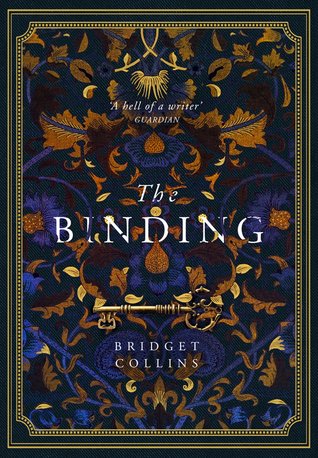
 With its attractive cover and intriguing premise, I hoped for great things from The Binding, but sadly it was not to be. I could tell almost from the beginning that it was probably not the right book for me, but I continued anyway, hoping it would get better – and it did. For a while in the middle I found myself enjoying it…but by the time I reached the end my feelings had turned to disappointment again and I wished I had followed my first instincts and stopped reading early on. For the right reader, though, I think this will probably be the great read it promised to be, so don’t let me put you off if you like the sound of the book!
The Binding is set in an unspecified time period, but there were clues that pointed to the late 19th century. Most of the action takes place in and around Castleford, a town in West Yorkshire, but it really could be anywhere. I’m sure the vagueness is deliberate because, as you’ll see, the world of The Binding is not quite the same as our own.
The novel begins with young Emmett Farmer receiving a summons to take up an apprenticeship as a bookbinder. He is reluctant to go – because he doesn’t want to leave his parents, his sister and the family farm, and also because he has always been told that books are dangerous and should be avoided – but it seems he is to be given no choice in the matter. Arriving at Seredith’s isolated bindery in the countryside, he learns from her the art of producing beautiful leather-bound books. But the real skill is involved in creating the contents…
Binders have a talent for drawing out unhappy or painful memories from people’s minds and trapping them between the covers of a book. With their memory wiped clean that person can then move on with the rest of their life, while the secrets of their past remain locked away in a vault. It’s a fascinating ability, but one which is open to abuse. What if one of these books falls into the wrong hands? What if someone is forced to have their memories bound because someone else wants them to forget? It’s a fascinating concept and the novel explores many of the equally fascinating issues that arise from it.
The book was divided into three sections and I think this structure caused some of the problems. In the first third of the book, we learned very little about Emmett even though he was our narrator and protagonist. His background was not really described in any detail, his relationships with his family and then with Seredith didn’t feel fully developed and I couldn’t even have told you what sort of personality he had. When the middle section of the story began to unfold, I understood why so much had been concealed from us and I was pleased to finally begin learning more about Emmett and the other characters – but by that time it was too late for me to feel the connection to them that I would have liked to have felt from the beginning.
I also think I’d had the wrong expectations for this book. I thought there would be a stronger fantasy element and that the concept of binding would play a bigger part in the story than it actually did. Instead, I couldn’t help feeling that the binding was only really there to provide a sort of framework for a romance between Emmett and another character. It’s disappointing because I think there was a lot of potential here and a lot of other intriguing ways that the binding idea could have been used. I’m sure there will be other readers who love this book, particularly those who enjoy young adult romances, but it just wasn’t quite right for me.



 She Reads Novels