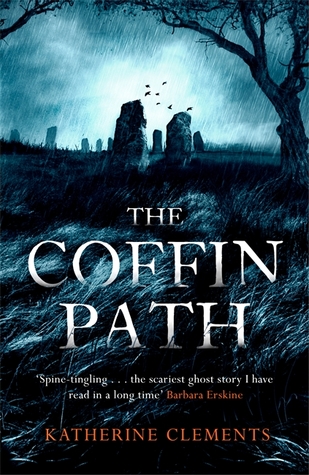
The Coffin Path by Katherine Clements

This is Katherine Clements’ third novel set in 17th century England, but it has a different feel from the previous two. Rather than being a straight historical novel like The Crimson Ribbon and The Silvered Heart, The Coffin Path is a ghost story with a lonely rural setting and this time there is much less focus on the political and social events of the period.

It’s 1674 and there are signs that spring is on its way to the Yorkshire moors. The first lamb of the season is about to make its appearance, but it is a difficult birth and requires human assistance. Mercy Booth of Scarcross Hall, who farms the land and tends the sheep for her elderly father, helps to deliver the lamb into the world but its mother dies in the process – the first of several bad omens. Next, three ancient gold coins go missing from her father’s collection and reappear in unexpected places – and then Mercy begins to hear noises coming from a disused bedchamber upstairs.

Around this time, a stranger arrives looking for work. His name is Ellis Ferreby and although the local people are slow to trust him, he soon proves himself to be a good shepherd and a reliable worker. Ellis, however, is a man with secrets and it seems that he could have reasons of his own for coming to Scarcross Hall.

We slowly get to know both Mercy and Ellis as their stories alternate with each other throughout the novel. We hear what Mercy’s life has been like, growing up without a mother, with only her eccentric father, Bartram, and the servants for company – and we learn of her hopes for the future, which centre around the knowledge that one day, as her father’s only heir, she will inherit her beloved Scarcross Hall. As for Ellis, his background is shrouded in mystery and the truth about both his past and his purpose in being at Scarcross is only revealed later in the novel.

The 17th century is obviously a period which interests Katherine Clements and of which she has a lot of knowledge: The Crimson Ribbon was the story of a servant in the household of Oliver Cromwell, while The Silvered Heart was about a highwaywoman in the aftermath of the English Civil War. The Coffin Path is set just a few decades after those two books yet I felt that the story would have worked just as well if it had been set in almost any other period, either an earlier century or a later one. Although the effects of the recent Civil War do still linger in the lives of our characters, this only has any real significance towards the end of the book – otherwise, perhaps because Scarcross Hall is so isolated from the wider world, there is a general feeling of timelessness.

However, what the novel lacks in sense of time is made up for in sense of place. There are some wonderful descriptions of the moors surrounding Scarcross Hall, bringing to life this harsh but beautiful landscape. We also explore some of the old traditions and beliefs which survive in this remote part of England: the White Ladies is an ancient stone circle which the villagers associate with evil, while the Coffin Path of the title refers to the old track down which coffins would be carried from the moors to the church for burial. It’s no wonder that in a place like this, people like Ellis and Mercy are viewed with suspicion and distrust – Ellis because he is an outsider and Mercy because she is an independent, unconventional woman, still unmarried in her thirties and doing ‘a man’s work’ on the farm.

I enjoyed following the personal stories of both main characters and I liked the supernatural elements too: they were suitably eerie, but at the same time subtle enough to keep me wondering whether there really were ghosts involved or whether something else was happening. My only problem with the book (other than the fact that, like many novels these days, it is written in present tense) was that there were times when the plot seemed to be moving forward very slowly. It didn’t help that the first few chapters are devoted to describing, in great detail, the birth of a lamb; I would have preferred a stronger opening to pull me straight into the story.

Of the three books by Katherine Clements I have read, I think I liked both of the others better than this one, but it’s good to see that she has tried something slightly different here. What will she write next, I wonder?

Thanks to Headline for providing a copy of this book for review via NetGalley.
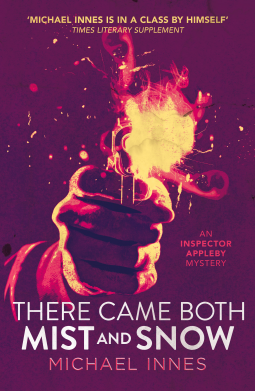
There Came Both Mist and Snow by Michael Innes

Having enjoyed two of Michael Innes’ Inspector Appleby novels last year – Hamlet, Revenge! and Lament for a Maker – I was drawn to this one next, because I liked the title and thought it would be appropriate as we’ve had some snowy weather here recently. Actually, although the novel is set during the Christmas period and there are a few mentions of snow, it doesn’t have a particularly wintry feel and could be read at any time of year.

It begins with our narrator, Arthur Ferryman, arriving at a family gathering at Belrive Priory, the home of his cousin, Basil Roper. The priory has been in the family for generations and nobody feels a closer affinity with its ancient stone walls, formal gardens and soot-blackened ruins than Arthur does. It comes as a shock, then, when he hears that Basil is planning to sell the estate to finance an expedition. As more members of the Roper family descend, along with various cousins and friends, it becomes clear that Arthur is not the only one unhappy with Basil’s decision. When one of the party is found shot while sitting at the desk in the study, there are plenty of suspects and plenty of motives. With perfect timing, Inspector Appleby arrives at the door just as the body is discovered, having received an invitation from Basil. Can Appleby find the culprit before someone else is hurt?

There Came Both Mist and Snow is my least favourite of the three Innes novels I’ve read so far. The mystery itself was well-constructed; Appleby seems to play a bigger role than in the other two books (certainly than in Lament for a Maker, where he only appeared near the end) and I enjoyed following the course of his investigations, with Arthur Ferryman as a sort of Watson character. There are several possible theories which are put forward by various members of the party and all of them seem plausible, which means the reader is constantly being led in the wrong direction. I would never have guessed the eventual solution; the clues aren’t concealed from the reader, exactly, but it’s definitely not something that is easy to deduce for yourself.

My problem with the book was due mainly to the length of time it took to get started. In the opening chapters we are given a lot of information on the Roper family background, the history of Belrive Priory and the changes that have come to the surrounding area as the neon lights of breweries and factories begin to shine into the priory’s ancient grounds. This information wasn’t completely insignificant, but I felt that it could have been woven more gradually into the story so that we could have reached the crime itself more quickly.

I think I would also have found the book more enjoyable if the characters had not been such an unpleasant and uninteresting group of people! I did like one of them – Arthur’s cousin Lucy Chigwidden, who happens to be a crime novelist, which gives Innes a chance to poke fun at his own profession – but none of the others were what I would consider strong or memorable characters.

I was a bit disappointed by this one, especially after enjoying the others so much, but I will continue to read the Appleby mysteries. I have The Daffodil Affair and Appleby’s End to choose from next.

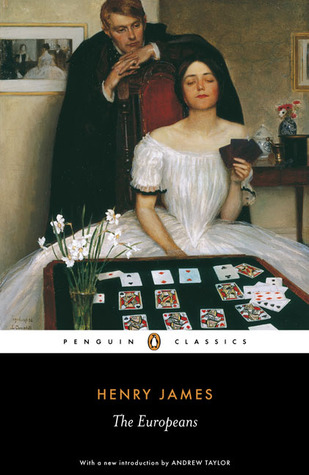
The Europeans by Henry James

I’m ashamed to say that this is the first book I’ve read by Henry James. Despite my love of 19th century literature, he is just not an author who has ever appealed to me and although I have started to read one or two of his novels in the past, I have never made it to the end of any of them. When I started to compile my new Classics Club list last year, Ottavia of Novels and Non Fiction recommended a few Henry James books that I might like and I decided on The Europeans based mainly, I have to admit, on the fact that it seemed quite short so I thought I would have a better chance of finishing it. I did finish it – and although I didn’t love it, I now feel more confident about reading more of his books in the future.

The ‘Europeans’ of the title are thirty-three-year-old Eugenia, Baroness Münster, and her younger brother, Felix Young, an artist. Eugenia’s morganatic marriage to Prince Adolf of Silberstadt-Schreckenstein looks to be in danger of falling apart. The prince’s family want to dissolve the marriage for political reasons and, although Eugenia has not yet given her consent, she has come to America with Felix to look for a rich American husband. The Youngs have cousins who live in Boston and on their arrival in New England, they spend some time getting to know them.

The American branch of the family consists of Mr Wentworth, his son Clifford, and his two daughters, Charlotte and Gertrude. Another cousin, Robert Acton, also lives nearby with his younger sister, Lizzie. Although she makes an effort at first, Eugenia decides that she has no desire to become part of the Wentworth’s social circle:

She had come to this quiet corner of the world under the weight of a cruel indignity, and she had been so gracefully, modestly thankful for the rest she found there. She had joined that simple circle over the way; she had mingled in its plain, provincial talk; she had shared its meagre and savorless pleasures. She had set herself a task, and she had rigidly performed it. She had conformed to the angular conditions of New England life, and she had had the tact and pluck to carry it off as if she liked them.

Felix, on the other hand, enjoys spending time with his cousins, especially Gertrude, with whom he has fallen in love. However, he is not the only one interested in Gertrude – Mr Brand, the minister, is expected to marry her, even though he is clearly better suited to Charlotte. Meanwhile, Clifford Wentworth, who has been sent home from Harvard for drinking, becomes attracted to both Eugenia and Lizzie Acton – while Robert Acton, recently returned from business in China, also turns his attentions to Eugenia. If you think this sounds confusing, you’re right. I was reminded of A Midsummer Night’s Dream as the relationships between these characters gradually became disentangled and each person found themselves with the right partner (apart from one, but I will leave you to discover who that one is).

The main theme of the book appears to be the differences between European and American people – or rather, the differences as Henry James perceived them in 1878, when the novel was written. The European characters, Felix and Eugenia, are portrayed as emotional, free-spirited people living bohemian lifestyles, while their American cousins are presented as serious, reserved and unsophisticated. They are stereotypes, of course, but probably quite different from the sort of stereotypes that would be used today.

This is a novel driven by the characters and the relationships between them, but I would have preferred more plot as I just didn’t find the characters strong enough to keep me interested from beginning to end. Eugenia intrigued me as it is never quite clear what her motives are or what decisions she is going to make, and the cheerful, optimistic Felix brightens every scene in which he appears, but the others were less memorable and I didn’t feel that I really got to know any of them. As I’ve said, though, this is only a short book and I’m sure that when I get round to reading some of James’ longer novels there will be more development of characters and ideas.

Which Henry James book do you think I should try next?

This is book 3/50 from my second Classics Club list.

The Brimming Cup by Dorothy Canfield Fisher

I had never read anything by Dorothy Canfield Fisher, so when I saw that she was the next author in Jane’s Birthday Book of Underappreciated Lady Authors, I thought this would be the perfect opportunity. Ideally I would have started with her most popular book, The Home-Maker, but as I didn’t have a copy of that one, it made sense to read the one I did have instead.

The Brimming Cup opens with a prologue set in Italy in 1909 in which we briefly meet Neale and Marise, a young couple who are very much in love and making plans for the future. Marise has a very clear idea of what she wants and expects from their relationship:

“But what would poison us to death…what I’m afraid of, between two people who try to be what we want to be to each other…how can I say it?” She looked at him in an anguish of endeavor, “…not to be true to what is deepest and most living in us…that would be the betrayal I’m afraid of. That’s what I mean. No matter what it costs us personally, or what it brings, we must be true to that. We must!”

Eleven years later, Marise and Neale are married and living in Vermont. It’s 1920 and Marise has just sent their youngest child, Mark, off to school for the first time. Where once she had three children at home all day, now she has none and, with Neale so busy running the family business, Marise’s role as wife and mother is no longer the same as it used to be.

When Mr Welles, a retired office worker, moves in next door accompanied by his younger friend, Vincent Marsh, Marise begins to feel even more unsettled. Vincent makes her think differently about her life and about her relationships with her husband and children. Do the children appreciate everything she has done for them? Do they even truly love her or would they feel the same about any adult who raised them? Is her life being wasted in this quiet little town in Vermont? Forced to question all the things in which she has ever believed, Marise remembers the vow she made in Rome – that she and Neale should each be true to themselves no matter what.

I found it interesting to see how this novel, published in 1919, explores some of the attitudes, views and theories of the time surrounding issues such as childcare, parenthood, identity and marriage. As newcomers to the town, Mr Welles and Vincent Marsh introduce Marise to different ideas and opinions. Vincent’s suggestions that Marise should be making more of her talent as a pianist and break away from the role she has fallen into in the home seem very tempting – especially as she is starting to wonder whether Neale is really the man she thought he was – while Mr Welles’ interest in helping his cousin in Georgia to fight prejudice against black people also gives her something to think about.

I found a lot to appreciate and enjoy in this novel, but I can’t say that I loved the book as a whole and I’m not sure yet whether Dorothy Canfield Fisher is really an author for me. There were times when some of the writing felt a bit too sentimental for my taste and there were some plot developments towards the end, involving another family, the Powers, which felt unnecessarily melodramatic and out of balance with the rest of the story. I will probably try at least one more of her books, though, because it could just be that this one wasn’t the best of introductions for me. I’m tempted by Rough-Hewn, which was published after The Brimming Cup and seems to be a prequel, but maybe I should read The Home-Maker instead to see why so many people love it so much.

The Girl in the Tower by Katherine Arden

I enjoyed The Bear and the Nightingale when I read it almost exactly a year ago and I remember my excitement on discovering that it was actually the first in a planned trilogy. We haven’t had to wait too long for the second book, The Girl in the Tower, and I’m pleased to say that I loved it even more than the first.

Katherine Arden’s books are a wonderful mixture of history, folklore and fairytales with an atmospheric and wintry Russian setting. If you haven’t read The Bear and the Nightingale yet, I would highly recommend starting with that one – and I should warn you that there may be spoilers for the first book in the rest of this post.

At the beginning of The Girl in the Tower, our heroine Vasilisa Petrovna (Vasya) is fleeing her childhood village of Lesnaya Zemlya. Despite her efforts to rescue the villagers from a great evil, the way in which her father and stepmother died has caused Vasya to be branded a witch, regarded with suspicion and distrust. Accompanied by her magnificent stallion Solovey, Vasya sets off on a journey across northern Rus’ to Moscow, home of her sister Olga – a journey which will be filled with danger as Vasya encounters a group of bandits sweeping across the countryside burning villages and kidnapping children. First, though, she must pay a visit to Morozko, the frost-demon, in his fir-grove deep in the forest…

This novel has a much wider geographical scope than the previous one, in which the action takes place almost entirely in and around Lesnaya Zemlya. I liked this aspect of the book; medieval Moscow is an interesting setting and, with Olga’s family close to the Grand Prince, Dmitrii Ivanovich, we are given some insights into the political situation during this period of Russian history. At the time of the story, the Rus’, as it was known then, is still part of the domain of the Great Khan and the Golden Horde, but with their influence weakening as the Grand Prince grows in power, it seems that things could be about to change.

I was also pleased to see Vasya reunited with her siblings, not just Olga but also their brother Sasha, who is now a priest. Sadly, her relationships with both Olga and Sasha are very strained, partly because of what happened in Lesnaya Zemlya, for which Vasya is unable to give an adequate explanation, and also because of her behaviour on arriving in Moscow, which they consider unladylike and inappropriate. To the modern reader, Vasya is a wonderful character – brave, independent and rebellious – but her refusal to conform to the 14th century ideal of what a woman should be leads her into a great deal of trouble. In contrast, Olga has accepted her place in society and expects her young daughter, Marya, to follow the same course in life. Marya, though, appears to have other ideas!

I’ve said very little so far about the fantasy elements of the novel. We don’t see very much of the household spirits who played such an important part in The Bear and the Nightingale, but there are some appearances by intriguing new figures from Russian myth including the Firebird – and another, more sinister, character whose name I won’t give here so as not to spoil anything! I also enjoyed Vasya’s interactions with her magical horse, Solovey, who has begun to form a personality of his own. Last, but certainly not least, there’s Morozko, frost-demon and god of the dead.

There were hints in the previous book of a possible romance between Vasya and Morozko, and in this book their relationship is developed further. It’s definitely not a conventional love story and because of who Morozko is and the role he has to play in Russian folklore, he has a tendency to come and go throughout the novel. It’s frustrating but it worked for me and I found myself looking forward to the scenes they shared. I loved The Girl in the Tower – and the good news is that the third book in the trilogy, The Winter of the Witch, is expected this August!

Thanks to Ebury Publishing for providing a copy of this book for review via NetGalley.
This book counts towards this year’s What’s in a Name? Challenge: A title containing the word ‘the’ used twice.

Top Ten Tuesday: Last year’s love affairs

This week’s Top Ten Tuesday (hosted by That Artsy Reader Girl) is a ‘Love Freebie’. I have decided to approach this topic by choosing ten of the most interesting, moving or memorable romances and love affairs from my last year of reading (February 2017 to February 2018).

***

1. Frenchman’s Creek by Daphne du Maurier

This isn’t one of my favourite du Maurier novels but I still enjoyed this story of Dona St Columb who, having grown bored and disillusioned with her marriage, heads for Cornwall to spend some time away from her husband and his friends. Here she meets the pirate Jean-Benoit Aubéry and as she begins to fall in love with him, she struggles to reconcile her impressions of the polite, cultured Frenchman with the terrible tales she has heard from the neighbours.

~

2. Shadow of the Moon by MM Kaye

I loved this book which I read as part of a readalong last summer. Set before and during the Sepoy Mutiny of 1857 it follows the story of Winter de Ballesteros, who travels across the sea to India to marry her fiance, the Commissioner of Lunjore. Captain Alex Randall is sent to escort her on the journey, but falls in love with her himself. Will he be able to prevent the marriage or is Winter too infatuated with the Commissioner to see clearly?

~

3. Wuthering Heights by Emily Brontë

I’m sure this one needs no introduction! This is one of my favourite books and I re-read it last February for the first time in years. As I said in my review, “the relationship between Heathcliff and Cathy is hardly a conventional romance and although there is love, it is an obsessive and unhealthy love”. It may not be the most romantic of love stories, but I have always liked the darkness, the passion and the melodrama.

~

4. Wintercombe and Herald of Joy by Pamela Belle

During the English Civil War, the home of Silence St Barbe, wife of a Parliamentarian officer, is garrisoned by Royalist soldiers. The romance between Silence and one of the enemy captains, which develops slowly over the course of two novels, was one of my favourites of last year. There’s more to these books than romance, though, and I would recommend them to anyone interested in this period of history.

~

5. Towers in the Mist by Elizabeth Goudge

The romance in this one forms a relatively small part of the novel. Published in 1937, it’s set in Oxford during the Elizabethan period and follows the story of fourteen-year-old Faithful Crocker who is welcomed into the household of Canon Leigh of Christ Church. We get to know all of the members of the family, but the romance between eldest daughter Joyeuce Leigh and the student Nicolas de Worde was one of my favourite storylines.

~

6. Long Summer Day by RF Delderfield

The first volume in Delderfield’s A Horseman Riding By trilogy introduces us to Paul Craddock who uses his inheritance to buy an estate in rural Devon. There are two love interests for Paul: sensible, kind-hearted Claire Derwent, daughter of one of his tenant farmers, and the strong and independent suffragette, Grace Lovell. I won’t tell you which way the story plays out!

~

7. The Fortune of War by Patrick O’Brian

Surgeon and spy Stephen Maturin and Diana Villiers met in the second book in O’Brian’s Aubrey/Maturin series; this is book number six and their tempestuous relationship still hasn’t been resolved. Will they find any happiness in the next volume? I have the seventh book lined up to read soon, so I’ll be able to find out!

~

8. Wolf Among Wolves by Hans Fallada

Set in Germany in 1923, gambler Wolfgang Pagel loses his money at roulette – and loses his fiancee, Petra Ledig, who refuses to see him again until he reforms. The two are separated for most of the novel, as Wolfgang tries to build a new life away from the temptations of the city, but their relationship and the question of whether they will ever be reunited was one of my favourite aspects of the book.

~

9. The Heart’s Invisible Furies by John Boyne

A very one-sided love affair! Our hero Cyril, whom we follow from birth to old age, is still a teenager when he falls in love with his more popular, more sophisticated friend, Julian Woodbead. Will he ever have the courage to tell Julian how he feels – and if he does, will his feelings be returned?

~

10. Anne Boleyn: A King’s Obsession by Alison Weir

This may seem an unusual one to include in a list of romances, especially when you consider how it ended, but surely the love affair between Henry VIII and Anne Boleyn was one of the most important in English history. After all, it was one of the factors leading to the king’s divorce from Katherine of Aragon, the break with Rome and the start of the Reformation. Alison Weir’s novel tells Anne’s story right from her early years through to her beheading.

~

What about you? Have you read any books with interesting romances or love affairs recently? What are your all-time favourites?

Historical Musings #35: Historical Fantasy

I have just finished writing my review of The Girl in the Tower, the second in Katherine Arden’s fantasy trilogy which began with The Bear and the Nightingale. The trilogy is set in 14th century Russia (or Rus’, as it was called then), a world which has been researched and recreated to resemble the real 14th century Rus’ – apart from the existence of household spirits, frost-demons, firebirds and magical horses. This made me think about other books I’ve read which have both historical and fantasy elements.

First, there are the books I consider to be mainly historical fiction with some elements of magical realism. A good example would be The Miniaturist by Jessie Burton, which is set in 17th century Amsterdam but has a supernatural twist in the form of a dolls’ house and a mysterious miniaturist. Another recent read, The Mermaid and Mrs Hancock by Imogen Hermes Gowar is set in Georgian England with only a few brief touches of fantasy, while The Bedlam Stacks by Natasha Pulley, about a quinine-collecting expedition to Peru, incorporates moving statues and exploding trees. At the other end of the scale there’s The Enchantress of Florence by Salman Rushdie, which takes us to a 16th century India populated with giants and witches, where emperors have imaginary wives and artists hide inside paintings.

Naomi Novik’s Temeraire series (of which I’ve still only read the first one!) is set during the Napoleonic Wars in a world very much as it would have been at the time, with one important difference: dragons exist and are used by both the British and French as a sort of early air force. Another book with the Napoleonic Wars for a setting, one which I read pre-blogging this time, is Jonathan Strange and Mr Norrell by Susanna Clarke. I remember loving the mixture of magic and history and the fascinating footnotes describing the world of Faerie.

Then there are Guy Gavriel Kay’s books, which are set in fantasy worlds which resemble real historical worlds. Tigana, my favourite, takes place in a world with one blue moon and one white, but there are clear parallels with Renaissance Italy, while The Lions of Al-Rassan has a setting similar to medieval Spain. The Last Light of the Sun takes us to a land where magical forces gather in the forests and faeries wait to claim the souls of the dead, yet this land is identifiable as Northern Europe in the time of the Vikings, the Anglo-Saxons and the Celts. Finally, Children of Earth and Sky is set in thinly-disguised versions of Venice, Dubrovnik and Constantinople during the Renaissance period. These are the only books I have read by Kay so far, but I will certainly be reading more.

How do you feel about fantasy or magical realism combined with historical fiction? Have you read any of the books I’ve mentioned here? Can you recommend more?