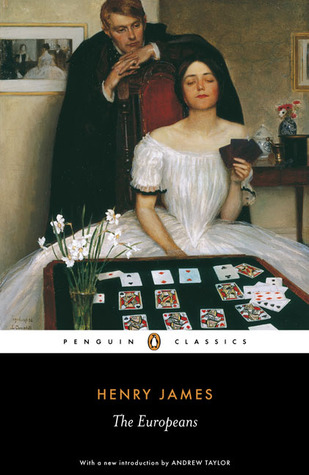
 I’m ashamed to say that this is the first book I’ve read by Henry James. Despite my love of 19th century literature, he is just not an author who has ever appealed to me and although I have started to read one or two of his novels in the past, I have never made it to the end of any of them. When I started to compile my new Classics Club list last year, Ottavia of Novels and Non Fiction recommended a few Henry James books that I might like and I decided on The Europeans based mainly, I have to admit, on the fact that it seemed quite short so I thought I would have a better chance of finishing it. I did finish it – and although I didn’t love it, I now feel more confident about reading more of his books in the future.
The ‘Europeans’ of the title are thirty-three-year-old Eugenia, Baroness Münster, and her younger brother, Felix Young, an artist. Eugenia’s morganatic marriage to Prince Adolf of Silberstadt-Schreckenstein looks to be in danger of falling apart. The prince’s family want to dissolve the marriage for political reasons and, although Eugenia has not yet given her consent, she has come to America with Felix to look for a rich American husband. The Youngs have cousins who live in Boston and on their arrival in New England, they spend some time getting to know them.
The American branch of the family consists of Mr Wentworth, his son Clifford, and his two daughters, Charlotte and Gertrude. Another cousin, Robert Acton, also lives nearby with his younger sister, Lizzie. Although she makes an effort at first, Eugenia decides that she has no desire to become part of the Wentworth’s social circle:
She had come to this quiet corner of the world under the weight of a cruel indignity, and she had been so gracefully, modestly thankful for the rest she found there. She had joined that simple circle over the way; she had mingled in its plain, provincial talk; she had shared its meagre and savorless pleasures. She had set herself a task, and she had rigidly performed it. She had conformed to the angular conditions of New England life, and she had had the tact and pluck to carry it off as if she liked them.
Felix, on the other hand, enjoys spending time with his cousins, especially Gertrude, with whom he has fallen in love. However, he is not the only one interested in Gertrude – Mr Brand, the minister, is expected to marry her, even though he is clearly better suited to Charlotte. Meanwhile, Clifford Wentworth, who has been sent home from Harvard for drinking, becomes attracted to both Eugenia and Lizzie Acton – while Robert Acton, recently returned from business in China, also turns his attentions to Eugenia. If you think this sounds confusing, you’re right. I was reminded of A Midsummer Night’s Dream as the relationships between these characters gradually became disentangled and each person found themselves with the right partner (apart from one, but I will leave you to discover who that one is).
The main theme of the book appears to be the differences between European and American people – or rather, the differences as Henry James perceived them in 1878, when the novel was written. The European characters, Felix and Eugenia, are portrayed as emotional, free-spirited people living bohemian lifestyles, while their American cousins are presented as serious, reserved and unsophisticated. They are stereotypes, of course, but probably quite different from the sort of stereotypes that would be used today.
This is a novel driven by the characters and the relationships between them, but I would have preferred more plot as I just didn’t find the characters strong enough to keep me interested from beginning to end. Eugenia intrigued me as it is never quite clear what her motives are or what decisions she is going to make, and the cheerful, optimistic Felix brightens every scene in which he appears, but the others were less memorable and I didn’t feel that I really got to know any of them. As I’ve said, though, this is only a short book and I’m sure that when I get round to reading some of James’ longer novels there will be more development of characters and ideas.
Which Henry James book do you think I should try next?
This is book 3/50 from my second Classics Club list.






 She Reads Novels