“I can’t tell you how many people have told me their scary house stories.
But none of them can compare to the houses in this story. These strange, strange houses.”
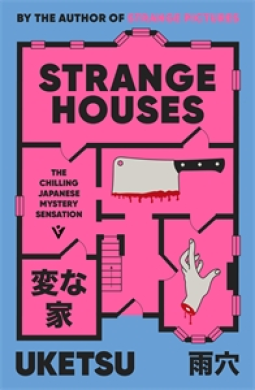 I loved Uketsu’s Strange Pictures when I read it earlier this year, so I was excited to see another of his books, Strange Houses, available on NetGalley. Like the first book, this one has been translated into English from the original Japanese by translator Jim Rion. Also like the first book, it contains a number of illustrations and diagrams that form an important part of the story.
The novel begins with our narrator, a freelance writer, being approached by his friend Yanaoka, who is searching for a suitable house in which he and his wife can raise their first child. Having viewed a house in a quiet residential area of Tokyo, Yanaoka and his wife have both fallen in love with it but are confused by the floor plan which shows a ‘dead space’ – in other words, a tiny hidden room with no doors. The narrator has another friend, Kurihara, who is an architect, so he decides to ask his opinion.
When Kurihara studies the floor plans, he picks up on several other unusual features of the house. These, together with the hidden room, lead him to form a bizarre but terrifyingly logical explanation for the design of the building. Yanaoka chooses not to buy it, but the narrator is intrigued and continues digging into the house’s history, uncovering connections with some other equally strange houses!
I really enjoyed the first half of this book, almost as much as Strange Pictures. It has a similarly interactive feel, where we are encouraged to look at the illustrations and identify the clues in them along with the narrator. Although Kurihara’s theory about the design of the Tokyo house seems ridiculously far-fetched, it does also make sense when you consider the layout of the rooms, the positions of doors and windows and the location of the house itself. I would never have imagined that floor plans could be creepy, but the ones in this book certainly are!
A difference between this book and Strange Pictures is that the other book is made up of several separate but interconnected stories, while this one consists of just one plot and one set of characters. The change in format means this book feels less varied and innovative, but it also allows us to follow the story of one family – the family who built the houses – through to the end. In the second half of the book, the focus moves away slightly from the plans and layouts and concentrates more on the history of the family. Things become quite convoluted, with complex relationships between the family members, rivalries between different branches and tales of curses and traditions going back several generations. I was reminded of Seishi Yokomizo’s mystery novels and I wonder if these, as well as Yukito Ayatsuji’s Bizarre House series, have influenced Uketsu.
In an interview, translator Jim Rion has talked about how Uketsu wants his writing to be easy to read and accessible to all readers and I think Rion has done a great job of keeping that same clarity in his translations. I’ve also discovered that a third book, Strange Buildings, is coming soon. Something to look forward to!
Thanks to Pushkin Vertigo for providing a copy of this book for review via NetGalley.

Book 6/20 for 20 Books of Summer 2025.
 She Reads Novels
I didn’t realise there was another book by this author. It sounds like another fascinating idea and I think an interactive novel sounds fun. This one does sound quite different from the first but I have to admit talk of curses always intrigues me. And although it may be a big farfetched I’m curious to see what the architect’s theory for the house plans is. I hope you enjoy the next one too. With so many books coming so close together it sounds like they must be popular.
Yes, I think they have been very successful in Japan, so the publisher is bringing out the English translations as quickly as possible. I enjoyed the first book more, but I can see why other people might prefer this one!
That makes sense, hopefully they’re doing well here too. It’ll be interesting to see which one I prefer. I’m curious about the house element of this one but I love interconnected stories sometimes. I’ll have to let you know how I felt once I’ve read both.
Turns out I have both of these books from NG and have yet to start them. I was interested to see your comments and post about them. I did look on my NG list and found another title with the word Strange in it. The Strange Case of Jane O. got me intrigued as well, as I have liked reading books about amnesiacs and their stories of loss of memory. Good to find these three books to read this July.
Harvee https://harvee44.blogspot.com/
I hope you enjoy these two books! I hadn’t heard of The Strange Case of Jane O, but I’ve just looked it up and it does sound interesting too.
This sounds fascinating – I love books about houses and I love floorplans (also snooping them on Rightmove) so a book with a plot that uses floorplans?! Yes pls!
It sounds as though this book could be ideal for you, then, although you won’t find any floorplans quite like these on Rightmove!
So intriguing, Helen, and sounding *ahem* right up my street! An author and a couple of titles for me to look out for.
I think you would find them interesting, particularly the first one!
I might try the first one.
I definitely thought the first one was a stronger book.
I have a copy of Strange Pictures, so good to know you felt that one was the strongest. I really struggle with floorplans as I find it very hard to visualise objects in space! It’s really hard for me to figure out what rooms might be on top of each other in a house, for example. So pictures might also be more accessible to me haha.
Yes, it sounds like Strange Pictures would be a better place for you to start. The illustrations in that one are easier to deal with visually – and it’s a stronger book, anyway!