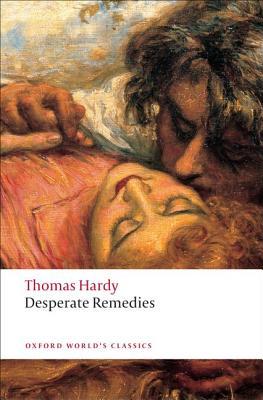
Desperate Remedies by Thomas Hardy

Desperate Remedies (1871) was Thomas Hardy’s first published novel, following an earlier manuscript which failed to find a publisher and was later destroyed. I love Thomas Hardy’s books and have been looking forward to reading this one as it has been described as a sensation novel, a genre of Victorian fiction that I’ve enjoyed since I first discovered authors like Wilkie Collins, Mary Elizabeth Braddon and Ellen Wood, in the years before I started my blog.

At the beginning of the novel, we learn that our heroine, Cytherea Graye, was named after her father’s one true love, a woman who disappeared without explanation and left him heartbroken. Mr Graye later married and had two children – Cytherea and her brother Owen – whom he raised alone after his wife’s death. When Mr Graye himself dies, having made some poor business decisions in the final years of his life, Cytherea and Owen are faced with making their own way in the world. Owen decides to pursue a career as an architect, while his sister advertises for work as a governess.

Finding it harder to get a job than she had expected, Cytherea eventually accepts a position as lady’s maid to Miss Aldclyffe, a middle-aged unmarried woman who seems to be hiding a number of secrets. Why does she have so much affection for Cytherea, whom she has never met until now? Why does she go to such great lengths to employ the mysterious Aeneas Manston as steward on her estate – and why is she so keen to encourage Cytherea to marry him? Manston is another person with secrets and Cytherea is reluctant to marry someone she feels she can’t fully trust, especially as she has already fallen in love with Edward Springrove, her brother’s friend. Unfortunately, Edward is engaged to another woman – and when Cytherea’s financial situation becomes increasingly desperate, she finds herself drawn into Aeneas Manston’s schemes.

I loved Desperate Remedies! It starts off slowly, introducing Cytherea and her family background and explaining the circumstances that lead to her arrival at Miss Aldclyffe’s house, but it quickly develops into an intriguing and entertaining page-turner with plenty of twists and surprises. I liked Cytherea; there are stronger, more interesting heroines in some of Hardy’s later novels, but Cytherea is by no means a weak and helpless woman and I enjoyed following her story.

I did find two of the novel’s big secrets quite easy to guess, but there were still times when I wasn’t sure where the story was going and when the actions of one character or another left me mystified. The plot makes it feel quite similar to a Wilkie Collins novel, but there are still some elements which make it recognisable as a book written by Thomas Hardy, such as the descriptions of the landscape and the portrayal of a small rural community. This isn’t one of my absolute favourite Hardy novels – I think some of his later ones are better – but it’s still a great read.

The remaining novels I have left to read by Hardy are all books that I know nothing about: The Well-Beloved, Two on a Tower, A Laodicean, The Hand of Ethelberta and The Trumpet-Major. Does anyone have any recommendations from those five? I also haven’t read any of his short story collections, Wessex Tales, Life’s Little Ironies and A Group of Noble Dames, so I still have lots of Hardy to look forward to.

This is book 4/20 of my 20 Books of Summer and book 6/50 from my second Classics Club list.

The Big Book of Swashbuckling Adventure, edited by Lawrence Ellsworth

After reading Lawrence Ellsworth’s new translation of the Alexandre Dumas novel The Red Sphinx last year, I discovered that Ellsworth was also the editor of the enticingly titled The Big Book of Swashbuckling Adventure. As a fan of the swashbuckling genre, I knew I would have to read it.

This is certainly a big book, containing eighteen stories and poems written in the 19th or early 20th centuries. Some of them are by well-known classic authors such as Dumas, Arthur Conan Doyle and Baroness Orczy, but some of the others are more obscure – authors who may have enjoyed some success at the time, but have been largely forgotten today. Ellsworth provides a brief introduction to each author’s work, including a short biography and some background information on the story which follows and why he selected it for this collection. All different types of swashbuckling hero are represented: the pirate, the musketeer, the jester, the swordsman, the aristocrat and more.

I’m not going to discuss all of the stories in depth here – there are too many of them – but I will highlight a few favourites and just give the others a quick mention.

One that I particularly enjoyed was Crillon’s Stake by Stanley J Weyman, an author I’ve heard about but have never actually read until now. Set in France in 1587, two men sit down to play a game of dice in which the stakes become higher and higher until they are literally gambling with their lives. The outcome of the game will have surprising consequences, however, as the participants become entangled in a conspiracy against the king.

Another favourite was The Black Death by Marion Polk Angellotti, one of only a few female authors to be featured in the book. This story is part of a series that she wrote about the adventures of the 14th century mercenary captain Sir John Hawkwood. On a journey through the mountains of Italy, Hawkwood tries to protect his men from attack by enemy soldiers, but with the Black Death raging across the country, he could be leading them into a different type of danger instead.

I also enjoyed Pirate’s Gold by H. Bedford-Jones, which was first published in an American ‘pulp magazine’ in the 1920s. George Roberts accepts a position as first mate on a ship sailing to Virginia, The King Sagamore, which is captained by the charismatic Captain Low. It is only when the ship has left port and is out at sea that Roberts discovers his captain is actually the notorious pirate better known as Bloody Ned. This is a much longer story than most of the others in the book – more of a novella, really, which allows more development of storyline and characters – and although I doubt I’ll look for anything else by Bedford-Jones, this was fun to read.

The Sin of the Bishop of Modenstein by Anthony Hope is another fun read, set in the kingdom of Ruritania, the same world as his famous novel The Prisoner of Zenda. In this story, King Rudolf of Zenda gambles away his castle and estate, but when the new owner, Count Nikolas of Festenburg, moves in, he discovers that Rudolf’s sister, Princess Osra, is still there…

I was surprised to find that I had already read some of the pieces in the book. The Cabaret de la Liberté by Baroness Orczy is taken from her collection The League of the Scarlet Pimpernel, which I read a few years ago. I couldn’t really remember this particular Pimpernel story, so I was happy to read it again. I did not re-read White Plume on the Mountain by Alexandre Dumas, which is not actually a standalone story, but a reproduction of several chapters from the end of The Red Sphinx.

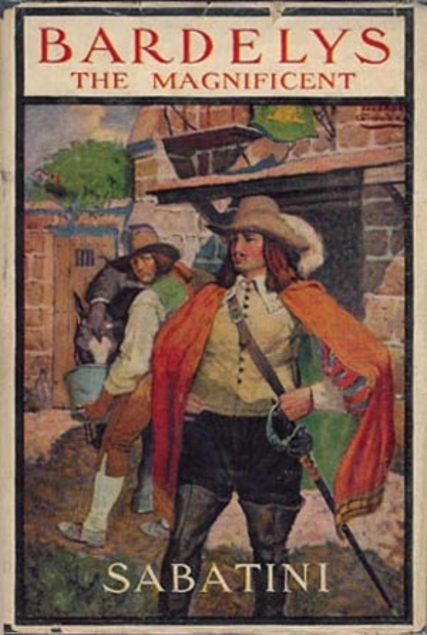
For the same reason I didn’t bother with Captain Blood’s Dilemma by Rafael Sabatini, and I only briefly looked at The Fight for Black Bartlemy’s Treasure by Jeffery Farnol, which are also the concluding chapters of full-length novels (Captain Blood and Black Bartlemy’s Treasure respectively). It just seemed an odd decision to include these in a collection of ‘short stories’ and will surely spoil the actual novels for anyone who hasn’t read them. On the other hand, Ellsworth does include the opening chapters of Johnston McCulley’s first Zorro novel, turning them into a story titled Señor Zorro Pays a Visit. This seems a much more sensible way to introduce a new reader to an author’s work!

There’s also a second story by Sabatini (Sword and Mitre, a true standalone this time), and one each by Sidney Levett-Yeats, John Bloundelle-Burton and Harold Lamb. I hadn’t come across any of the last three authors and I found their stories entertaining but forgettable (although Lamb’s is slightly different, being set in India). Finally, there’s a story by Arthur Conan Doyle which features his hero Brigadier Gerard, and a Robin Hood adventure by Pierce Egan. The collection is completed by several short poems, Cheerly O and Cheerly O by Jeffery Farnol, The Buccaneer’s Last Shot by Farnham Bishop and The Pirate Sea by Lilian Nicholson. These are interspersed amongst the stories and add a bit of extra variety.

As is usually the case with anthologies of this kind, the stories and the writing are of mixed quality and I found it quite uneven, especially towards the end. With such a variety of different types of story, though, I think there should be something for almost everyone here.

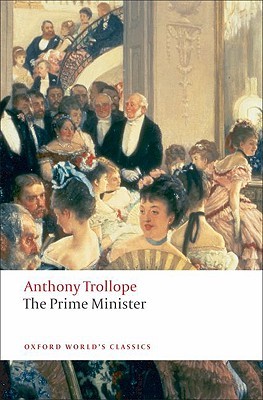
The Prime Minister by Anthony Trollope

I love Anthony Trollope’s books, but sometimes I need to be pushed into picking them up; I know I’m going to enjoy them, but they are all so long and, once you start reading and become caught up in the lives of the characters, so intense, that I really have to be in the right mood before starting one. As I have already read the first four books in the Palliser series, I added the last two – The Prime Minister and The Duke’s Children – to my Classics Club list to ensure that I got to them sooner rather than later.

The Prime Minister is the fifth in the series and, as predicted, once I got into it I loved it. It had been a while since I read the previous novel, Phineas Redux, (two years, in fact) but that didn’t matter at all – yes, we are reunited with some old friends, but there are new characters and new storylines too, so it wasn’t really necessary to be able to remember everything that happened in the last book. One of those new characters is Ferdinand Lopez, a handsome, charismatic adventurer, thought to be of Portuguese-Jewish descent, who sets his sights on marrying Emily Wharton, the daughter of a wealthy London lawyer.

Emily is in love with Lopez, but Mr Wharton is not at all happy at the prospect of having him as his son-in-law. He has always hoped to see Emily marry her friend Arthur Fletcher, whose family have connections with the Whartons. However, as his main objection to Lopez as a suitor is based on the fact that he is not an Englishman and nobody knows who his parents are, Mr Wharton eventually agrees to let Emily choose her own husband. Will she be happy with her choice or will she end up regretting her decision?

Ferdinand Lopez is a wonderful character; it is obvious from the start that he is going to be the villain of the novel, but we don’t know exactly what form his villainy will take. Watching him plot and scheme as he tries to make himself rich and rise up the social ladder is what drives the story forward. It’s disappointing, from a modern day perspective, that Ferdinand’s background is seen as one of the factors against him, but of course it’s realistic that a conservative, conventional Victorian gentleman like Mr Wharton would have held those views. Anyway, he is much more interesting to read about than Emily’s other love interest, the likeable, socially acceptable but slightly boring Arthur Fletcher. The relationship between the three of them reminded me of the two similar storylines in the first Palliser novel, Can You Forgive Her?

But this book is called The Prime Minister and so far I haven’t mentioned the title character at all! He is a man we already know from the previous books in the series: Plantagenet Palliser, who has recently inherited the title of Duke of Omnium. With neither main political party able to form a government on their own, a coalition has been formed and Plantagenet has been made Prime Minister, mainly because no one else is considered suitable. And Plantagenet is not entirely suitable either; he is an honest, dignified, principled man but lacks the ruthlessness and the leadership skills that are needed in his new job.

The Duchess of Omnium – formerly Lady Glencora Palliser – is much happier in her role as Prime Minister’s wife than Plantagenet is in his as Prime Minister! In some ways she has a better understanding of politics than he does, but their very different methods of dealing with their new position in the world lead to some conflict and tension in their marriage – particularly when Ferdinand Lopez arrives at one of Glencora’s parties hoping to be shown some favour by the new Prime Minister.

Both stories – the story of Emily and her husband and the story of the Prime Minister – are interesting and compelling. Although it was published in 1876 some aspects of the plot still have a lot of relevance today, such as the power of the press and the integrity of politicians being called into question. This is one of my favourite books in the Palliser series and I’m now looking forward to reading the final one, The Duke’s Children.

This is book 4/50 from my second Classics Club list.

The Europeans by Henry James

I’m ashamed to say that this is the first book I’ve read by Henry James. Despite my love of 19th century literature, he is just not an author who has ever appealed to me and although I have started to read one or two of his novels in the past, I have never made it to the end of any of them. When I started to compile my new Classics Club list last year, Ottavia of Novels and Non Fiction recommended a few Henry James books that I might like and I decided on The Europeans based mainly, I have to admit, on the fact that it seemed quite short so I thought I would have a better chance of finishing it. I did finish it – and although I didn’t love it, I now feel more confident about reading more of his books in the future.

The ‘Europeans’ of the title are thirty-three-year-old Eugenia, Baroness Münster, and her younger brother, Felix Young, an artist. Eugenia’s morganatic marriage to Prince Adolf of Silberstadt-Schreckenstein looks to be in danger of falling apart. The prince’s family want to dissolve the marriage for political reasons and, although Eugenia has not yet given her consent, she has come to America with Felix to look for a rich American husband. The Youngs have cousins who live in Boston and on their arrival in New England, they spend some time getting to know them.

The American branch of the family consists of Mr Wentworth, his son Clifford, and his two daughters, Charlotte and Gertrude. Another cousin, Robert Acton, also lives nearby with his younger sister, Lizzie. Although she makes an effort at first, Eugenia decides that she has no desire to become part of the Wentworth’s social circle:

She had come to this quiet corner of the world under the weight of a cruel indignity, and she had been so gracefully, modestly thankful for the rest she found there. She had joined that simple circle over the way; she had mingled in its plain, provincial talk; she had shared its meagre and savorless pleasures. She had set herself a task, and she had rigidly performed it. She had conformed to the angular conditions of New England life, and she had had the tact and pluck to carry it off as if she liked them.

Felix, on the other hand, enjoys spending time with his cousins, especially Gertrude, with whom he has fallen in love. However, he is not the only one interested in Gertrude – Mr Brand, the minister, is expected to marry her, even though he is clearly better suited to Charlotte. Meanwhile, Clifford Wentworth, who has been sent home from Harvard for drinking, becomes attracted to both Eugenia and Lizzie Acton – while Robert Acton, recently returned from business in China, also turns his attentions to Eugenia. If you think this sounds confusing, you’re right. I was reminded of A Midsummer Night’s Dream as the relationships between these characters gradually became disentangled and each person found themselves with the right partner (apart from one, but I will leave you to discover who that one is).

The main theme of the book appears to be the differences between European and American people – or rather, the differences as Henry James perceived them in 1878, when the novel was written. The European characters, Felix and Eugenia, are portrayed as emotional, free-spirited people living bohemian lifestyles, while their American cousins are presented as serious, reserved and unsophisticated. They are stereotypes, of course, but probably quite different from the sort of stereotypes that would be used today.

This is a novel driven by the characters and the relationships between them, but I would have preferred more plot as I just didn’t find the characters strong enough to keep me interested from beginning to end. Eugenia intrigued me as it is never quite clear what her motives are or what decisions she is going to make, and the cheerful, optimistic Felix brightens every scene in which he appears, but the others were less memorable and I didn’t feel that I really got to know any of them. As I’ve said, though, this is only a short book and I’m sure that when I get round to reading some of James’ longer novels there will be more development of characters and ideas.

Which Henry James book do you think I should try next?

This is book 3/50 from my second Classics Club list.

The Crowded Street by Winifred Holtby

The Crowded Street is on my Classics Club list, so when I saw that Jessie of Dwell in Possibility was hosting a Persephone Readathon this week, my choice was obvious. This particular book has also been published as a Virago Modern Classic, but my edition is the Persephone one, with the endpapers pictured below. Having already enjoyed several of Holtby’s books – South Riding, The Land of Green Ginger and Poor Caroline – I’ve been looking forward to this one for a while and I’m pleased to say that I loved it even more than I hoped I would.

The novel was published in 1924, at a time when it was assumed that most young women wanted nothing more than to find a husband and then stay at home to raise their children. In The Crowded Street, Holtby looks at what it was like to be a woman who, for one reason or other, was unable to conform to these expectations. Through the stories of Muriel Hammond, her sister Connie and her friends Clare and Delia, she explores the very different routes through life taken by four very different women.

We first meet Muriel in December 1900 when she is eleven years old and attending her first ‘grown-up’ party. Her excitement soon turns to shame when she finds that none of the boys want to dance with her and her dance card remains almost blank. Muriel is confused: The unforgivable sin at a party is to have no partners. To sit quietly in the drawing-room at home was a virtue. The sense that she has somehow let her mother down is a feeling which will stay with her for the next two decades as she continues to go through life partnerless, waiting and hoping for something to happen. She does initially have ambitions – to study astronomy, to go to college – but she doesn’t pursue these as she receives no encouragement from her mother or from her school teacher, who says:

“Character, my dear, to be a fine womanly woman, that matters so much more than intellectual achievement. To serve first your parents, then, I hope, your husband and your children, to be pure, unselfish and devoted, that is my prayer for each one of my girls.”

As a single woman myself, there were times when Muriel’s story resonated with me, but thankfully not all the time! I may not be married, but nobody ever prevented me from going to university or getting a job. Muriel watches with envy as Delia, another unmarried girl from the same Yorkshire village, goes off to Cambridge University, then heads for London and throws herself into political activism.

“But then, she has her work. Women who have their work have an immense thing, even if they are unfortunate in the people whom they love. It is when you have nothing, neither work, nor love, nor even sorrow, that life becomes rather intolerable.”

Of course, some women today are happy to stay at home with their parents, there are some who find plenty of fulfilment in marrying and having children, while others want to move away to pursue their career. There is no right or wrong way to live, but the point is that we have a choice. What makes Muriel’s story so tragic is that she feels she has no choice. She believes that marriage is the only possible way to escape, but if that doesn’t happen, all she can do is continue to help her mother around the house, doing what she sees as her duty (even though her help isn’t particularly necessary). As a result, she becomes more and more depressed, feeling that life is passing her by but lacking the confidence to do anything about it and making excuses to justify why she can’t.

Her younger sister, Connie, tries to break away from the stifling confines of life in Marshington, but she is so desperate that she makes a bad decision which has disastrous consequences. It seems that the only one who is likely to be happy is Muriel’s old school friend, the cheerful and sophisticated Clare, who goes through life without a care in the world and catches the eye of Godfrey Neale, the one man Muriel dreams of as her own potential husband. Clare, though, has the opposite problem. Having had a very different upbringing from Muriel and Connie, will she be able to adapt to living in a small Yorkshire village?

At one point, Muriel thinks to herself:

“All books are the same – about beautiful girls who get married or married women who fall in love with their husbands. In books things always happen to people. Why doesn’t somebody write a book about someone to whom nothing ever happens – like me?”

Well, Winifred Holtby has written that book and I don’t think it’s quite true that nothing happens to Muriel. She does develop as a person as the novel progresses and, although it takes a long time, she slowly becomes aware that if she is to have any happiness she will have to take matters into her own hands. I loved the way her story ended: she has an important decision to make and in my opinion she does the right thing.

As well as following the characters I’ve mentioned above, we are also given some insights into the effects of the First World War on small communities like the fictional Marshington. I particularly enjoyed the vivid depiction of the bombardment of Scarborough in 1914, something Winifred Holtby could draw on personal experience to describe. The Crowded Street is a wonderful book in so many ways and a great choice for both the Classics Club and the Persephone Readathon!

This is Book 2/50 from my second Classics Club list

The Man Who Was Thursday by GK Chesterton

This 1908 novel from the author of the Father Brown mystery series is subtitled A Nightmare and it certainly does have a dreamlike feel. I picked it up expecting a vintage detective novel and emerged at the other end wondering what on earth I had just been reading and what it meant.

The novel opens with a conversation between two men who meet for the first time one evening in Saffron Park in London. One, Lucian Gregory, is an anarchist poet; the other, Gabriel Syme, is a member of the secret anti-anarchist police. They spend the whole of the first chapter debating the meanings of anarchy and of law and order, using arguments like this:

Gregory struck out with his stick at the lamp-post, and then at the tree. “About this and this,” he cried; “about order and anarchy. There is your precious order, that lean, iron lamp, ugly and barren; and there is anarchy, rich, living, reproducing itself—there is anarchy, splendid in green and gold.”

“All the same,” replied Syme patiently, “just at present you only see the tree by the light of the lamp. I wonder when you would ever see the lamp by the light of the tree.”

And this:

“An artist disregards all governments, abolishes all conventions. The poet delights in disorder only. If it were not so, the most poetical thing in the world would be the Underground Railway.”

“So it is,” said Mr. Syme.

“Nonsense!” said Gregory, who was very rational when anyone else attempted paradox.

It seems they will never agree, but to at least prove that he is serious about his cause, Gregory invites Syme to accompany him to an underground meeting of anarchists. Gregory gets more than he bargained for, however, when Syme puts himself forward for a position in which he himself had been interested: one of seven coveted seats on the Council of the Seven Days, the central council of the European anarchists.

Elected to the council and given the code name Thursday, Syme is introduced to his fellow days of the week, but will he be able to prevent them from guessing that he is an undercover policeman? And who is Sunday, their mysterious and sinister leader who is so big, so powerful and so much larger than life?

I don’t think there is much more I can say about the plot without spoiling the story. I can’t discuss the themes of the novel either, or the symbolism it contains, because those things are also spoilers. It’s such a strange and unusual book that I really think it’s best not to know too much about it before you begin. Just be aware that it’s not a conventional mystery or detective novel (or a conventional anything). There are parts that I loved, such as a scene where Syme is followed through the streets of London in the snow; there are funny moments too, some witty and amusing dialogue, and lots of thought-provoking philosophical ideas. At other times it becomes a little bit too bizarre, particularly after the action moves to France halfway through the book.

There are plot twists throughout the novel, some of which are quite predictable – but the revelations near the end of the book were not what I had been expecting at all. Looking back, there were plenty of hints and clues, but I didn’t pick up on them. I’m sure I didn’t fully grasp what Chesterton was trying to say, but I think there are probably different ways to interpret this book anyway. It certainly left me with a lot to think about and I love it when that happens – when you continue to engage with a story even after you’ve turned the final page.

I don’t have any more of Chesterton’s books, but I see there are some I could read for free at Project Gutenberg. I have previously read two of his Father Brown short stories (included in Miraculous Mysteries and Murder Under the Christmas Tree); should I read more of those or is there another of his books that you would recommend?

Death Comes for the Archbishop by Willa Cather

This is the first book I’ve read from my new Classics Club list and my third by Willa Cather. I’m grateful to the recent Classics Spin for choosing it for me because although I do like Cather’s writing I seem to need something to push me into picking up her books. This one could have lingered on my list for a long time otherwise, which would have been a shame as once I started reading it I loved it. It’s certainly my favourite of the three I’ve read so far (the others are The Professor’s House and My Ántonia).

Death Comes for the Archbishop is set in the nineteenth century and follows the stories of Bishop Jean Marie Latour and his friend Father Joseph Vaillant, two French missionaries who have been sent into the newly formed diocese of New Mexico – territory which has recently been acquired by America. As they begin their work of spreading their faith to the people of New Mexico, they face a number of challenges. The landscape, although beautiful, is harsh and often inhospitable; the railroad has not yet arrived so travel must be by mule over difficult terrain. When they do eventually reach other settlements, they are disappointed to find that the Catholic priests already established in these communities are, in most cases, not suitable for the job. They are either corrupt, greedy, too powerful, too weak or insufficiently devoted to their religion.

It is the task of Father Latour, with the help of Father Vaillant, to decide how to tackle these problems, while also learning to love his new home and getting to know the people who have lived there for generations. These include not only Americans and Mexicans, but also the Hopi, Navajo and other Native American people, whom Cather writes about with sensitivity and sympathy. Each group have their own customs, traditions, stories, histories and superstitions and as all of these things are new to the Bishop and his friend, the reader is able to learn along with them.

I have never been to New Mexico so as I read I found myself turning to Google for images of the deserts and hills, mesas and pueblos, plants and trees that are mentioned in the novel. After Latour visits the pueblo of Acoma and hears about the legend of the Enchanted Mesa, for example, I wanted to see what it would be like to live in such a harsh and isolated location. Cather writes beautifully about the New Mexico landscape; her use of colour is wonderful, helping to bring her descriptions to life. Here is the moment when Latour arrives at Santa Fé for the first time:

As the wagons went forward and the sun sank lower, a sweep of red carnelian-coloured hills lying at the foot of the mountains came into view; they curved like two arms about a depression in the plain; and in that depression was Santa Fé, at last! A thin, wavering adobe town…a green plaza…at one end a church with two earthen towers that rose high above the flatness. The long main street began at the church, the town seemed to flow from it like a stream from a spring. The church towers, and all the low adobe houses, were rose colour in that light,–a little darker in tone than the amphitheatre of red hills behind; and periodically the plumes of poplars flashed like gracious accent marks,–inclining and recovering themselves in the wind.

My favourite aspect of the novel is the relationship between Bishop Latour and Father Vaillant. The two men have known each other since they were students together at the seminary in France and I found the depiction of their friendship very moving, particularly later in the book when Father Vaillant has the chance to take up a new mission far away; the Bishop, who can’t bear to lose his companionship, must decide whether to keep his friend with him for selfish reasons or to let him go and give him the chance to develop his own career elsewhere and carry out the work which will make him happy. The characters are based on real historical figures – Jean-Baptiste Lamy and Joseph Projectus Machebeuf – but I like the names Cather has chosen for them. Vaillant, meaning ‘valiant’, is perfect for Joseph, who is brave and energetic, warm and friendly, while Latour (‘the tower’) is quieter and more reserved, finding it more difficult to open up and make friends. Their different qualities, different strengths and weaknesses are what make them such a successful partnership.

Death Comes for the Archbishop has no real plot, being more a series of little stories and vignettes spread across a number of years and describing the various experiences Latour and Vaillant have as they travel around the New Mexico diocese. I do prefer novels that strike a balance between the plot-driven and the character-driven, but I still thoroughly enjoyed this book – it got my new Classics Club journey off to a great start! I’m looking forward to reading more Willa Cather and I think the next one I pick up will be either Shadows on the Rock or A Lost Lady.

~

Book 1/50 from my second Classics Club List