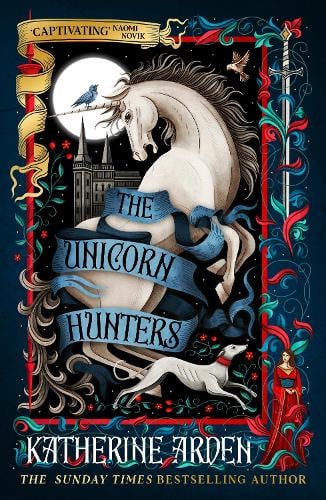
 This was one of my most anticipated new releases of the year, having loved first Katherine Arden’s Winternight trilogy and then her standalone novel, The Warm Hands of Ghosts. The Unicorn Hunters promised the same blend of history, fantasy and folklore and sounded just as fascinating.
The novel is set in 15th century Brittany, at that time an independent duchy. Following the death of Duke Francis II, his daughter, Anne, has succeeded him as Duchess of Brittany. She believes she will be able to govern Brittany well and had promised her father she would never allow it to be conquered, but naturally a land ruled by a young, unmarried woman quickly comes under threat from other, more powerful nations. Determined to avoid a union with France at all costs, Anne secretly marries Maximilian of Austria by proxy but as she waits for her new husband to join her in Brittany, Charles VIII of France and his forces draw closer to the duchy.
As a delaying tactic, Anne suggests a unicorn hunt in the enchanted forest of Brocéliande. She’s sure the king and his men will be unable to resist the temptation of capturing a magical beast – and according to legend, a unicorn can only be tamed by a virgin, which means Anne should be able to avoid being forced into marriage with Charles until Maximilian arrives and her secret can be revealed. No one is really expecting to see a unicorn – until one emerges from the trees and allows Anne to take a lock of its mane. With Anne under increasing pressure to agree to the French marriage, it seems there could be a way to save Brittany after all, but it will mean delving further into the world of magic.
I really enjoyed The Unicorn Hunters, although I found it a bit uneven. The first half is mainly concerned with the politics of Brittany and France, with only a few fantasy elements: the brief appearance of the unicorn, whom we don’t see again until later; the role of diviners who use dice, wine or beetles to spy on rival courts and coloured cloths to communicate what they’ve learned; and a man who stumbles out of the Lost Lands, a sinister realm that borders the forest of Brocéliande and is inhabited by korrigans (Breton fairies or spirits). I was reminded very much of Guy Gavriel Kay’s books, which are mostly set in thinly disguised worlds based on real countries and real historical periods and have subtle supernatural touches. In the second half of this novel, though, the fantasy elements become much stronger as Anne and her friends and enemies move in and out of the Lost Lands.
I liked Anne as a character, but I should point out that the Anne of Brittany in this book is not quite the same as the historical one and her story follows a different path, so be aware that you aren’t learning the ‘real history’ here. For example, the real Anne was eleven when she succeeded to the duchy, but Katherine Arden’s Anne is an adult. Other characters, such as Louis of Orléans and Anne’s sister Isabeau, have also had large parts of their stories altered – and Charles VIII’s sister, Anne of France, is renamed Marguerite to avoid confusion. Arden explains some of her choices in an author’s note at the end of the book, although I wonder whether it would have been more sensible to have just changed the names of all of the people and places, like Kay does, and set the book in an entirely alternate version of history.
Something I really loved about this book is the way so many aspects of Breton myth and legend are incorporated into the story: the mythical lost city of Kêr-Is, swallowed up by the sea in the Bay of Douarnenez; the presence of the korrigans and the anaon (spirits of the dead); the ancient forest of Brocéliande, associated with Merlin and the Arthurian legends; and of course, the unicorn – but unicorns obviously appear in the myths of other cultures as well. The real Anne of Brittany does actually have a connection with unicorns as it has been speculated that she commissioned the famous set of tapestries known as The Unicorn Tapestries, although this has never been proven.
I preferred the earlier sections of the book as I felt there was a definite shift in tone and pace in the second half, but I’m sure other readers will have the opposite preference depending on whether you like your fiction to be more grounded in history and politics or more fantasy-heavy. The Winternight books are still my favourites by Katherine Arden (start with The Bear and the Nightingale and read all three in order) but this was enjoyable as well and I’ll be looking out for her next book.
Thanks to Random House UK/Century for providing a copy of this book for review via NetGalley.

Book 3/20 of 20 Books of Summer