Six Degrees of Separation: From Redhead by the Side of the Road to The Mirror Crack’d from Side to Side

It’s the first Saturday of the month which means it’s time for another Six Degrees of Separation, hosted by Kate of Books are my Favourite and Best. The idea is that Kate chooses a book to use as a starting point and then we have to link it to six other books of our choice to form a chain. A book doesn’t have to be connected to all of the others on the list – only to the one next to it in the chain.

This month we are starting with Redhead by the Side of the Road by Anne Tyler. It’s a book I haven’t read and know nothing about, but here is the description from Goodreads:

Micah Mortimer isn’t the most polished person you’ll ever meet. His numerous sisters and in-laws regard him oddly but very fondly, but he has his ways and means of navigating the world. He measures out his days running errands for work – his TECH HERMIT sign cheerily displayed on the roof of his car – maintaining an impeccable cleaning regime and going for runs (7:15, every morning). He is content with the steady balance of his life.

But then the order of things starts to tilt. His woman friend Cassia (he refuses to call anyone in her late thirties a ‘girlfriend’) tells him she’s facing eviction because of a cat. And when a teenager shows up at Micah’s door claiming to be his son, Micah is confronted with another surprise he seems poorly equipped to handle.

Redhead by the Side of the Road is an intimate look into the heart and mind of a man who sometimes finds those around him just out of reach – and a love story about the differences that make us all unique.

~

I struggled to think of a first link (some months it’s much more difficult than others, particularly if you haven’t read the book), so I’m afraid I’m going to be unimaginative and just link to another book with the word ‘road’ in the title: The Road to Wigan Pier by George Orwell (1). In this non-fiction book, first published in 1937, Orwell writes about the poor living conditions of working-class people in the north of England, with a particular focus on miners and their families. In one chapter, Orwell describes how he went down a coal mine himself to observe the working conditions.

Another book from the 1930s – fictional this time – which is set in a coal mining community is How Green Was My Valley by Richard Llewellyn (2). The story is narrated by Huw Morgan who is looking back on his childhood growing up in the valleys of South Wales, watching his elder brothers go off one by one to join their father in the mines. I loved this poignant and beautifully written novel.

My next link is to another novel set in Wales, but in a much earlier period. Here Be Dragons (3) is the first book in Sharon Penman’s Welsh Princes Trilogy and tells the story of Joanna, daughter of King John of England, and her marriage to Llewelyn ab Iorweth, Prince of Gwynedd. I loved this book and the second one, Falls the Shadow, and was sorry to hear of Sharon Penman’s death a few weeks ago. I must get round to reading the final book in the trilogy soon.

The title ‘Here Be Dragons’ refers to a term used to describe unexplored territories on maps; there are no actual dragons in the story! My next book, however, does involve dragons. Temeraire by Naomi Novik (4) is the first in a series of historical fantasy novels set during an alternate version of the Napoleonic Wars in which dragons provide military support to the British and French navies. I really enjoyed it and loved the relationship between Captain Will Laurence and his dragon, Temeraire, so I don’t know why I still haven’t continued with the second book in the series.

I have read quite a lot of other books set during the Napoleonic Wars but the one I’m going to link to here is Watch the Wall, My Darling by Jane Aiken Hodge (5), a gothic suspense novel from 1966 complete with smugglers, spies, a haunted house and plenty of family secrets! The unusual title, ‘Watch the wall, my darling’, is a line from Rudyard Kipling’s poem, A Smuggler’s Song.

There are many books that have titles inspired by poetry, so I’m going to finish my chain with Agatha Christie’s The Mirror Crack’d from Side to Side (6). The title of this Miss Marple mystery is taken from Tennyson’s The Lady of Shalott – “Out flew the web and floated wide – The mirror crack’d from side to side; ‘The curse is come upon me,’ cried The Lady of Shalott”.

~

And that’s my chain for February. My links have included: the word ‘road’, coal miners, Wales, dragons, the Napoleonic Wars and lines from poems. I have even managed to bring the chain full circle with the word ‘side’ in both the first and last title!

Next month we’re starting with Phosphorescence by Julia Baird.

Top Ten Tuesday: Authors I read for the first time in 2020

This week’s theme for Top Ten Tuesday (hosted by Jana at That Artsy Reader Girl) is:

New-to-me authors I read in 2020.

There are lots of authors I read for the first time last year, but I have listed here a mixture of some that I loved and definitely want to explore further and some that I’m still not sure about.

~

1. Robertson Davies – I enjoyed Fifth Business, the first book in Davies’ Deptford Trilogy, so the next logical step is to read the next book, The Manticore. I hope to get to it at some point this year.

2. Dorothy B. Hughes – I loved The Expendable Man, published by Persephone, and am looking forward to reading more of her books.

3. Hella S. Haasse – In a Dark Wood Wandering was another of my favourite books from last year. Her other novels all sound intriguing; I just need to decide which one to try next.

4. Ann Patchett – The Dutch House was a surprise; I hadn’t expected to enjoy it as much as I did. I had previously dismissed her as not for me, but will now have to investigate her earlier books.

5. Matthew Plampin – Mrs Whistler is a fascinating novel about the artist James Whistler and his relationship with Maud Franklin; Plampin’s other books all seem just as interesting!

6. Maggie O’Farrell – I didn’t love Hamnet as much as most other readers seem to have done, but I liked her writing enough to want to give her another chance.

7. Carol McGrath – I enjoyed The Silken Rose, a novel about Eleanor of Provence, and am looking forward to reading Carol McGrath’s next novel about another medieval queen, Eleanor of Castile, when it is published later this year.

8. Georges Simenon – Now that I’ve read Simenon’s atmospheric 1934 novella, The Man from London, I think I’ll have to try his Maigret series next!

9. Joseph Conrad – Lord Jim was my first Joseph Conrad book, apart from an earlier failed attempt to read Heart of Darkness. I don’t think he’s my sort of author, although I could be tempted to try one more, possibly Nostromo.

10. Ethel Lina White – The Wheel Spins is the book on which The Lady Vanishes was based. Although I didn’t love the book as much as the film, I’m now interested in reading more of her work.

~

Have you read any of these authors? Can you recommend which of their books I should try next?

Six Degrees of Separation: From Hamnet to Macbeth

It’s the first Saturday of the month (and of the new year) which means it’s time for another Six Degrees of Separation, hosted by Kate of Books are my Favourite and Best. The idea is that Kate chooses a book to use as a starting point and then we have to link it to six other books of our choice to form a chain. A book doesn’t have to be connected to all of the others on the list – only to the one next to it in the chain.

This month we are beginning with Hamnet by Maggie O’Farrell. I read this book last year and although I thought the writing was beautiful, I didn’t love it as much as most other people seem to have done. It’s a great book to start this month’s chain with, though, because there are so many possible options for the first link!

Drawing on Maggie O’Farrell’s long-term fascination with the little-known story behind Shakespeare’s most enigmatic play, Hamnet is a luminous portrait of a marriage, at its heart the loss of a beloved child.

Warwickshire in the 1580s. Agnes is a woman as feared as she is sought after for her unusual gifts. She settles with her husband in Henley street, Stratford, and has three children: a daughter, Susanna, and then twins, Hamnet and Judith. The boy, Hamnet, dies in 1596, aged eleven. Four years or so later, the husband writes a play called Hamlet.

Award-winning author Maggie O’Farrell’s new novel breathes full-blooded life into the story of a loss usually consigned to literary footnotes, and provides an unforgettable vindication of Agnes, a woman intriguingly absent from history.

Shakespeare is not named in Hamnet; he is always referred to as ‘the husband’ or ‘the father’, which puts the focus on Agnes and their children. The Secret Life of William Shakespeare by Jude Morgan (1) does use Shakespeare’s name, as well as the more commonly used Anne Hathaway in place of Agnes, but it also focuses on Shakespeare as a husband and father and is written largely from his wife’s perspective.

Another book I’ve read with a title beginning ‘The Secret Life of’ is The Secret Life of Wilkie Collins (2), a biography of one of my favourite Victorian authors. The writer of the biography, William M. Clarke, was married to Collins’ great-granddaughter, which gave him access to personal information about Collins’ private life, family relationships and romantic entanglements, and these things form the basis of the book. However, I found the writing style quite dry and I would also have preferred more discussion and analysis of Collins’ work as well as his life.

Next, I’m linking to a book by Wilkie Collins himself: The Frozen Deep (3), not one of his better known books but still one that I enjoyed reading. It’s a short one – a novella, really – but still an entertaining and compelling story, inspired by reports of Sir John Franklin’s famously doomed 1845 voyage to the Arctic in search of the Northwest Passage during which the ships became icebound and the members of the expedition disappeared.

Clare Carson’s historical novel The Canary Keeper (4) is set just a few years after the Franklin Expedition. The novel follows Birdie Quinn, a young woman who finds herself a suspect in a murder case, as she travels to the Orkney Islands to try to identify the real killer and clear her name. As she investigates, she discovers some fascinating links between the murder and the expedition.

I can only think of one other novel I’ve read set in Orkney and that is King Hereafter by Dorothy Dunnett (5), a very different kind of story from The Canary Keeper and taking place many centuries earlier! This beautifully written and thoroughly researched novel is based around the theory that Macbeth, the historical King of Alba, and Thorfinn, Earl of Orkney, were the same person.

This, of course, leads me to Macbeth by William Shakespeare (6) and so brings the chain full circle! It’s not often that I manage to do that, so I’m pleased to have achieved it with my first chain of the year.

~

And that’s this month’s Six Degrees of Separation. My links included Shakespeare, secret lives, Wilkie Collins, the Franklin Expedition, Orkney and Thorfinn/Macbeth.

In February we will be starting with Redhead By the Side of the Road by Anne Tyler.

Top Ten Tuesday: My favourite books of 2020

This week’s Top Ten Tuesday (hosted by That Artsy Reader Girl) asks us to list our top ten favourite books of 2020. I know there are still a few days of 2020 left, but I’m confident that I’m not going to finish anything before the end of the year that would have made it onto my list, so I think it’s safe to post it now!

I have found it difficult to concentrate on reading at times this year (I’m sure I don’t need to tell you why) and I haven’t read as many books as I normally would – the fewest since 2010, in fact. I also feel that, although I’ve read some very good books this year, there aren’t many that really stand out from all the others and I struggled to pick out ten favourites. Instead of ten, then, I am only listing eight – and here they are:

~

1. The Expendable Man by Dorothy B Hughes (1963)

From my review: “If you think you might want to read this book, it’s best that you know as little as possible before you begin. And I do highly recommend reading it! I was completely gripped from beginning to end…I couldn’t bear to put the book down until I knew what was going to happen to Hugh.”

2. A Murder is Announced by Agatha Christie (1950)

From my review: “Of all the Christie novels I’ve read, this has one of the best openings: first an introduction to each character in turn as we jump from house to house as newspapers are opened and the announcement is read; then the murder scene itself – a wonderful set piece with all of the suspects together in one place. We are given many of the clues we need in that scene and the rest in the chapters that follow, so that the reader has at least a chance of solving the mystery before the truth is revealed.”

3. In a Dark Wood Wandering by Hella S Haasse (1949)

From my review: “Both Hella S Haasse’s recreation of early 15th century France and her portrayal of the key historical figures of the period feel completely real and believable…I loved the imagery Haasse uses in her writing; her descriptions of poppies glowing in green fields, sunlight sparkling on clear water and reflections of clouds in the river unfold like medieval tapestries.”

4. The Dutch House by Ann Patchett (2019)

From my review: “You could describe this as a book about a house, but I think of it more as a book about people and the connections between them – in particular, the relationship between a brother and a sister…the bond between them is deep and unbreakable and although there are times when it seems to restrict them from doing things they really want to do and times when it gets in the way of their other relationships, I still found it very moving.”

5. Moonflower Murders by Anthony Horowitz (2020)

From my review: “I didn’t love this book quite as much as Magpie Murders, probably because I already knew what to expect so it didn’t feel as original, but it was still hugely entertaining and, like the previous novel, packed with word games and other little puzzles cleverly woven into the text. And of course, as an Agatha Christie fan I adore the Atticus Pünd stories in both books, which are such perfect homages to Christie herself. ”

6. Greenwitch by Susan Cooper (1974)

From my review: “Like the previous books in the series, this is an atmospheric and eerie story, steeped in magic and ancient folklore…I found this book as compelling as the first two and read most of it in one day; as a book aimed at younger readers, it’s quite short and the plot moves along at a fast pace, but as an adult there’s still enough depth and complexity to the story and characters to hold my attention.”

7. The Butcher of Berner Street by Alex Reeve (2020)

From my review: “This is one of several new historical mystery series I have been enjoying over the last few years…The plot is well constructed and although I did guess who the murderer was, there were several possible suspects and enough twists and turns to give me a few doubts. More than the plot, though, I loved the setting, the atmosphere and the insights into various aspects of Victorian life: the class differences and the fate of those living in poverty, the early days of the women’s suffrage movement and attitudes towards the Catholic church.”

8. Still She Wished for Company by Margaret Irwin (1924)

From my review: “The book is beautifully written, with the same elegant prose and powerful descriptive writing I’ve loved in the other Margaret Irwin novels I’ve read…The eighteenth century storyline on its own could have been the basis for a compelling novel, but the addition of the ghost story/time travel elements make it something special, particularly as they are handled so well that they feel almost believable. It’s a lovely, magical read and just the sort of thing I was in the mood for at the moment!”

~

Have you read any of these?

What are your favourite books of 2020?

Top Ten Tuesday: Historical Winter Reads

This week’s Top Ten Tuesday (hosted by That Artsy Reader Girl) is a ‘seasonal freebie’. Here are ten historical fiction novels I have read and reviewed on my blog, all with the word Winter in the title. I hope my list gives you some ideas for your winter reading!

~

1. The Winter Isles by Antonia Senior – Set in 12th century Scotland, this is the story of Somerled and his rise to become Lord of the Western Isles.

2. Winter Siege by Ariana Franklin and Samantha Norman – In the winter of 1141, a little girl is rescued by a soldier and together they become caught up in the Anarchy, the conflict between King Stephen and the Empress Matilda.

3. The Winter Crown by Elizabeth Chadwick – This is the second book in Chadwick’s Eleanor of Aquitaine trilogy and follows the breakdown of Eleanor’s marriage to Henry II, the rebellion of their four sons, and the King’s feud with Thomas Becket.

4. Kingmaker: Winter Pilgrims by Toby Clements – A monk and a nun are forced to flee their priory, only to find themselves drawn into the Wars of the Roses. This is the first in a series, although I still haven’t read the others.

5. Wolves in Winter by Lisa Hilton – Set in Renaissance Italy, this novel takes us from the household of Piero de’ Medici in Florence to the home of Caterina Sforza, Countess of Forlì and Imola.

6. Wintercombe by Pamela Belle – First in a series set during the English Civil War and following the story of Silence St Barbe, left behind by her Parliamentarian husband to protect their beautiful home, Wintercombe.

7. The Winter Prince by Cheryl Sawyer – A novel about Prince Rupert of the Rhine, nephew of King Charles I and commander of the Royalist Cavalry during the Civil War.

8. The Winter Palace by Eva Stachniak – The early years of Catherine the Great, as seen through the eyes of Varvara, a fictional character who is brought to Russia’s Imperial Court as a spy for the Chancellor, Count Bestuzhev.

9. A Place Called Winter by Patrick Gale – A young man tries to build a new life for himself in a place called Winter in Saskatchewan, Canada at the turn of the 20th century.

10. One Night in Winter by Simon Sebag Montefiore – A thriller set in Stalin’s Moscow at the end of World War II and based on a true story.

~

Have you read any of these? If I had included other genres on my list, I could also have added The Winter of the Witch by Katherine Arden (historical fantasy) and Winter King by Thomas Penn (non-fiction). Are there any other books with ‘winter’ titles you can think of?

Six Degrees of Separation: From Are You There God? It’s Me, Margaret to A Long Petal of the Sea

It’s the first Saturday of the month which means it’s time for another Six Degrees of Separation, hosted by Kate of Books are my Favourite and Best. The idea is that Kate chooses a book to use as a starting point and then we have to link it to six other books of our choice to form a chain. A book doesn’t have to be connected to all of the others on the list – only to the one next to it in the chain.

This month we are starting with Are You There God? It’s Me, Margaret by Judy Blume. I read a lot of Judy Blume books in my childhood/early teens and this is one I particularly remember – not every detail of the plot, but certain scenes and lines. Here’s the blurb:

Life isn’t easy for Margaret. She’s moved away from her childhood home, she’s starting a new school, finding new friends – and she’s convinced she’s not normal. For a start she hasn’t got a clue whether she wants to be Jewish like her father or Christian like her mother. Everyone else seems really sure of who they are. And, worst of all, she’s a ‘late developer’. She just knows that all her friends are going to need a bra before she does. It’s too embarrassing to talk to her parents about these things. So she talks to God instead – and waits for an answer…

For my first link I have chosen another novel with a question as the title: Madam, Will You Talk? by Mary Stewart (1). Of all of the Stewart suspense novels I’ve read, I think this one and Nine Coaches Waiting are two of the best. Published in 1955, this was her first novel and features some beautiful descriptions of the French countryside where our heroine, Charity, is trying to protect a thirteen-year-old boy whose father has been acquitted of murder.

In Madam, Will You Talk? the characters visit the Château d’If, made famous as the fortress off the coast of Marseille where Edmond Dantes is unjustly imprisoned near the beginning of The Count of Monte Cristo by Alexandre Dumas (2). If I was forced to choose my absolute favourite classic novel, this would probably be it. At nearly 1,000 pages it has an incredibly complex plot, but it can be described quite simply as a tale of revenge. This leads me to..

Hamlet, Revenge! by Michael Innes (3), the second in his series of novels featuring Inspector John Appleby. This Golden Age mystery from 1937 is set in an English country house where a guest is murdered during an amateur performance of Shakespeare’s Hamlet. It was the first of the Appleby novels I read and I enjoyed it so much I have since read another seven of them, although with more mixed results.

Another book in which the characters are staging a production of a Shakespeare play is Hag-Seed by Margaret Atwood (4). The play in this case is The Tempest and the novel follows Felix Phillips as he helps a group of prisoners to study the play and improve their literacy. I really enjoyed this book – it has so many different layers and even includes an element of revenge, so has a double link to book 3 in my chain!

Phillip Tempest is the name of the villain in Louisa May Alcott’s A Long Fatal Love Chase (5). Having only been familiar with Alcott as the author of Little Women and its sequels, I remember being very surprised to discover that she had written a book like this which has much more in common with the Victorian sensation novels of authors like Wilkie Collins than it does with Little Women!

To finish my chain, I’m linking to another book with a title beginning ‘A Long’ – A Long Petal of the Sea by Isabel Allende (6). I don’t think I’m ever going to be a fan of Allende’s writing; I have tried two of her books and didn’t love either of them, but they always sound interesting and I might be tempted to give her one more chance. A Long Petal of the Sea is set in Spain during the Civil War and then in Chile in the decades that follow.

~

And that’s my chain for this month! My links have included titles that are questions, the Château d’If, tales of revenge, Shakespeare’s plays, tempests and titles beginning with ‘A Long’.

In January we are starting with Hamnet by Maggie O’Farrell.

Six Degrees of Separation: From Uprooted to Jamaica Inn

It’s the first Saturday of the month which means it’s time for another Six Degrees of Separation, hosted by Kate of Books are my Favourite and Best. The idea is that Kate chooses a book to use as a starting point and then we have to link it to six other books of our choice to form a chain. A book doesn’t have to be connected to all of the others on the list – only to the one next to it in the chain.

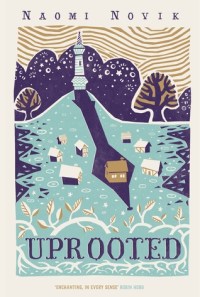
This month is slightly different as we’ve been given the freedom of starting with any book with which we ended a previous chain. As I’ve been taking part in Six Degrees of Separation most months for nearly three years, I had plenty of options but decided to choose the book that ended my chain this time last year, in November 2019. That book was Uprooted by Naomi Novik, a fantasy novel set in a world closely resembling sixteenth century Poland. Our narrator, Agnieszka, lives in a village on the edge of a dark, forbidden forest until her seventeeth birthday when she is selected by a great wizard known as the Dragon who takes her away with him to his tower.

Thinking of the name of the wizard in Uprooted leads me to a book with the word ‘Dragon’ in the title: Named of the Dragon by Susanna Kearsley (1). This is not one of my favourite Kearsley novels, but I did enjoy it. It’s set in modern day Wales but steeped in Arthurian myths and legends.

Staying with those myths and legends, my next link is to Mary Stewart’s series of Arthurian novels which begins with The Crystal Cave (2). The title refers to a magical, crystal-filled cave near Merlin’s home in Wales where Merlin retreats on several occasions throughout the series to receive visions and revelations.

Another novel in which some of the characters live in caves is The Moon Sister by Lucinda Riley (3). This is the fifth book in Riley’s Seven Sisters series and is set in both present day Scotland and in Spain during the Spanish Civil War. There are some wonderful descriptions of the caves of Sacromonte, the traditional home of the Spanish gitano community.

That Lady by Kate O’Brien (4) is also set in Spain, but in a much earlier period. Beginning in 1576, it tells the story of Ana de Mendoza, Princess of Eboli, and her relationship with King Philip II. As you can see from the portrait on the book cover, Ana wore an eye patch which, according to the novel, was because she lost an eye fighting a duel.

Someone else who lived in the same century as Ana and also wore a patch after losing an eye was Francis Bryan, the subject of a non-fiction book by Sarah Beth-Watkins which I read earlier in the year. Sir Francis Bryan: Henry VIII’s Most Notorious Ambassador (5) gives a short and factual account of Bryan’s life at the Tudor court. Bryan was nicknamed ‘the Vicar of Hell’ and this takes me to the final book in my chain.

Jamaica Inn (6), Daphne du Maurier’s Gothic novel of smugglers and shipwrecks on the Cornish coast also features a ‘vicar’ whose name is Francis: Francis Davey, the Vicar of Altarnun. I first read Jamaica Inn many years ago, immediately after reading Rebecca, and found it disappointing in comparison; I read it again more recently and really enjoyed it the second time.

~

And that’s my chain for this month! My links have included dragons, Arthurian legends, cave-dwellers, Spanish history, eye patches and vicars called Francis.

In December we are starting with a book I remember from my childhood: Are You There God? It’s Me, Margaret by Judy Blume.